

15 Home Command Center Ideas To Organize Busy Families
Every busy household has an invisible problem.
Information that lives in too many places. The school permission slip on the counter, the dentist appointment in a phone, the football practice schedule on the fridge, the car keys in a different spot every morning, the homework somewhere in a backpack, the mail in a pile that grows daily.
No single system holds all of it. So everything gets missed, searched for, or forgotten at exactly the wrong moment.
A home command center fixes this.
One dedicated wall. One organized system. Every piece of household information — schedules, keys, mail, homework, menus, charging — lives there and only there.
It’s the organizational equivalent of giving the entire household a single, shared brain.
It doesn’t need to be large. It doesn’t need to be expensive. It needs to be in the right place, set up for how your specific household functions, and maintained with one simple daily habit.
These 15 ideas cover every version — from a minimal three-component system for a small apartment to a full wall command center for a large family with multiple schedules to coordinate.
Save this. Your household is about to run significantly more smoothly.
1. What a Command Center Actually Is
Before choosing a style — understand the purpose.
A home command center is a single, dedicated organizational hub that centralizes all household information, communication, and daily management tools in one location.
Not every command center includes all of these. The best command center includes exactly what the specific household needs — and nothing more.
A command center is not a decorative wall. It’s an organizational system that looks beautiful.
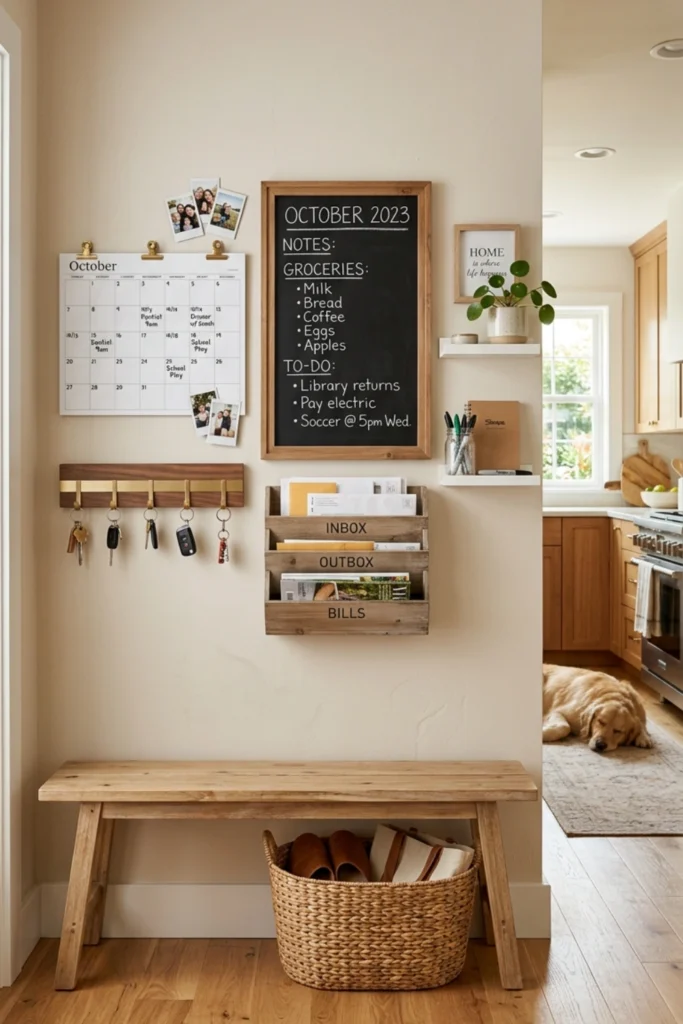
2. Choosing the Right Location
Location is the most important command center decision — and the one most people get wrong.
The right command center locations:
- Kitchen — the most used room, where most household management happens
- Mudroom or laundry room — where the family enters and exits daily
- Hallway — between the bedrooms and the main living areas
The kitchen is the most common and most successful command center location for families.
The right location is the one where the whole family already goes. Put the system where the people are. Also Read: Home Organization Ideas
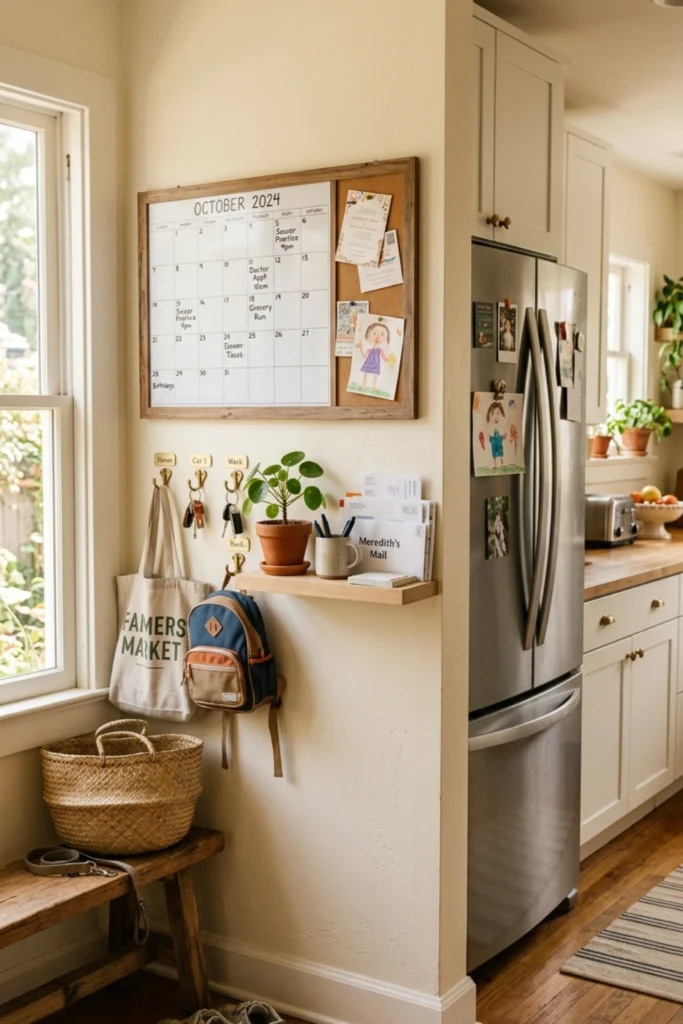
3. The Minimal Wall Command Center
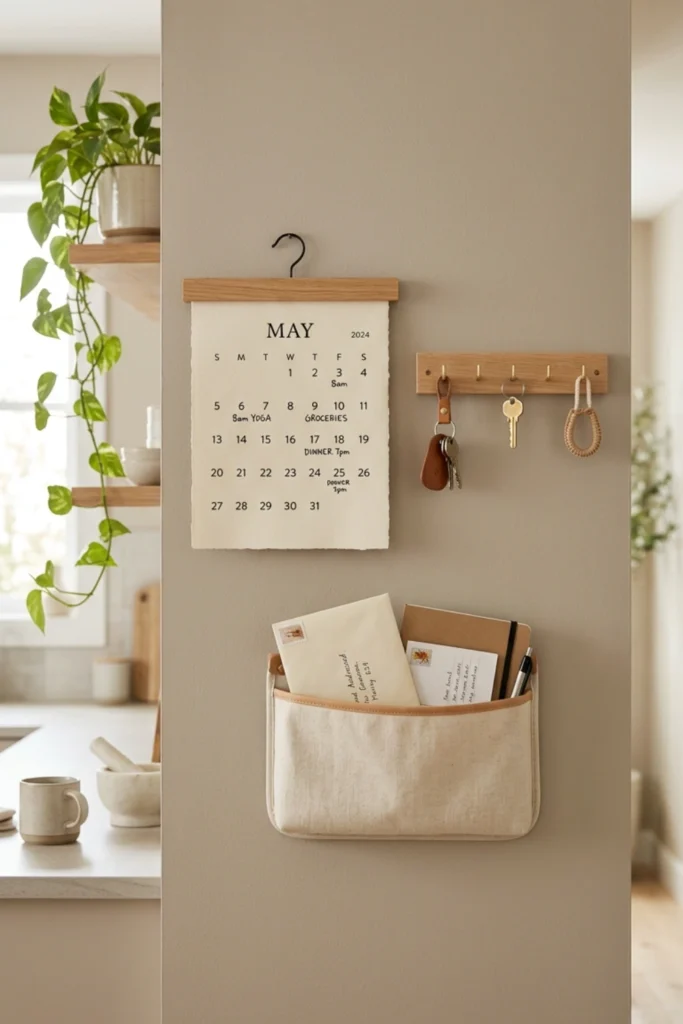
For households that want organization without visual overwhelm — the minimal command center.
The minimal command center:
- A monthly wall calendar — appointments and events visible to everyone
- A key hook rail — three to five hooks, one per household member
- A small mail tray or wall pocket — incoming mail only
The minimal command center works for couples, small households, and anyone who prefers a calm visual environment over a feature-rich system.
Size: as small as 18 inches wide by 24 inches tall.
Three components. One wall. The household runs on a system instead of chaos.
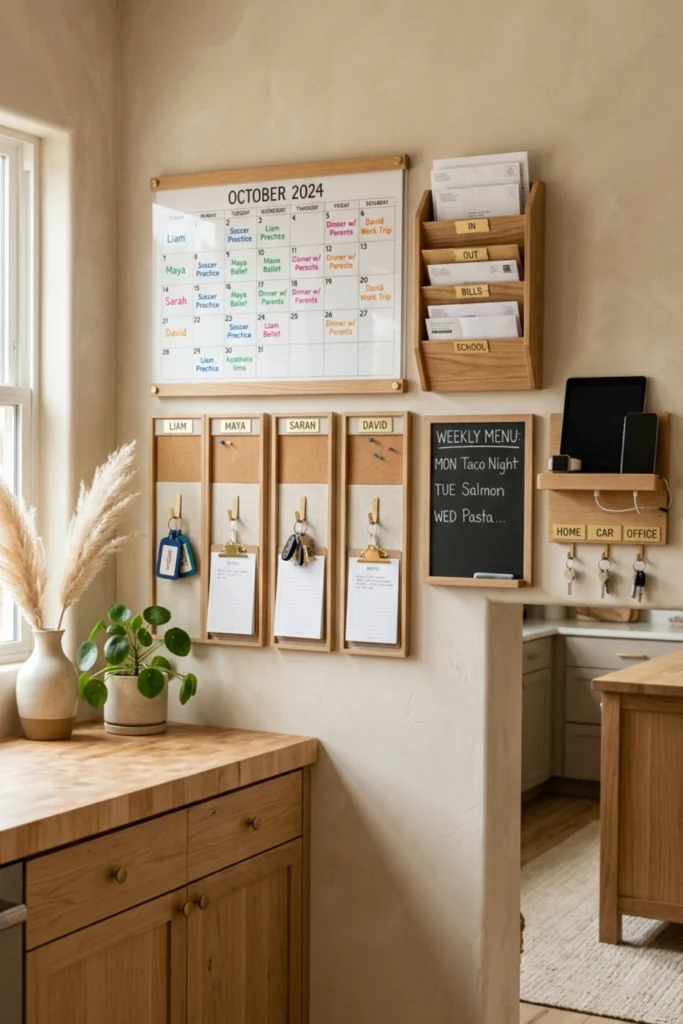
4. The Full Family Command Center Wall
For large families with multiple children, multiple schedules, and high household information volume — the full command center wall.
This version dedicates a full wall section — often three to four feet wide and floor to ceiling — to the complete household management system.
Built as a cohesive wall system using matching frames, boards, and organizers in one consistent color palette.
The full command center wall is the organizational infrastructure of a functioning family home. More Inspiration: Paper Organization Ideas
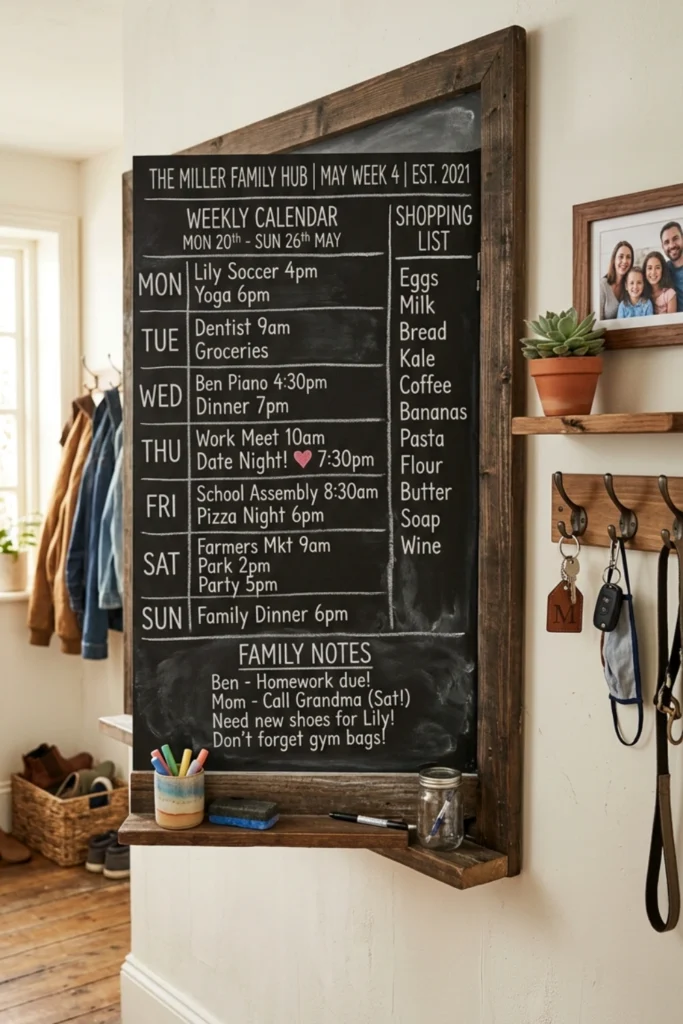
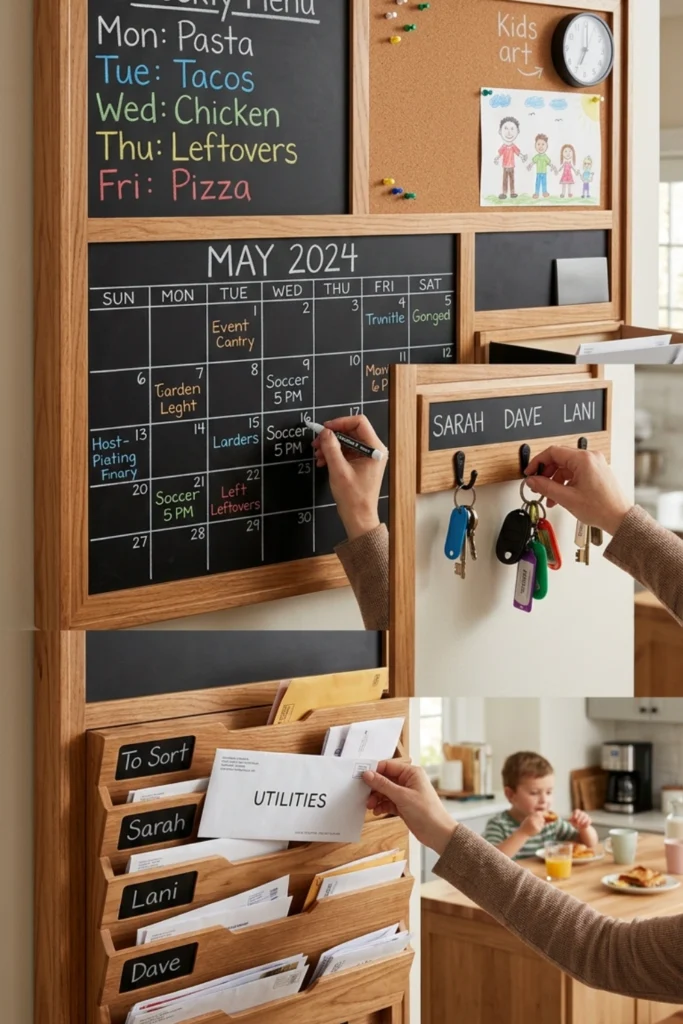
5. A Chalkboard Command Center
The chalkboard command center is the most flexible and most aesthetically warm version of any household management wall.
A large chalkboard — or a section of chalkboard paint on the wall itself — becomes a completely adaptable surface. Calendar one week, menu planner the next, notes and reminders as needed.
The chalkboard aesthetic is warm, organic, and consistently beautiful — it looks intentional in every season and for every style of home.
A chalkboard command center never looks outdated. It always looks personal.
6. The Magnetic Board System
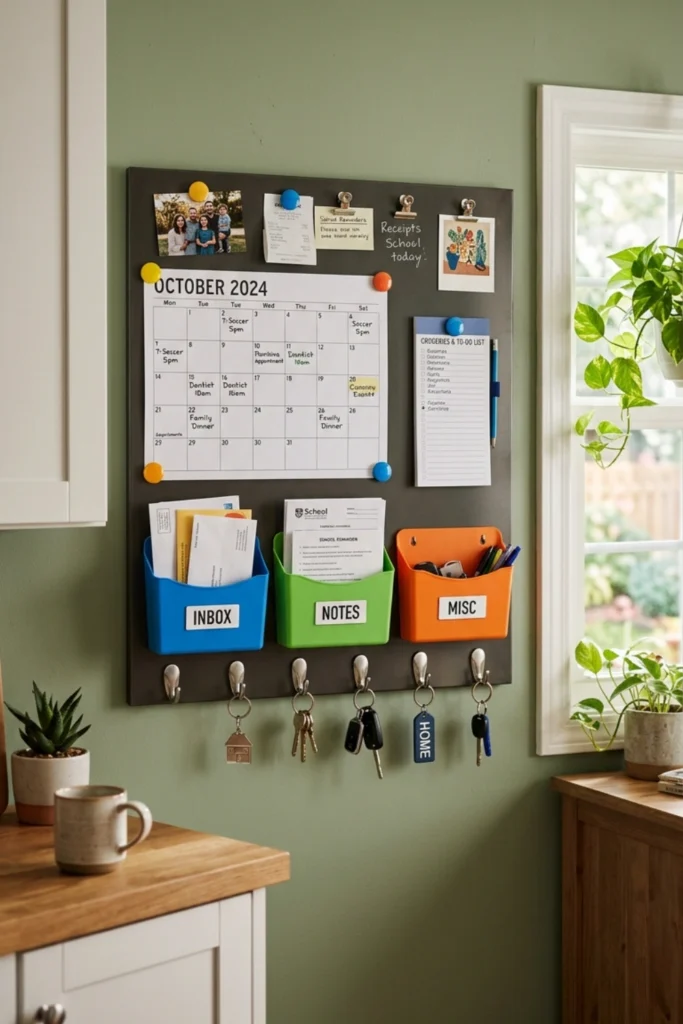
A magnetic command center offers the flexibility of a chalkboard with the precision of a printed system.
A large magnetic board — or a section of magnetic paint on the wall — holds printed calendar sheets, magnetic notepads, colorful magnetic labels, and magnetic key hooks.
The magnetic system is the most easily updated of all command center styles. Change the calendar, update the list, rearrange the layout — without removing anything permanently. Keep Reading: Entryway Organization Ideas
7. A Pegboard Command Center
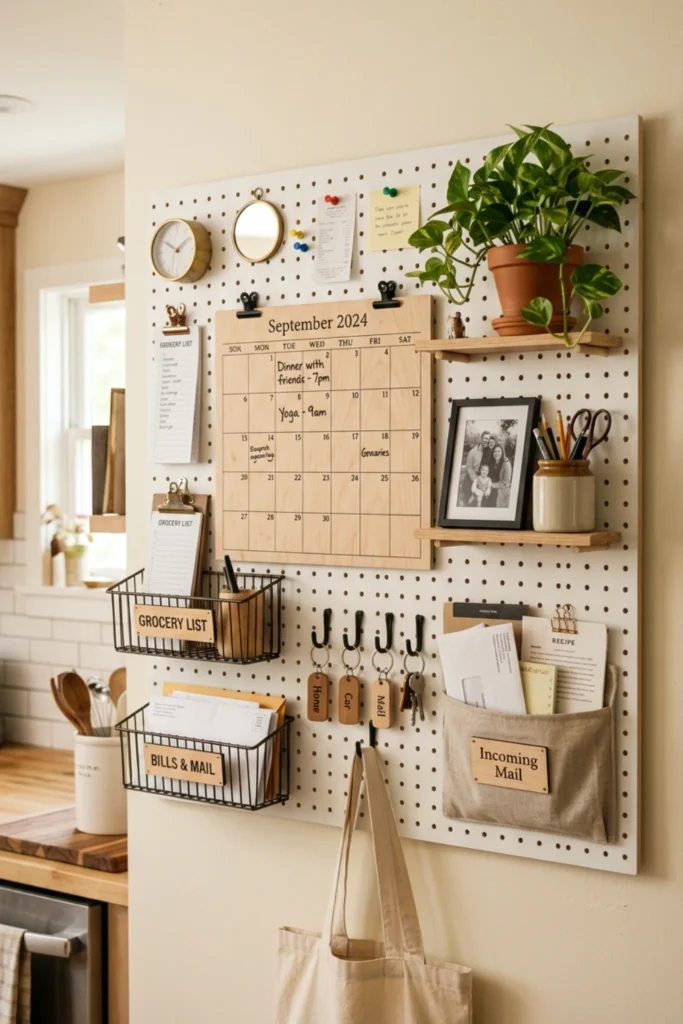
The pegboard command center is the most customizable organizational wall system available — and one of the most popular on Pinterest.
A painted pegboard panel — in white, sage green, or warm neutral — mounted on the kitchen or hallway wall with a completely flexible arrangement of hooks, shelves, bins, and organizers.
The pegboard rearranges as household needs change. Add a new component when a new need arises. Remove one when it’s no longer needed.
A pegboard command center grows and changes with the household. It never becomes outdated.
8. The Calendar and Schedule Wall
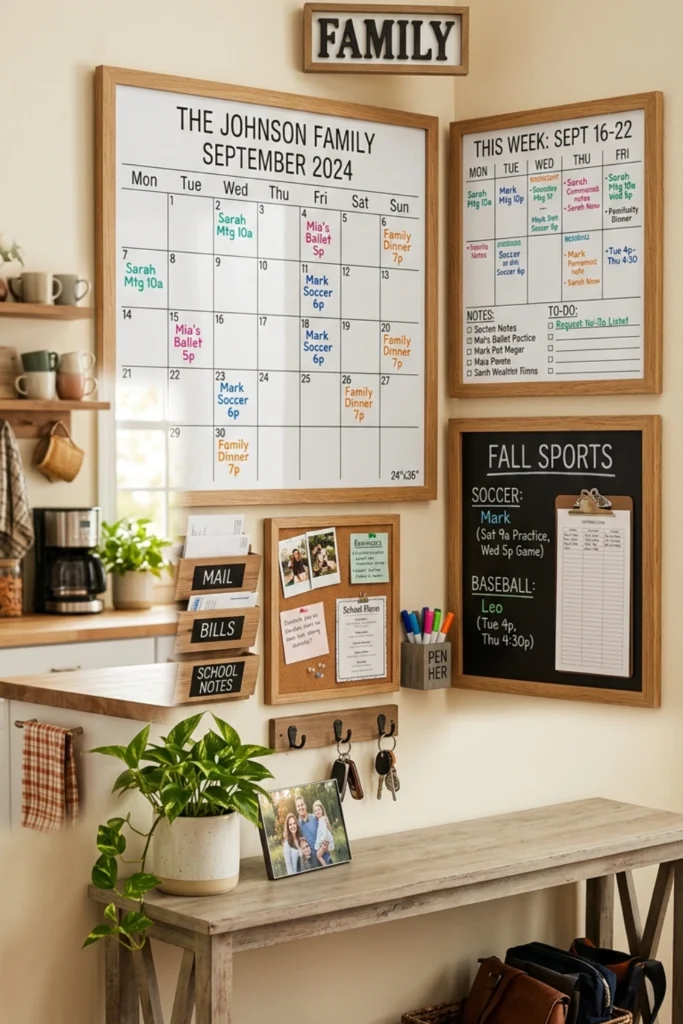
For households where scheduling is the primary organizational challenge — a calendar wall dedicated entirely to schedule management.
Color-coding is the feature that makes a busy family calendar legible at a glance. When each person has a color — reading the week takes ten seconds.
A color-coded family calendar means nobody misses anything because everyone can read it at a glance. You May Also Like: Kids Room Organization Ideas
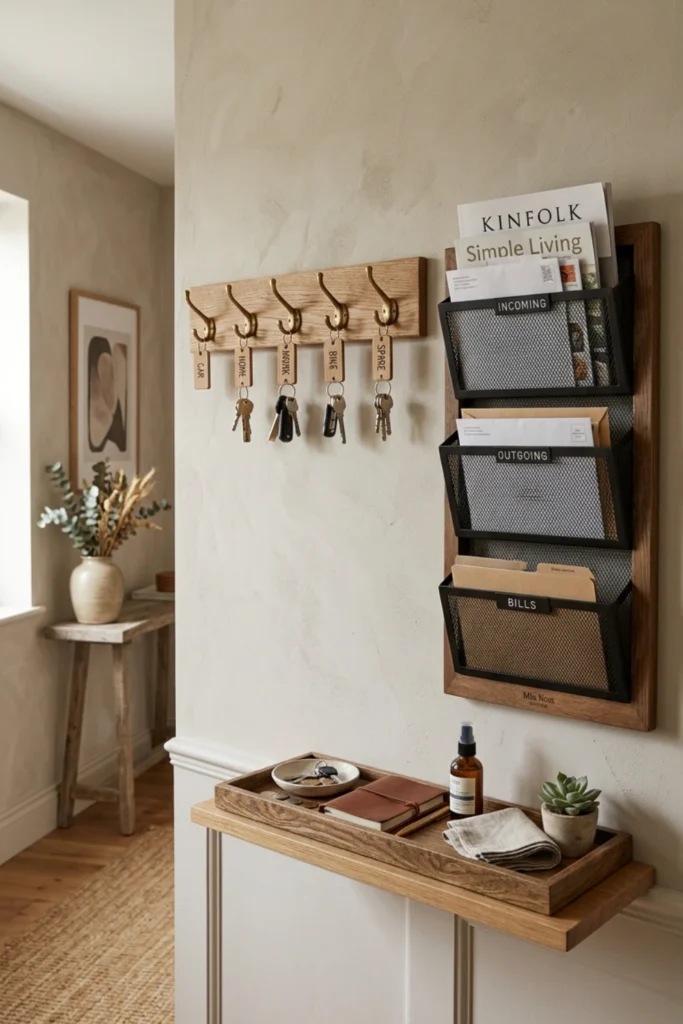
9. The Key and Mail Station
The two items most consistently lost in a busy household — and the ones a command center solves most immediately.
A dedicated key and mail station is the minimum viable command center for any household.
The mail station:
- Three slots — incoming, to-action, outgoing
- Mail sorted at the door — immediately, every day
- Junk mail discarded before it reaches the station
- Bills in the to-action slot — processed weekly
- Nothing accumulates — the station has a weekly processing habit
Together — keys and mail are findable in under five seconds. Every time.
A key hook and a mail slot. The two things that make a household run smoothly.
10. A Homework Command Center
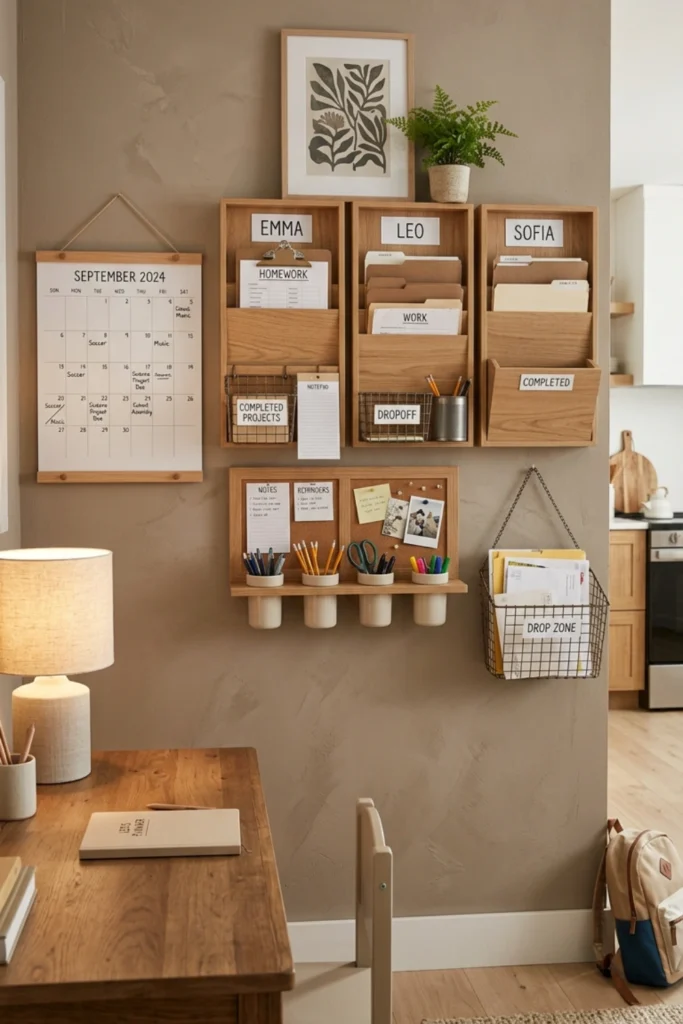
For households with school-age children — a homework command center dedicated to academic organization.
This component handles all school-related information, supplies, and paper management in one contained section.
The homework command center prevents school papers from spreading across the kitchen table permanently — everything school-related lands here and stays here.
A homework command center ends the morning backpack scramble permanently. Explore Next: Junk Drawer Organization Ideas
11. The Menu Planning Station
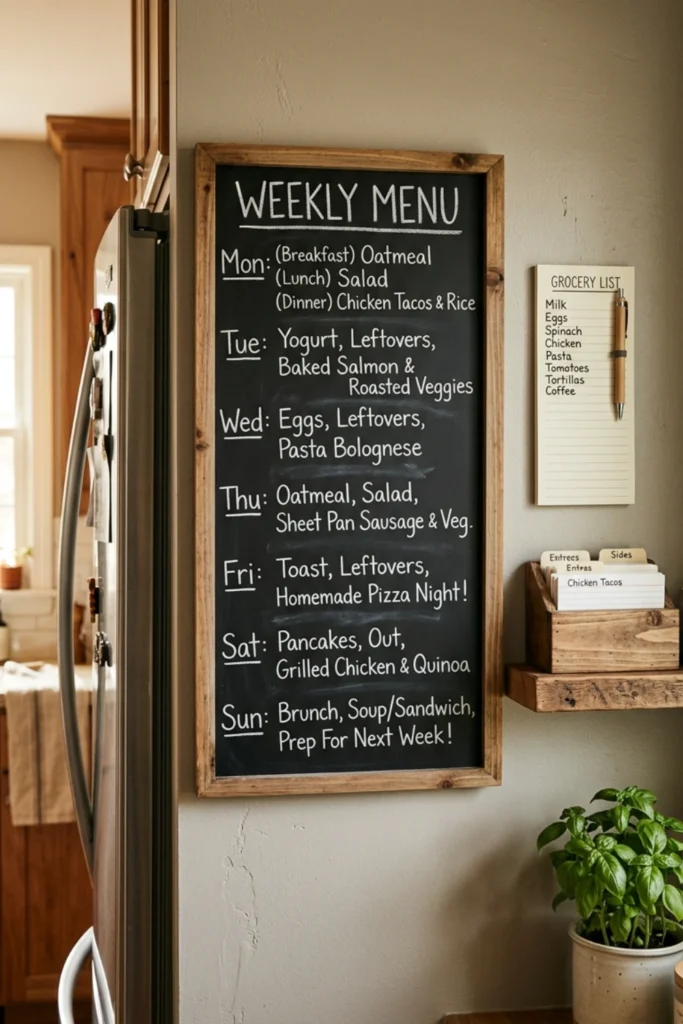
The menu planning station is the command center component that saves the most time and the most money of any organizational system in the kitchen.
A visible weekly menu eliminates the daily “what’s for dinner” decision — and the last-minute takeout that accompanies it.
Position beside or near the fridge — where meal planning decisions naturally happen.
A visible weekly menu board saves the average household two to three takeout orders a week.
12. A Charging and Tech Station
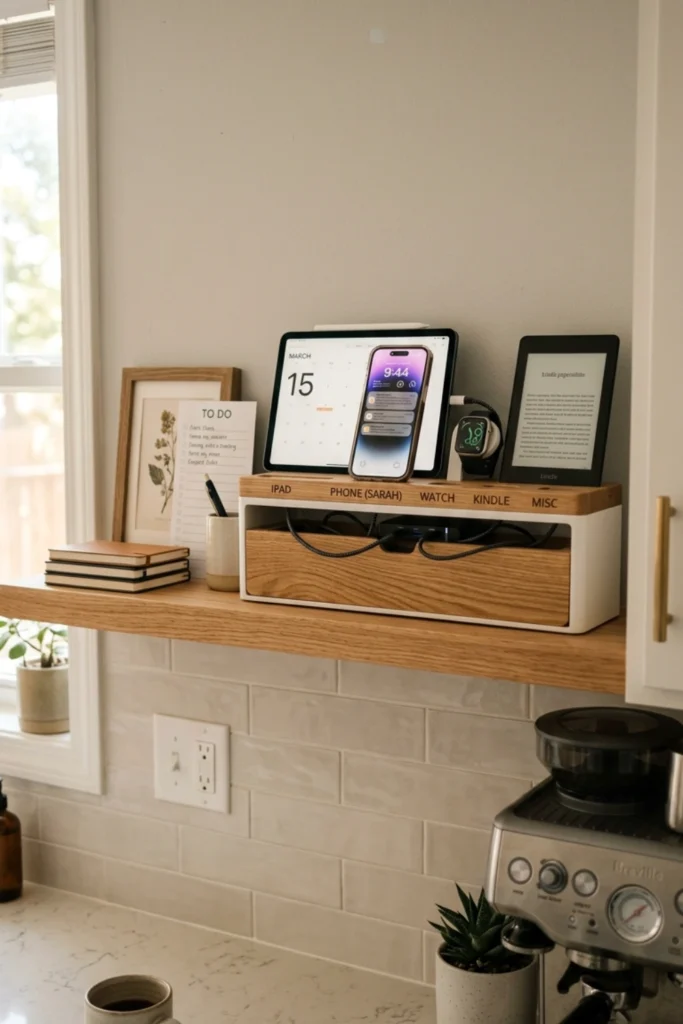
The charging station component of the command center solves one of the most universal household frustrations — devices dying at inconvenient moments because chargers are never where they’re needed.
The charging station creates a household rule alongside an organizational system. Devices charge here. People are present at the table.
The charging station is the command center component that changes household culture, not just organization.
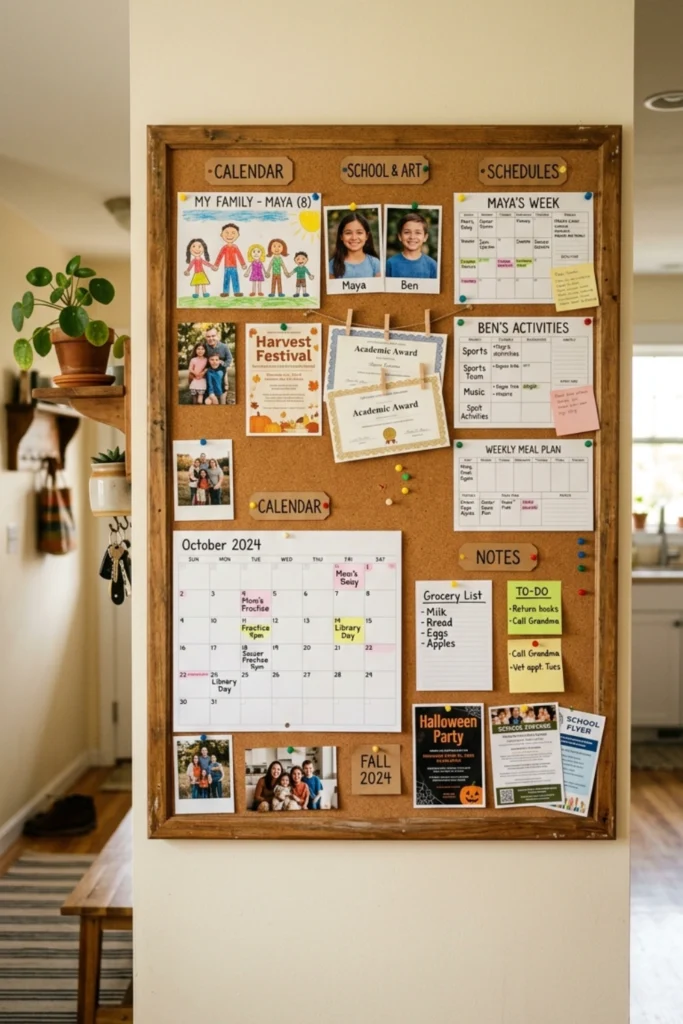
13. The Corkboard Gallery Command Center
The corkboard command center is the warmest, most personal version of any family organizational wall.
A large corkboard — or a series of smaller ones arranged as a gallery — holds everything with a simple pushpin. Calendar sheets, school photos, children’s artwork, permission slips, invitations, notes, schedules, and reminders.
The corkboard is the most human of all command center styles. It holds the evidence of a life being lived — the birthday party invitation, the child’s drawing, the holiday photo.
A corkboard command center is organized and personal simultaneously.
14. A Command Center for Small Spaces
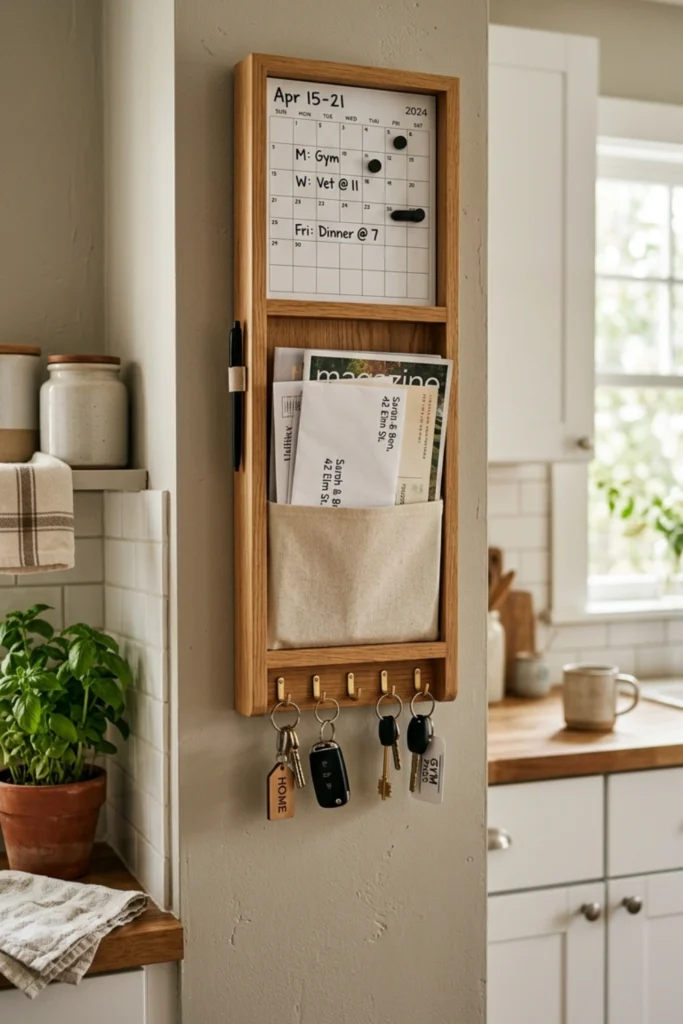
No hallway. No mudroom. A kitchen wall the size of a door. The command center still works — it just needs to think vertically.
The small space command center:
- Vertical orientation — tall and narrow rather than wide
- Combined components — a board that functions as both calendar and notes
- Compact key hook — three hooks maximum, slim profile
- A single mail pocket — one slot, one function
- No shelf — wall-mounted only to preserve floor space
- Digital where possible — some functions move to a shared family app
A command center for a small space is built on the principle of doing more with less — each component serving multiple functions, the overall footprint as small as possible.
15. The Command Center Maintenance Habit
The most beautifully designed command center becomes useless without one habit.
A daily two-minute update. Every day. Same time — morning or evening.
Two minutes. Every day.
The command center stays current. The household stays informed. The system that took a weekend to build continues to function indefinitely.
The weekly reset:
- Replace old notes and reminders with current ones
- File or discard processed mail
- Update the calendar for the coming week
- Restock supplies if needed
Two minutes daily is the entire maintenance system for a command center that runs a household.
The Wall That Runs the Household
A home command center is not a Pinterest project.
It’s a functional system that reduces the invisible mental load of running a household. It moves information out of individual heads and onto one shared wall where everyone can see it, update it, and act on it.
The dentist appointment doesn’t get missed because it’s on the wall. The keys are found in ten seconds because they’re on the hook. Dinner is planned because the board is visible. The permission slip is signed because it has a dedicated home.
That’s what a command center does. Not decoration — function.
Save this to your home organization board. Come back when you’re ready to choose a location and start building.
Which command center style fits your household best? Tell me in the comments.


