
15 Junk Drawer Organization Ideas You’ll Wish You Tried Sooner
Every home has one.
That drawer. The one in the kitchen, or the hallway, or beside the front door. The one that holds everything that doesn’t have another home — batteries, rubber bands, takeout menus from 2019, a key that fits nothing, seventeen pens of which three actually work, and something you genuinely cannot identify.
The junk drawer is not a character flaw. It’s a universal human experience.
But here’s what nobody tells you: the junk drawer is also one of the fastest, most satisfying spaces in the entire home to organize. It takes an afternoon. It costs almost nothing. And the before-and-after is so dramatic that it’s one of the most consistently saved organization posts on Pinterest.
These 15 ideas give you the complete system — from the initial edit to the weekly habit that keeps it organized indefinitely.
Save this. Your drawer will never be the same.
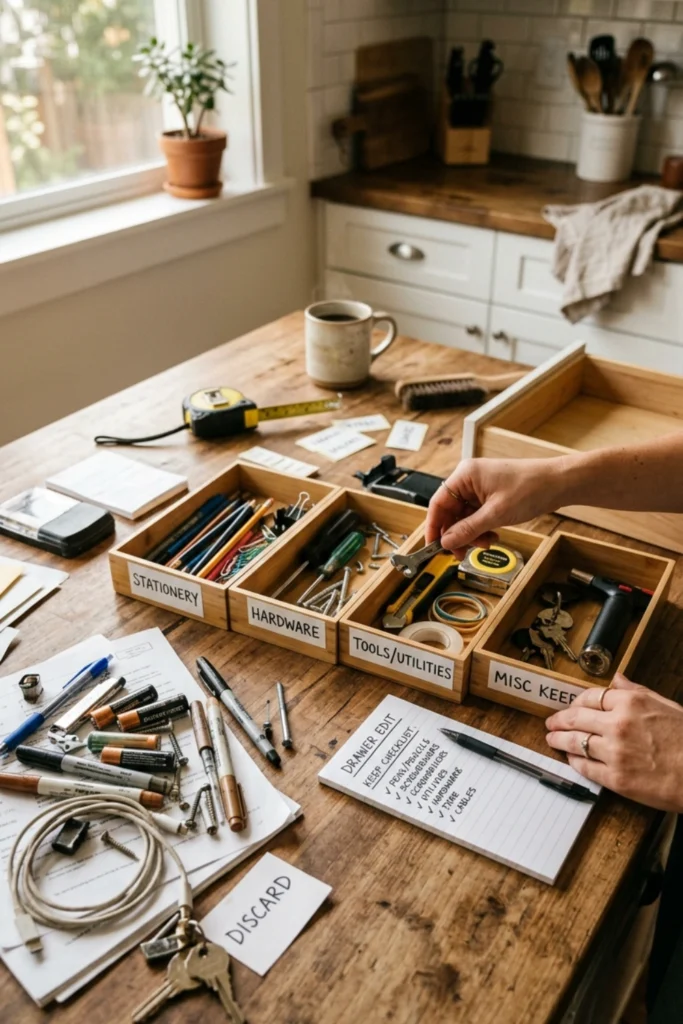
1. The Complete Empty-First Rule
Before a single organizer goes in — everything comes out.
Pull every item from the drawer and lay it on the counter or table. Look at what you actually have. All of it. At once.
This moment is usually equal parts horrifying and clarifying.
Most people discover the drawer is sixty percent things that don’t belong there. The edit alone transforms the space before a single organizer is purchased.
Empty first. Always.
The edit is the organization. Every other step just contains what remains.
2. Rename It — The Utility Drawer Mindset
This sounds small. It isn’t.
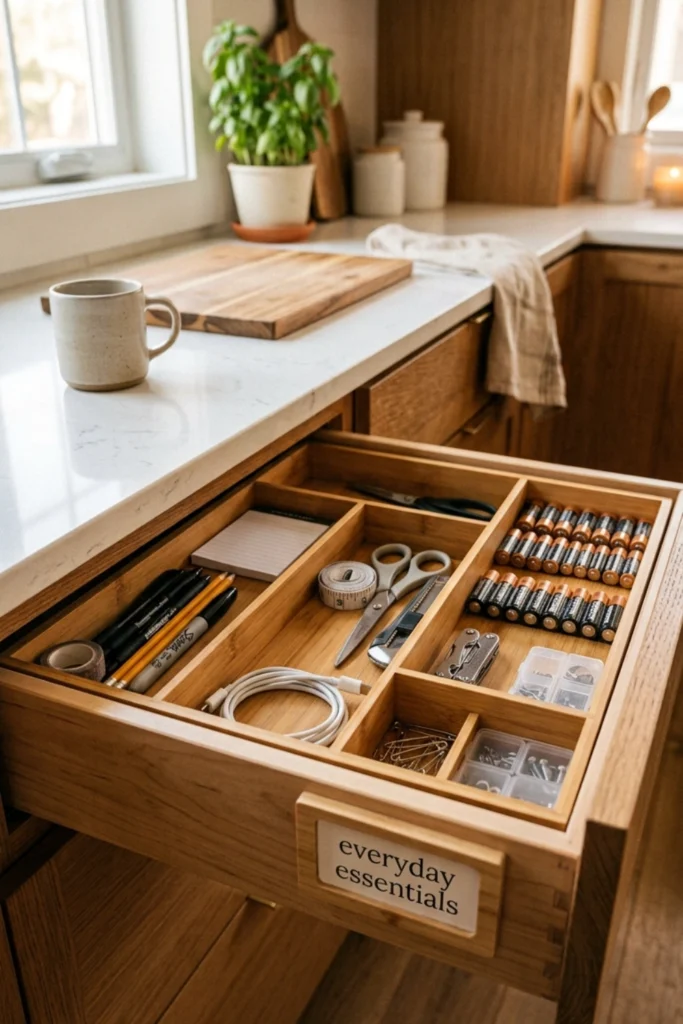
The word “junk” gives the drawer permission to collect anything. The moment you rename it — the utility drawer, the kitchen drawer, the everyday essentials drawer — the rules change.
A junk drawer holds whatever lands in it. A utility drawer holds specific, useful, intentional items that serve a real household purpose.
When the category is defined — everything that doesn’t fit the category gets redirected. The drawer stays organized almost automatically.
Rename the drawer. Change what it holds. Also Read: Home Organization Ideas
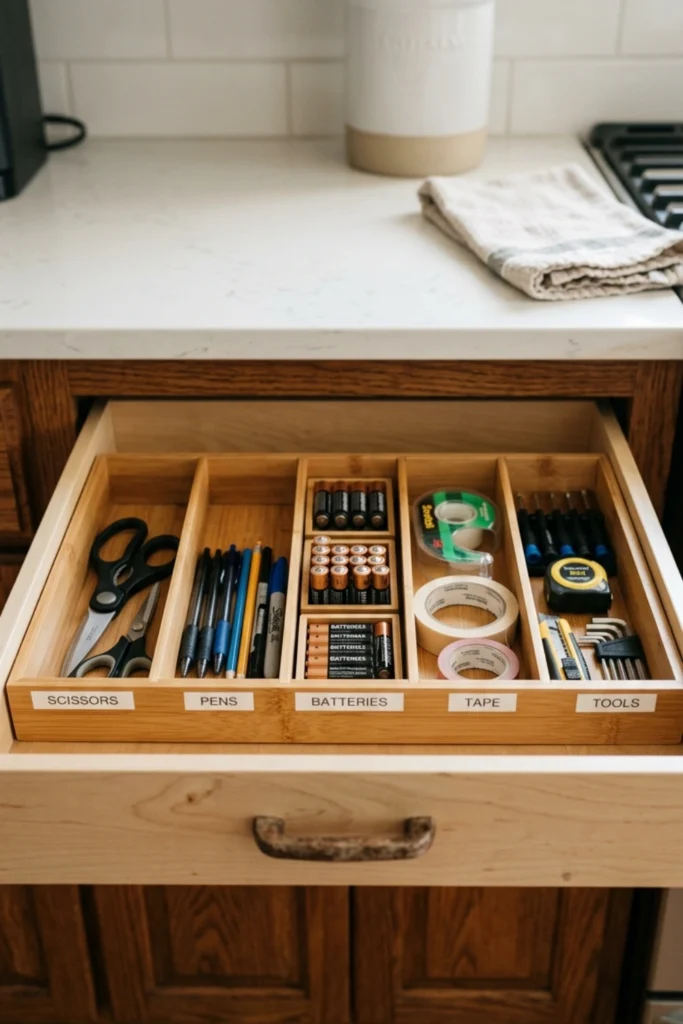
3. The Modular Bamboo Organizer System
The most popular junk drawer organization product on Pinterest — and the one that delivers the most consistent results.
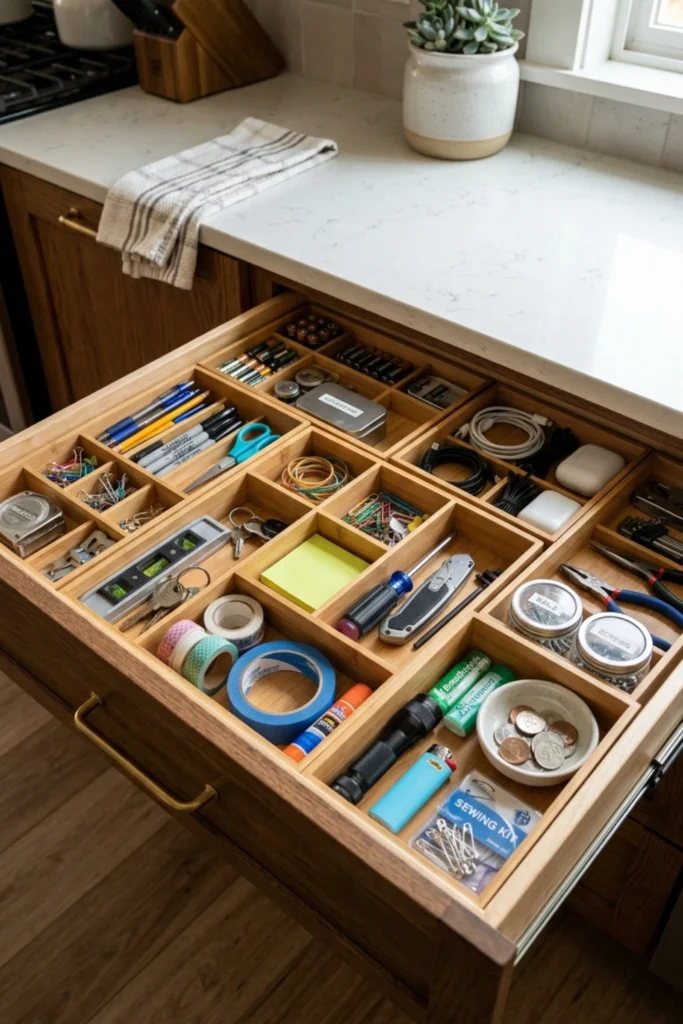
A modular bamboo drawer organizer system uses individual interlocking pieces in various sizes to create a fully customized grid inside the drawer. Unlike fixed-grid organizers, modular systems adjust to the exact dimensions of any drawer — and to the exact categories of anything inside.
Measure the drawer interior before purchasing. Configure the modules to fit.
A modular bamboo organizer is the single purchase that transforms any drawer from chaos to calm.
4. Clear Acrylic Dividers Done Right
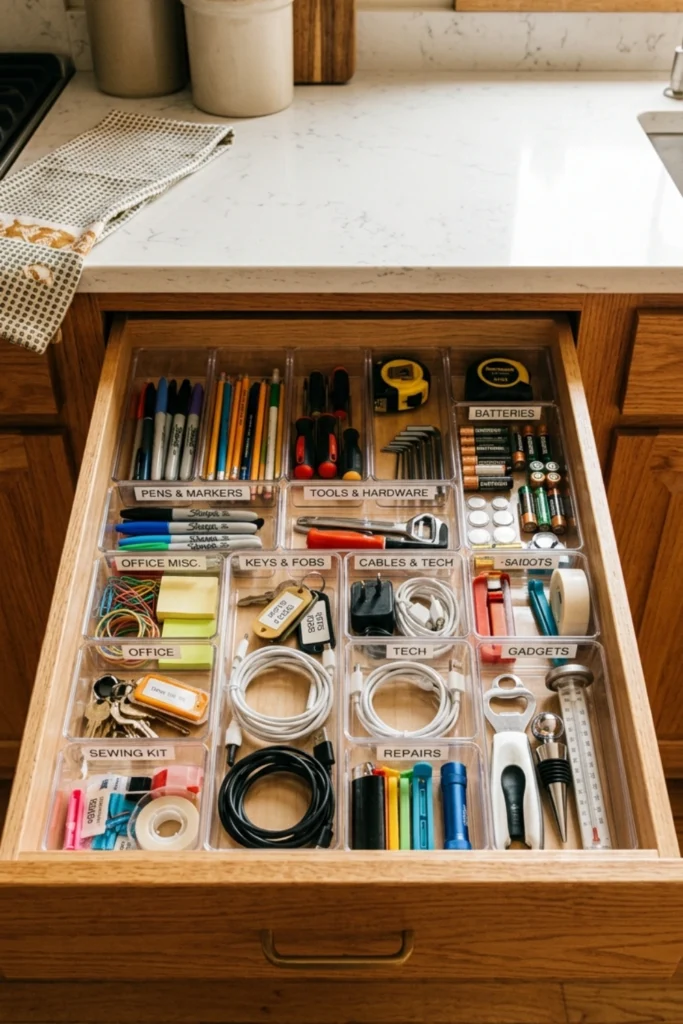
When the goal is to see everything at a glance — clear acrylic is the answer.
Clear acrylic drawer dividers create individual sections inside the drawer that contain each category while keeping everything completely visible. Open the drawer — see every item immediately. No lifting bins. No moving things to find what’s at the back.
Choose a set that expands to fit the drawer width. Many acrylic organizers have adjustable or interlocking pieces. More Inspiration: Under Sink Organization Ideas
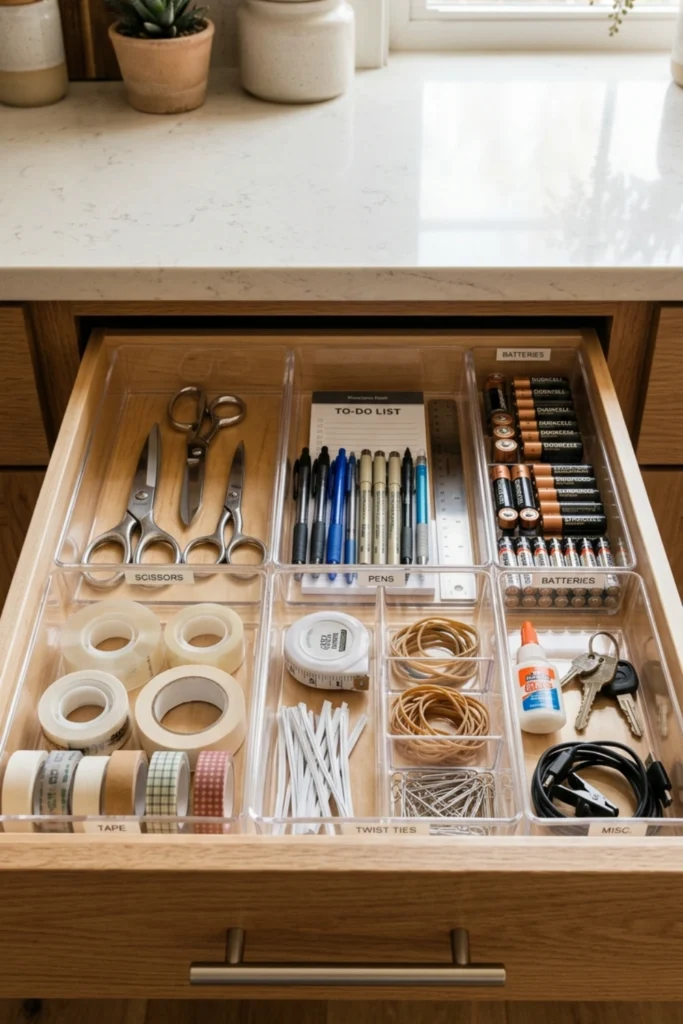
5. The Category Method
The single most important organizational principle for any drawer.
Everything in the drawer belongs to a category. Every category has a dedicated section. Nothing lives outside its category.
The miscellaneous section is intentionally small. When it fills — it gets edited.
Every item has a category. Every category has a home. The drawer stays organized because the system makes it logical.
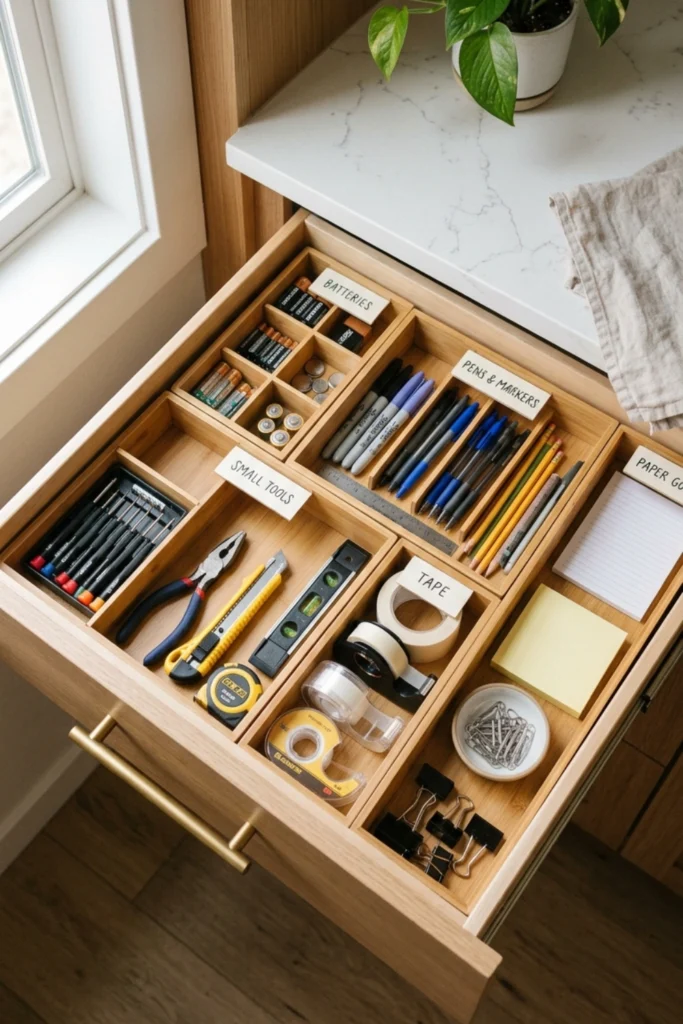
6. Matching Bins for Visual Calm
When bins match — the drawer looks organized even before you examine the contents.
The visual calm of uniform containers is exactly what makes The Home Edit approach so satisfying and so Pinterest-worthy. Every bin the same material. Every bin the same height. Every bin labeled in the same font.
Choose one material. Buy a set. Use the entire set.
Matching bins make a drawer look like it was professionally organized — because the uniformity reads as intention. Keep Reading: Paper Organization Ideas
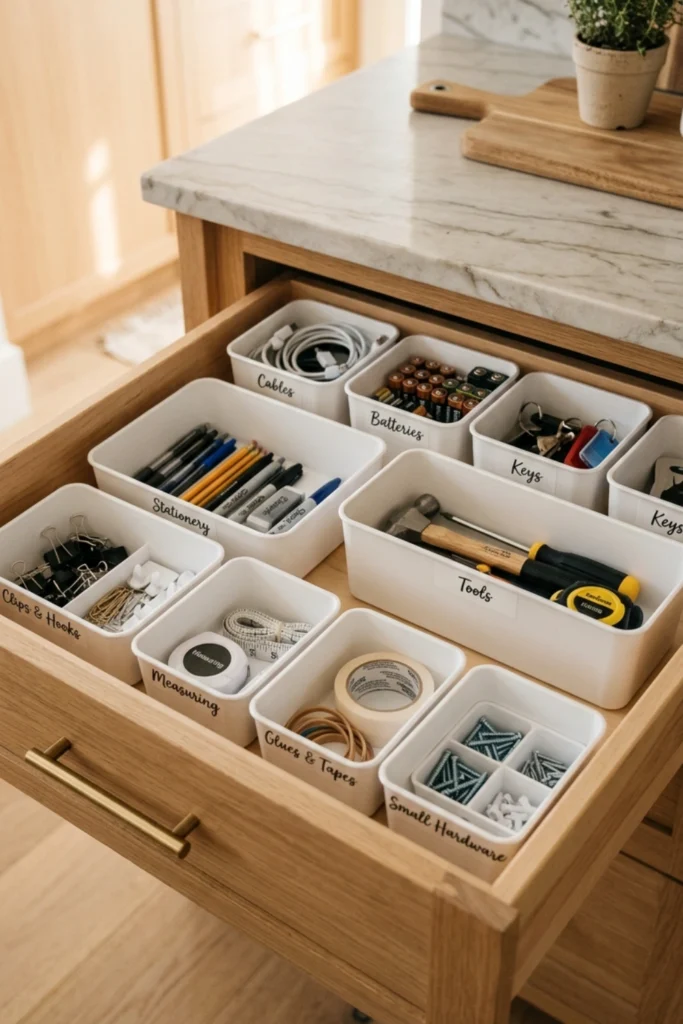
7. The Home Edit Rainbow Method
For those who want their utility drawer to be genuinely beautiful — not just organized.
The Home Edit rainbow method applies color organization to the contents of the drawer — grouping items by color family within each category.
Pens organized light to dark. Rubber bands by color. Even cables grouped by color code.
It’s a level of organization most people consider excessive until they see the result. Then they save the photo immediately.
Where the rainbow method works in a drawer:
- Pen and marker section — organized by color
- Sticky note section — colors in gradient order
- Cable section — sorted by cord color
- Rubber bands — grouped by tone
The functional result is identical to standard organization. The visual result is extraordinary.
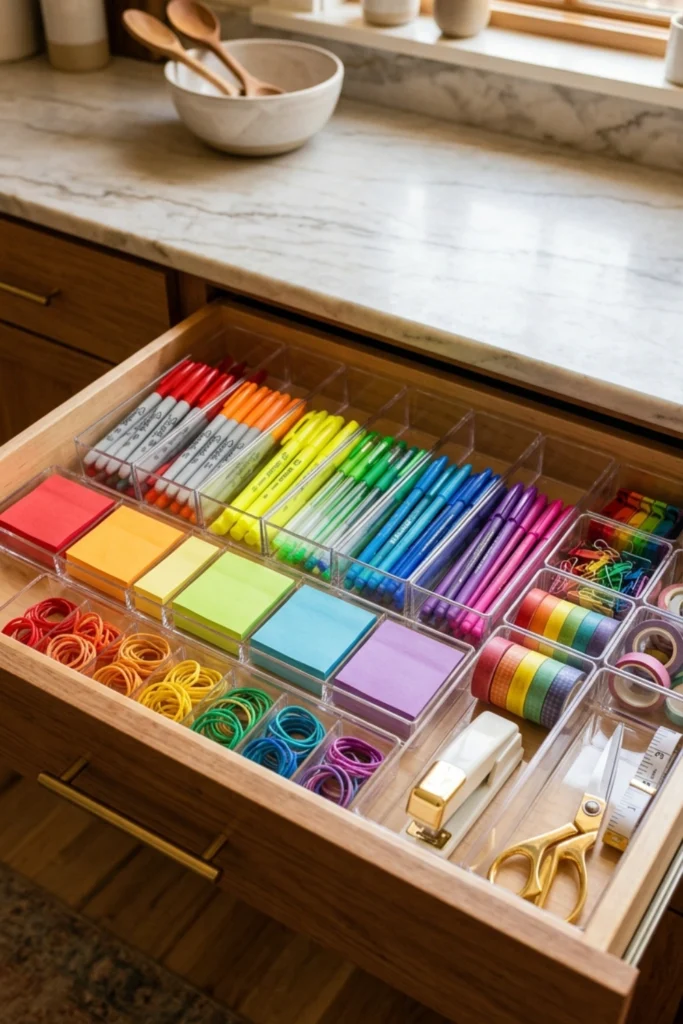
8. Label Everything Consistently
A labeled drawer stays organized. An unlabeled drawer drifts back to chaos within weeks.
Labels communicate two things: where something belongs and where it returns. When every household member can read the label — everyone maintains the system without instruction.
Consistency is the visual organizer. A unified label system reads as intentional and beautiful — not just functional.
The label is the final ten percent that makes an organized drawer look professionally done. You May Also Like: Home Command Center Ideas
9. The Junk Drawer Edit Checklist
Use this every time you organize the drawer — and every time you do the monthly reset.
Things that always leave the junk drawer:
- Pens that don’t work — test every one, remove the dead ones
- Batteries with no charge — test or discard
- Keys that fit nothing — if unknown after one year, discard
- Expired coupons or menus — remove immediately
- Duplicate items — keep one, relocate or discard the rest
- Mystery objects — if unidentified after 30 seconds, discard
- Items belonging in another room — relocate immediately
- Rubber bands dried and cracked — discard
Things that always stay:
- One working pen per person in the household (maximum five)
- One pair of scissors
- One roll of tape
- Batteries in current use sizes only
- One small notepad
- One measuring tape
This checklist removes the ambiguity from editing. Every item either fits the keep criteria or it doesn’t.
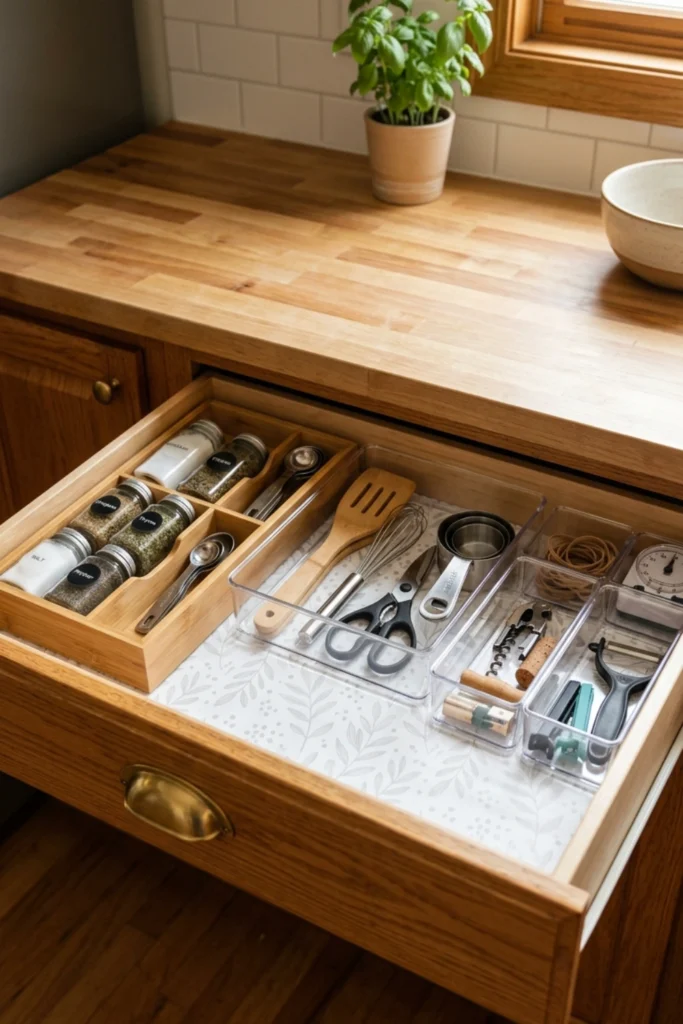
10. Drawer Liners for an Instant Upgrade
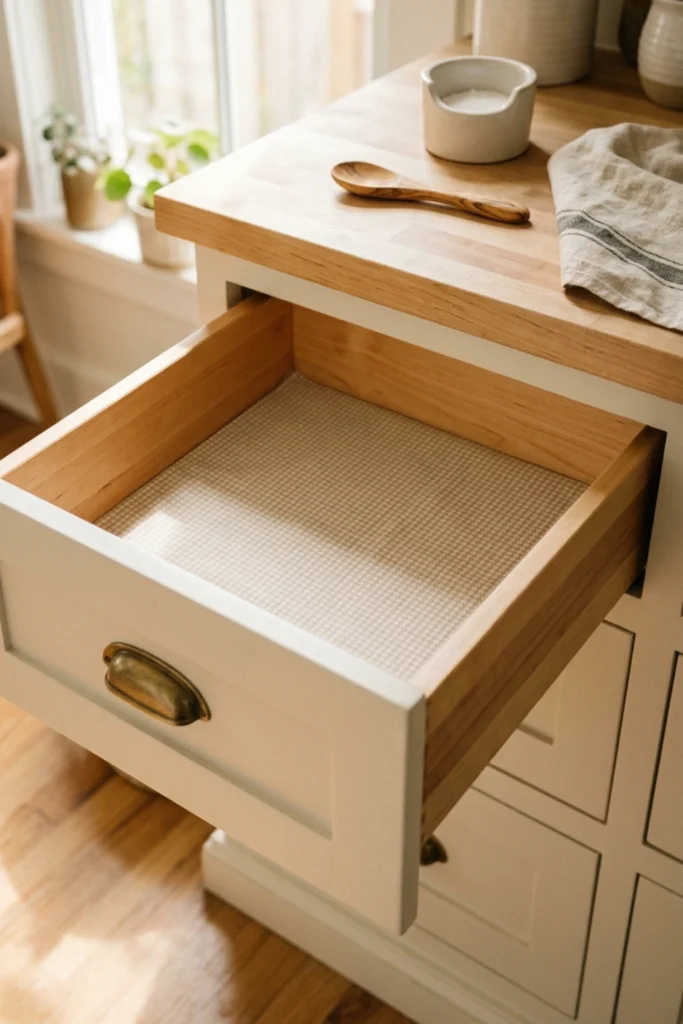
Before any organizer goes in — a drawer liner goes down.
A liner serves three purposes: it protects the drawer base, it prevents organizers and loose items from sliding, and it adds a visual polish that makes the organized drawer look intentional rather than improvised.
Choose a liner that complements the kitchen or hallway where the drawer lives. Even a plain white liner makes a dramatic visual difference.
A drawer liner costs almost nothing and makes the entire organization look finished. Explore Next: Entryway Organization Ideas
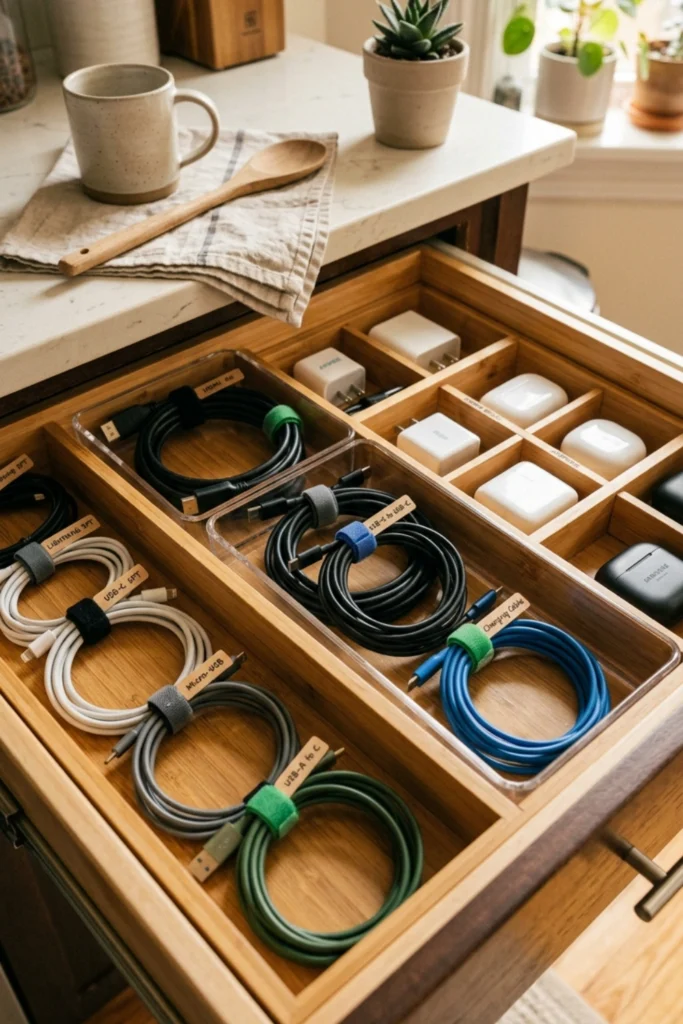
11. The Charging and Tech Section
Every kitchen junk drawer eventually becomes a graveyard of cables.
Solve it permanently with a dedicated tech section.
A cable organizer within the section keeps each cable coiled, labeled, and findable instantly.
When a new device enters the home — its cable gets assigned to this section. The old cable it replaces leaves.
One cable per device. Coiled. Labeled. The cable chaos ends permanently.
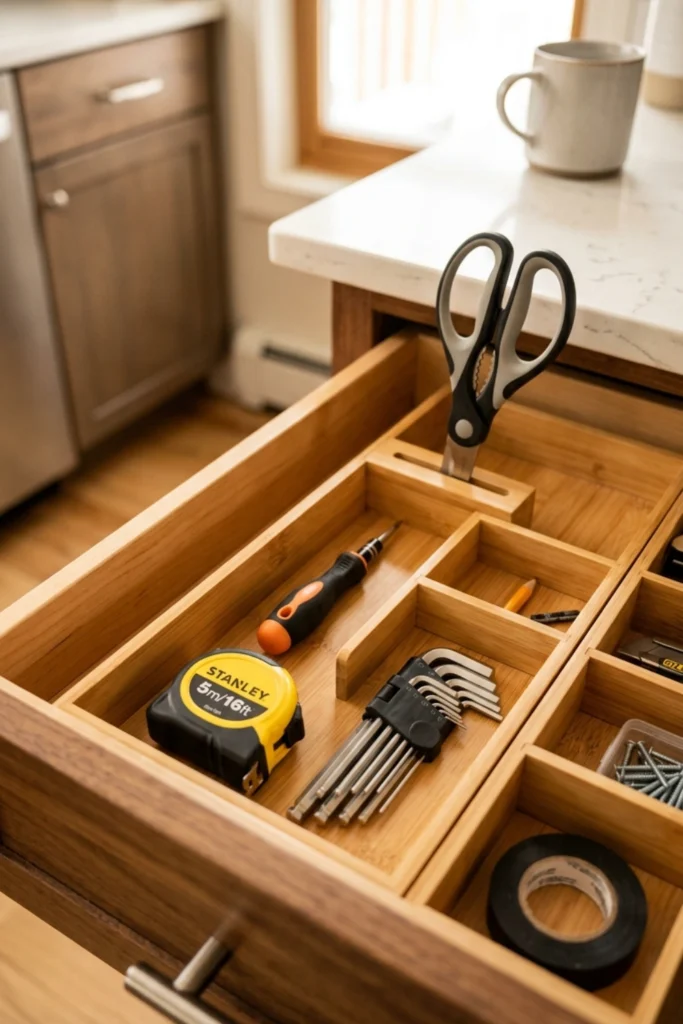
12. A Small Scissors and Tool Zone
Every household needs one pair of scissors in an immediately findable location.
The utility drawer is that location — but only if the scissors have their own dedicated spot.
The small tool zone:
- One pair of scissors — standing upright or laid flat in their section
- One small flathead and one Phillips screwdriver
- One measuring tape
- Allen keys — on a ring to keep together
- Spare hooks, picture nails — in a small container within the section
The tool zone exists so that when something minor needs fixing — you find what you need in thirty seconds rather than searching the entire home.
Keep it minimal. Only the tools used at least monthly earn their spot.
13. The Paper and Writing Section
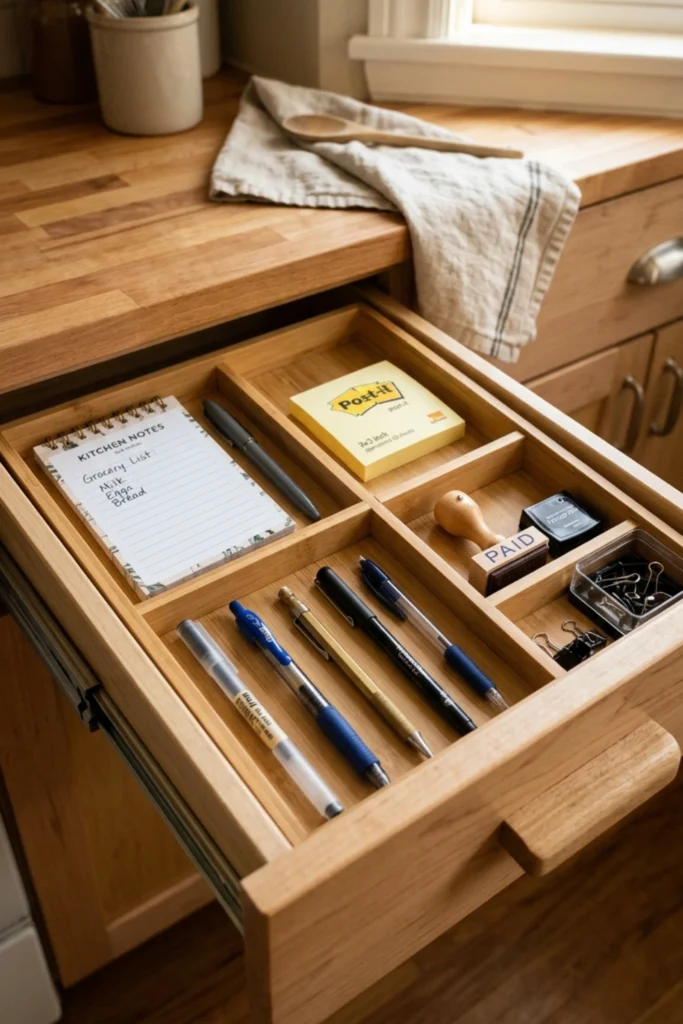
Paper chaos is what makes most junk drawers feel overwhelming.
Scraps of paper with notes. Old receipts. Takeout menus. Coupons. Business cards. They accumulate silently and fill available space faster than anything else.
The paper system that works:
- One small notepad — spiral or adhesive, current only
- One pad of sticky notes — one pack, one color
- Five pens maximum — tested and working
- Stamps — in a small labeled section if mailed correspondence happens
- Everything else — removed from the drawer entirely
Receipts get photographed and filed digitally or go directly into a dedicated receipt folder — not the junk drawer. Menus go digital. Business cards get photographed and discarded.
The paper section stays small because the criteria stay strict.
14. The Everything Drawer — For Homes That Need One
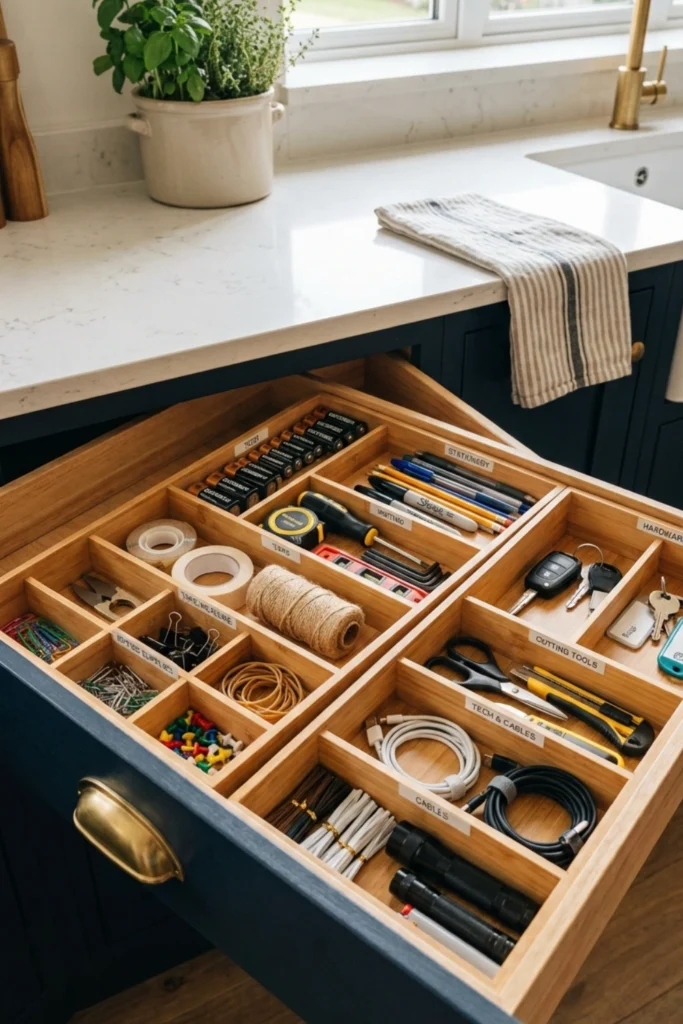
Not every drawer needs to be a minimalist utility space.
Some households genuinely need an “everything drawer” — a more generous catch-all that still operates within a system.
The difference between a junk drawer and an everything drawer is intention.
The everything drawer rules:
- Still organized with modular dividers — categories exist
- Larger miscellaneous section is permitted — but contained
- Edited monthly without exception
- Nothing stays longer than three months without being used or removed
- The drawer closes fully — always
An everything drawer that closes completely and can be navigated in under ten seconds is not a junk drawer. It’s a functional household tool.
The goal isn’t perfection. It’s a drawer that works.
15. The Five-Minute Weekly Reset
The most organized drawer in the world returns to chaos without one habit.
Five minutes. Once a week. Same day each time — Sunday works for most households.
Five minutes. The drawer stays permanently close to its organized baseline.
Once a month — do the full edit. Empty, wipe, replace.
The weekly reset is what separates a drawer organized once from a drawer that stays organized indefinitely.
Five minutes a week is the entire maintenance system. That’s all it takes.
The Drawer That Reflects How You Want to Live
The junk drawer is a small thing.
But it’s also the drawer you open every time you need tape before wrapping a gift, or scissors before opening a package, or a pen before taking a phone message.
You open it multiple times a week. Every time — you either feel a small spike of frustration or a small moment of calm.
These 15 ideas make sure it’s the latter.
Save this to your home organization board. Come back this weekend with an empty counter and a trash bag ready.
Which idea are you starting with? Tell me below.