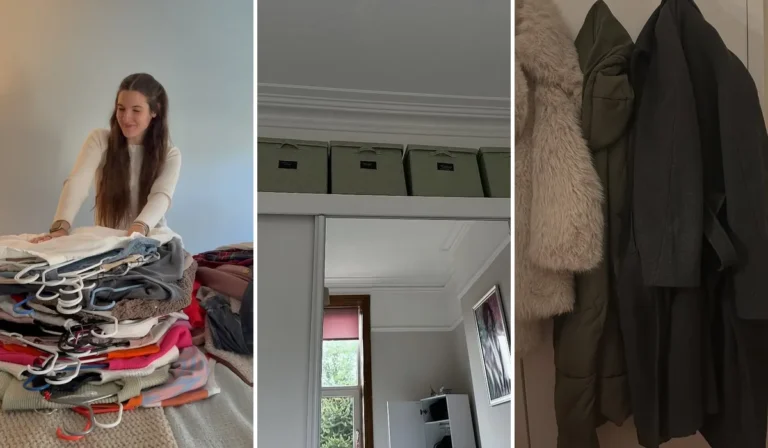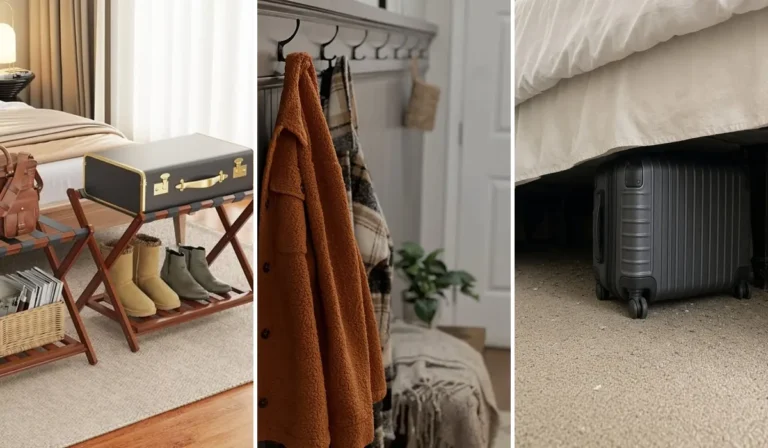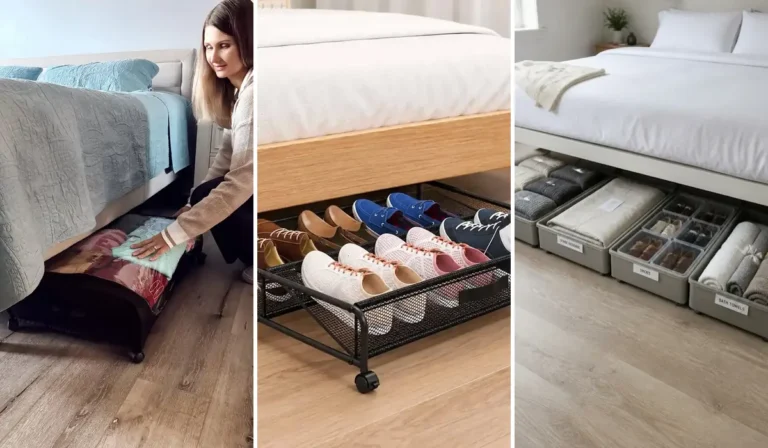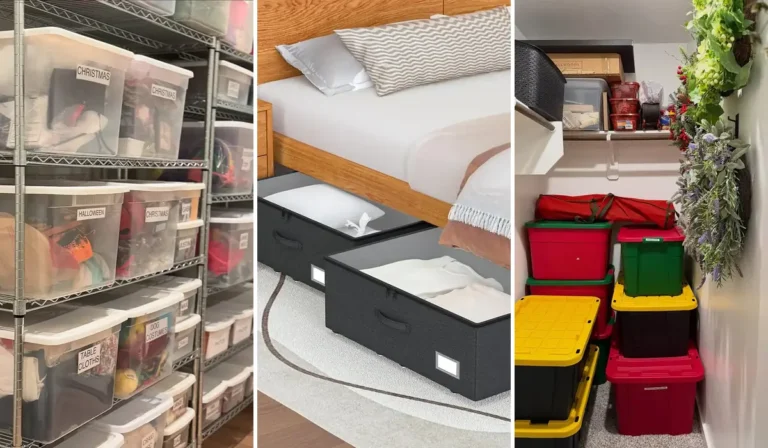
Two people, one rail, and a closet that was never built for both of you. When every hanger slides into the middle and the shoes pile up on the floor, mornings turn into a quiet tug of war over space you both pay rent for. These 19 small closet organization ideas split the closet fairly, from a rail divided down the middle to bins, hooks, and a ten-minute reset you do together. Start with the split that ends the most arguments, and let the rest follow.
1. Split the Rail Down the Middle So Each of You Owns a Side
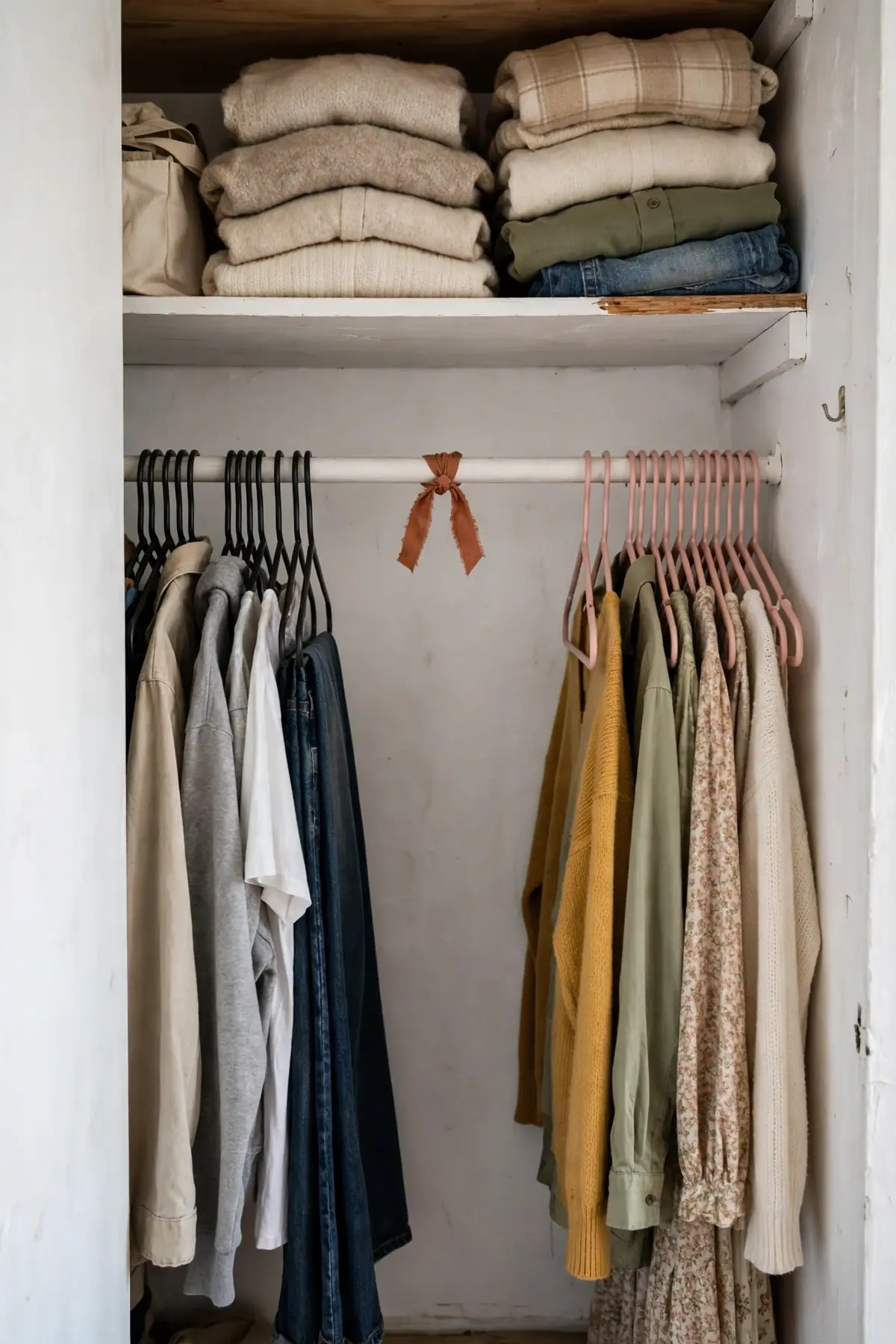
Stand in front of the closet together and look at the rail as one long shared line. Slide a simple marker to the middle, a small ring, a ribbon tie, or a painted wooden divider, and the rail stops being a free-for-all. Each of you now owns a side, and the boundary is visible every time the door opens.
Give the left side to one of you and the right side to the other, then hang only your own clothes on your half. When a shirt drifts across the line, slide it back without a debate. The split keeps mornings calm because neither of you has to hunt through the other's clothes to find your own.
Mark the middle like this
✅ Tie a ribbon or slide a ring onto the rail at the centre, so the split is visible at a glance.
✅ Give each side its own hanger colour, so a stray shirt is easy to spot and slide back.
✅ Move the marker when one of you needs more room, instead of letting clothes creep across the line.
2. A Second Hanging Rod That Doubles Your Rail Overnight
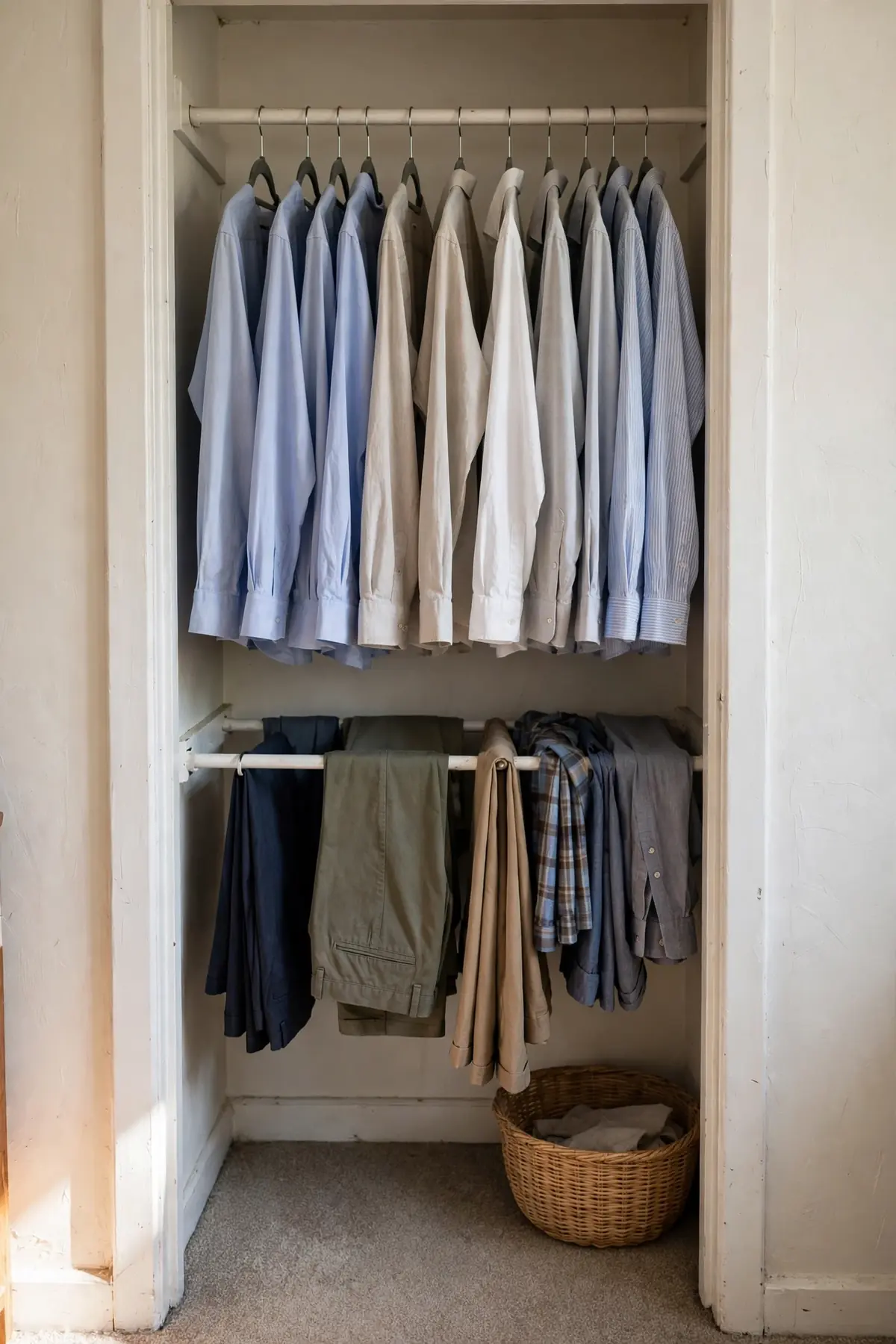
Under your hanging shirts sits a stretch of empty air, and that gap is where your shared closet finds room for both of you. A hang-down rod hooks straight onto the rail you already have, so no drilling is needed before the two of you can use it.
✅ Measure the drop to the floor, then hang the second rod so shirts clear the floor. ✅ Give each of you one side of the lower rod, so shirts never slide together by morning. ✅ Keep long dresses and coats on the single-height side, and let short pieces live double-hung. ✅ Swap bulky hangers for slim ones, since every saved inch fits another shirt. ✅ Slide a low basket under the lower rod, and the floor earns its keep.
Make the second rod work for two
✅ Hang the rod on the short-clothes side only, and leave one end free for dresses and coats.
✅ Put the taller person’s shirts on the top rod and the shorter person’s on the lower one, so neither of you stretches or stoops.
✅ Leave two empty hangers on each rod, so clean laundry has a home without a reshuffle.
3. Matching Slim Hangers in a Colour Each, So Whose Is Whose at a Glance
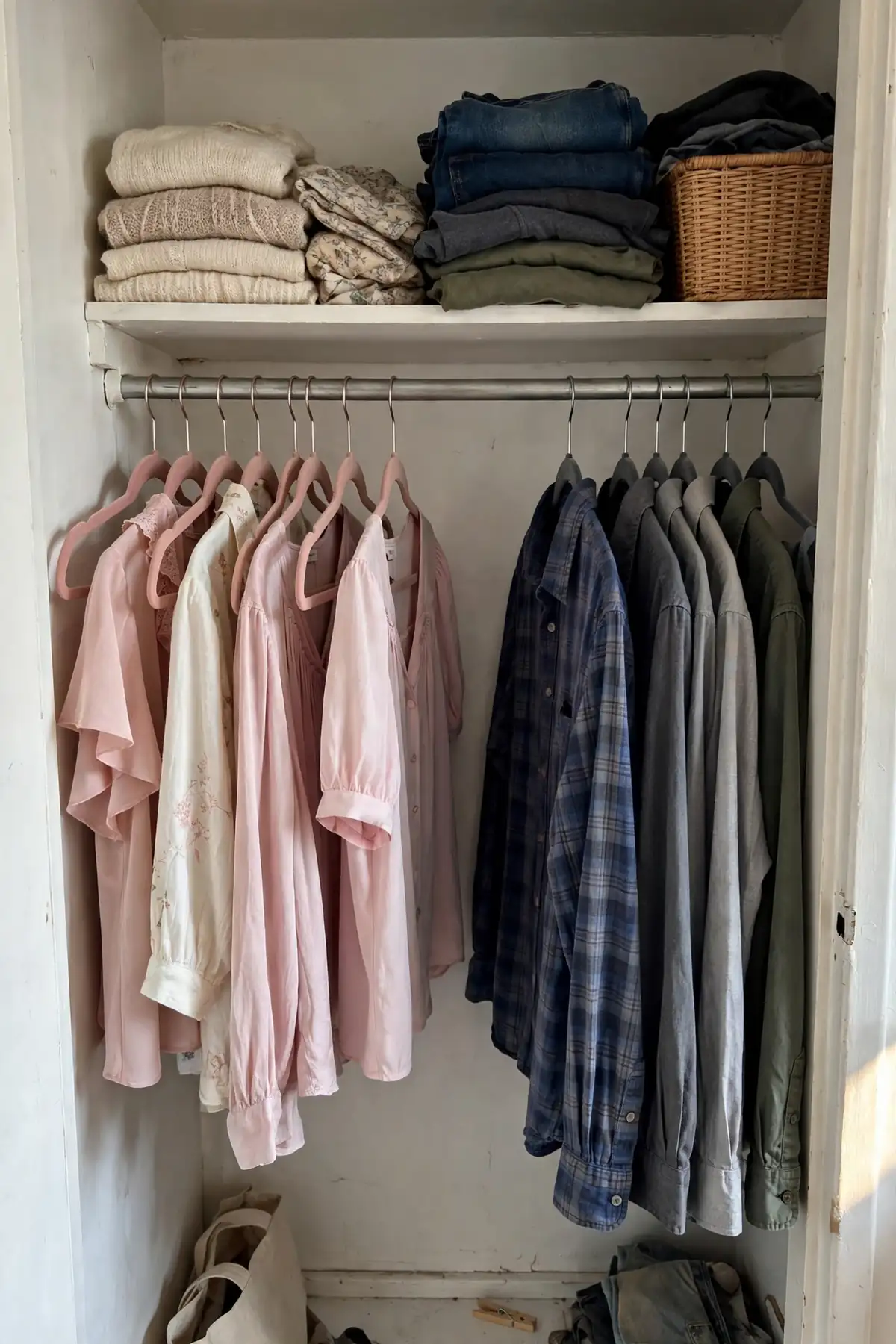
Mismatched hangers slide along the rail in a jumble, wire beside wood beside thick plastic, each one a different shape and colour, and nothing about the row tells you whose shirt is whose. What changes if you both switch to the same slim velvet hanger, in a colour each? Start by picking two colours you can tell apart at a glance, blush for you and charcoal for them, say, then move every garment onto its owner's colour in one sitting. The slim shape frees real inches on the rail, the velvet grip stops silky tops sliding to the floor, and the colour split does the sorting for you. When a charcoal hanger drifts onto your side, you spot the stray in a second and hand it back.
Make the colour split stick
✅ Pick two colours you can tell apart in dim morning light, not two near-identical shades.
✅ Move every garment in one sitting, so no stray old hanger hides in the middle of the row.
✅ Keep a small spare stack of each colour on the shelf, so a new shirt joins the right side at once.
4. Shelf Dividers That Stop Your Stacks Toppling Into Each Other
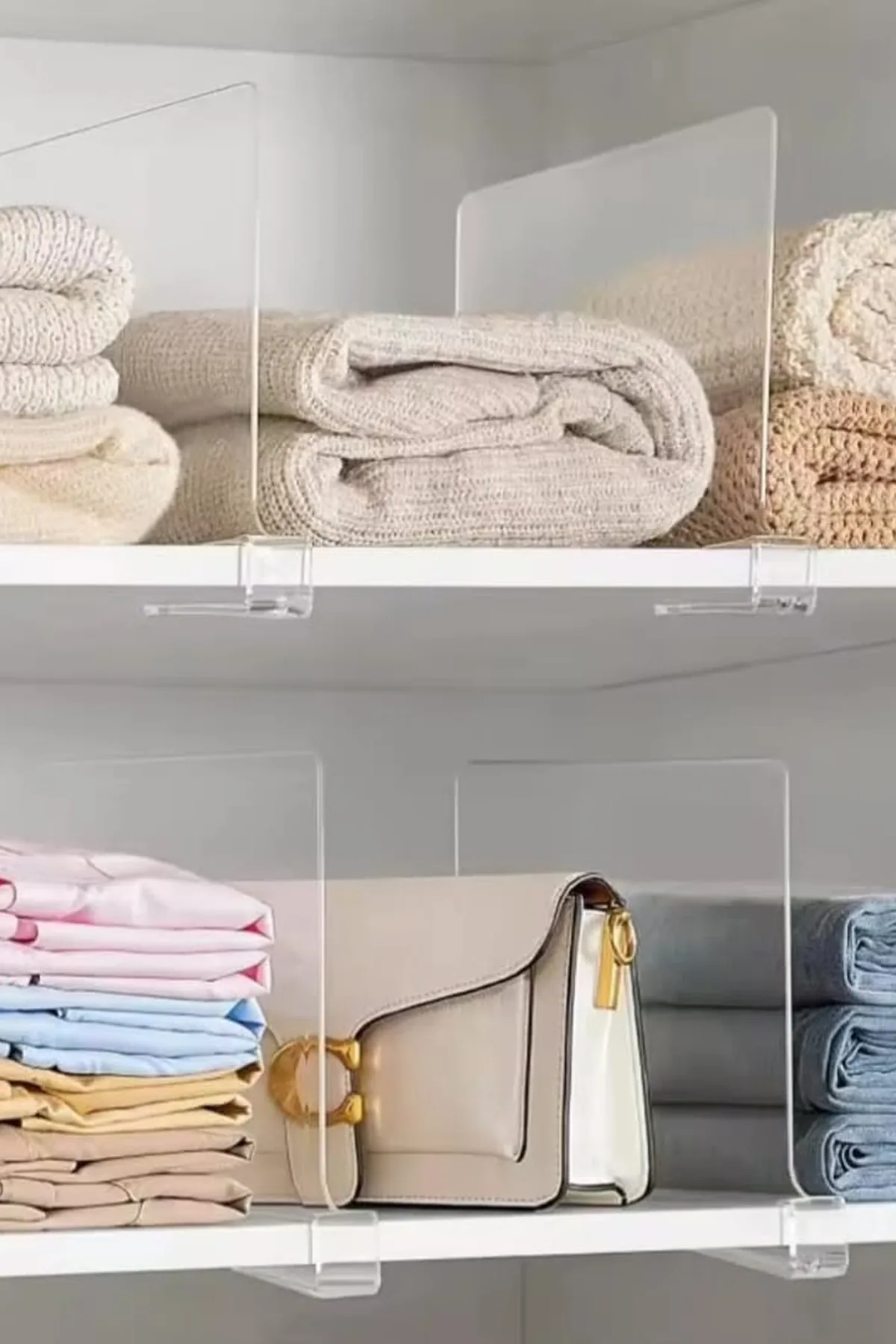
Your folded jumpers lean sideways into your partner's stack, and the top one slides off every time you pull a shirt from the middle. That slow topple is what shelf dividers stop. Measure the height of your folded stack, then slide a divider upright between the two piles so each person's clothes stay on their own side of the shelf.
Start with one divider in the middle of the shelf where the two stacks meet. Add a second divider at the outer edge of the taller pile if it still leans. Pick dividers that grip the shelf edge or clamp to the shelf board so they do not slide when you tug a jumper free. Give each of you a stack zone and keep the shared shelf tidy between washes.
Stop the topple in three moves
Measure your tallest folded stack, then slide one divider upright where the two piles meet.
Add a second divider at the outer edge of the taller pile if it still leans.
Pick dividers that grip or clamp to the shelf, so they stay put when you tug a jumper free.
5. Labelled Shelf Zones With a Name Each, So Nothing Drifts
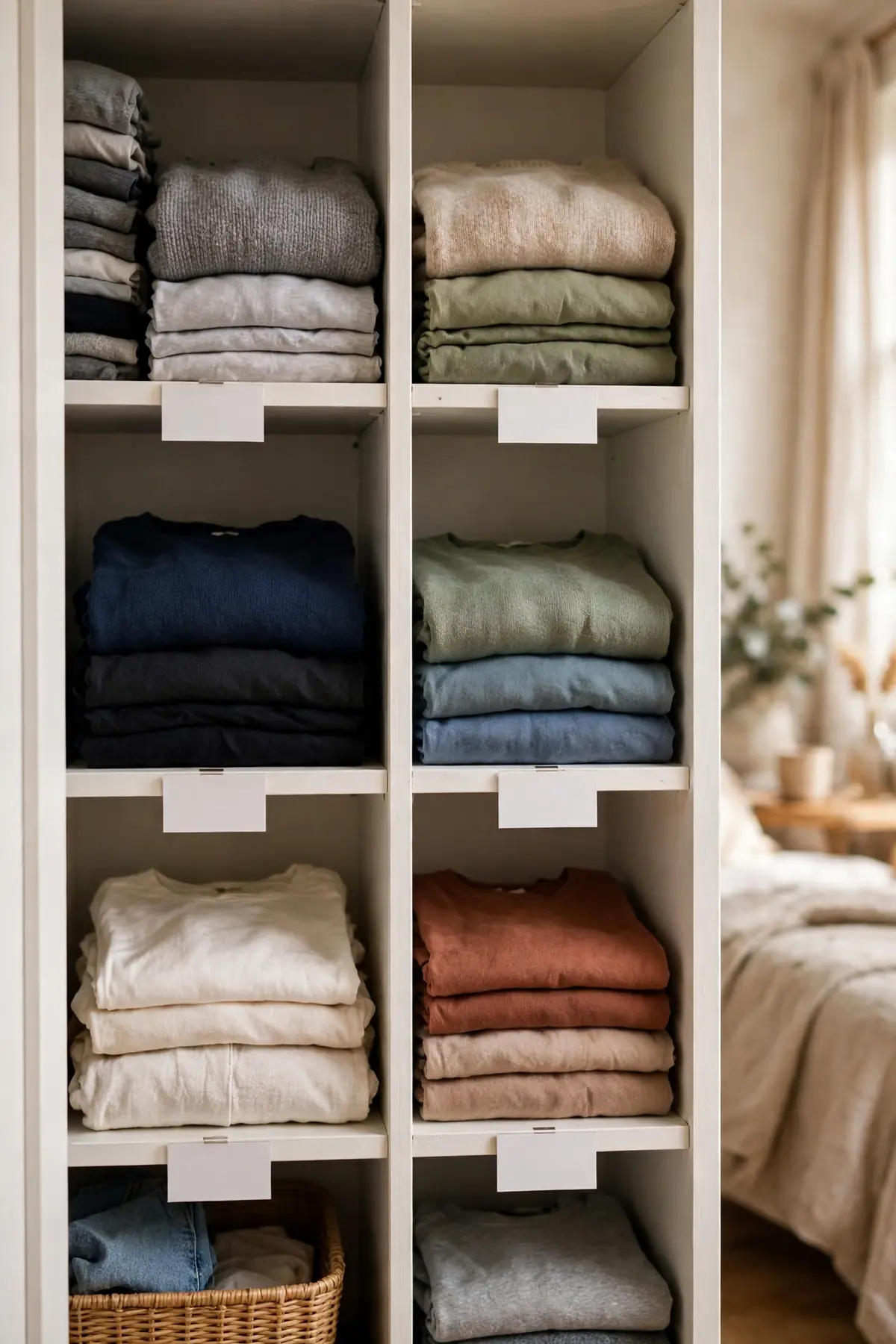
The shelf where your jumpers and theirs have quietly merged into one pile is the shelf that needs a name on it. Give each person one shelf zone and put a small label at the front edge with their name on it, so a folded stack has a home and a border. Keep the labels short and readable from the doorway, and place each person's everyday knits, tees and loungewear inside their own zone only. A label maker works well, and so does masking tape with a marker, since the point is the boundary, not the tool.
Tip: check the zones together once a month and move anything that has drifted back to its owner's shelf.
Three zones, two names, no drift
✅ One label at the front edge of each zone keeps the border visible from the doorway.
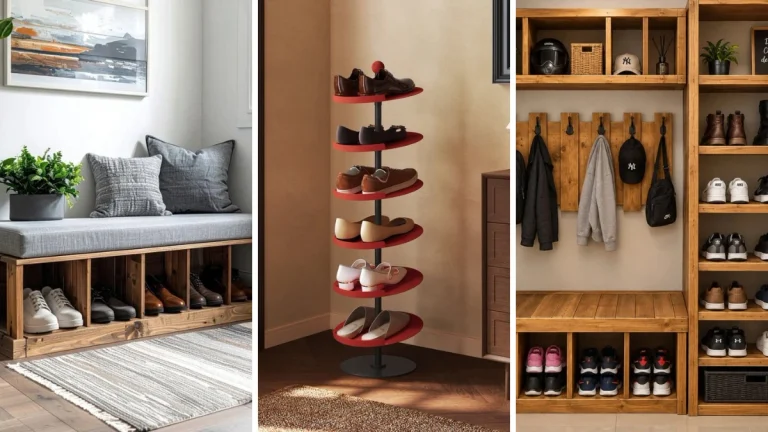
6. A Shoe Rack on the Closet Floor With a Side Each
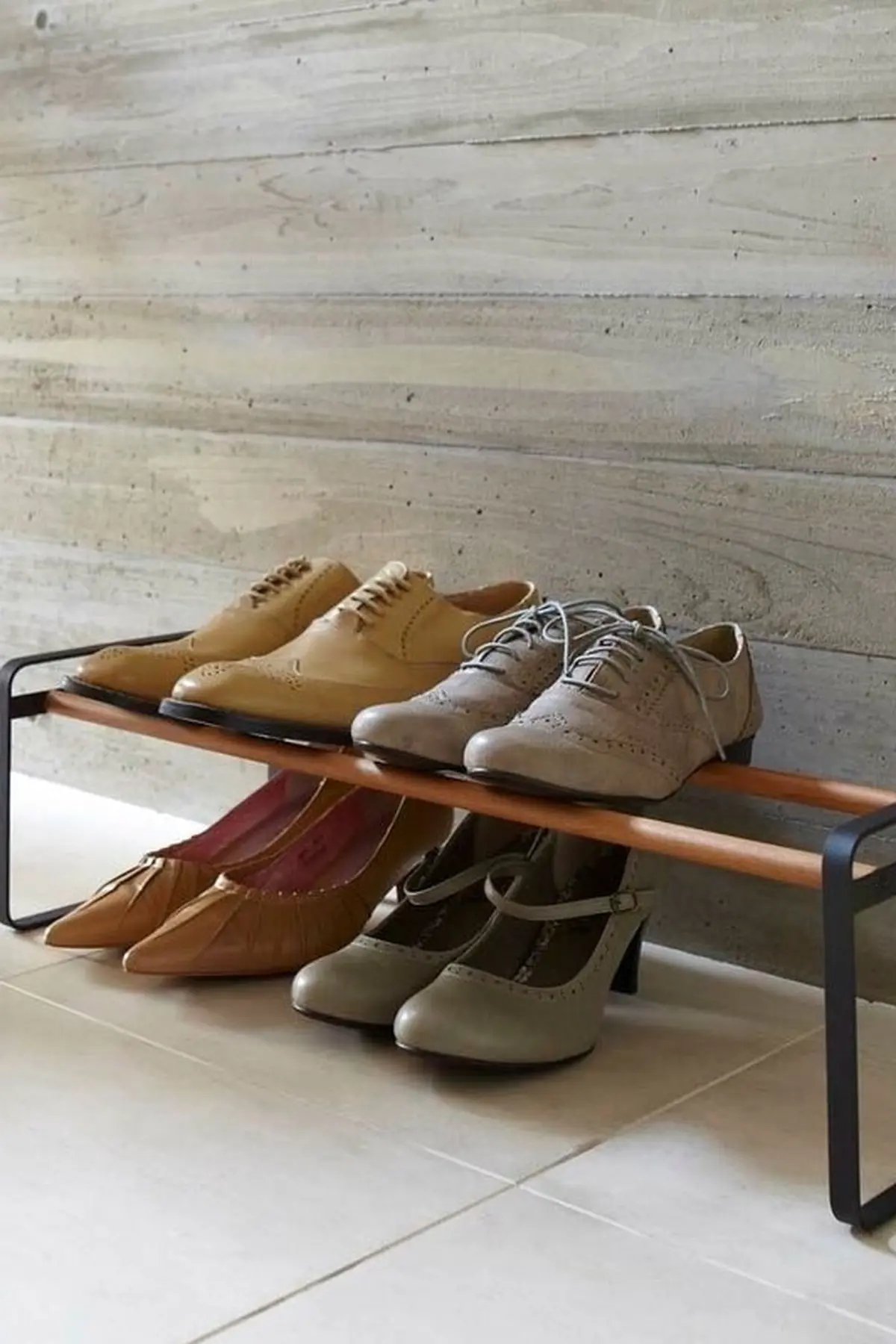
Right now your shoes live in a heap on the closet floor, pairs pulled apart and one shoe missing when you need to leave. A low two-tier rack ends that scramble without eating the floor space you have. Set it under the hanging clothes, then give each of you a side: your everyday pairs on the left, theirs on the right, with the shelf above holding the pairs you reach for next. Keep boots and heels off the rack, since they topple and steal room, and leave one spare slot each so a wet pair can dry without crowding the rest. Mornings get faster when every pair sits where your hand expects it, and neither of you has to dig through the other's shoes to find your own.
| On the rack | Off the rack |
|---|---|
| Everyday sneakers, flats and loafers, one pair per slot | Tall boots and heels, which topple and steal room |
| The pairs you wear this week, toes facing out | Occasion shoes you wear twice a year |
| One spare slot each for a wet pair to dry | A second pair squeezed into a slot that already holds one |
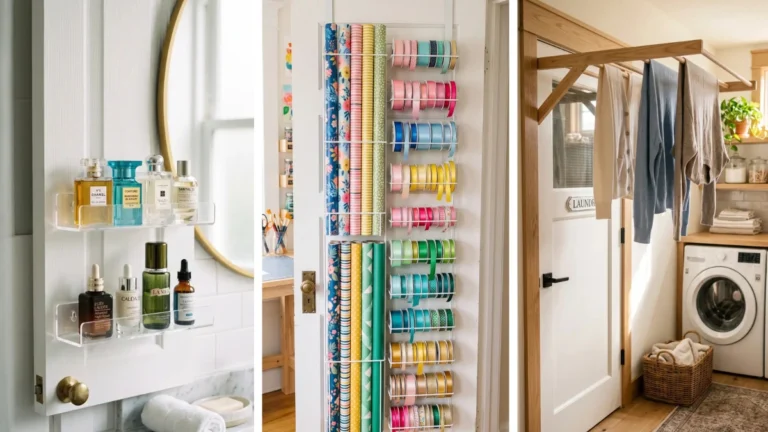
7. An Over-the-Door Organizer That Holds Shoes and Accessories
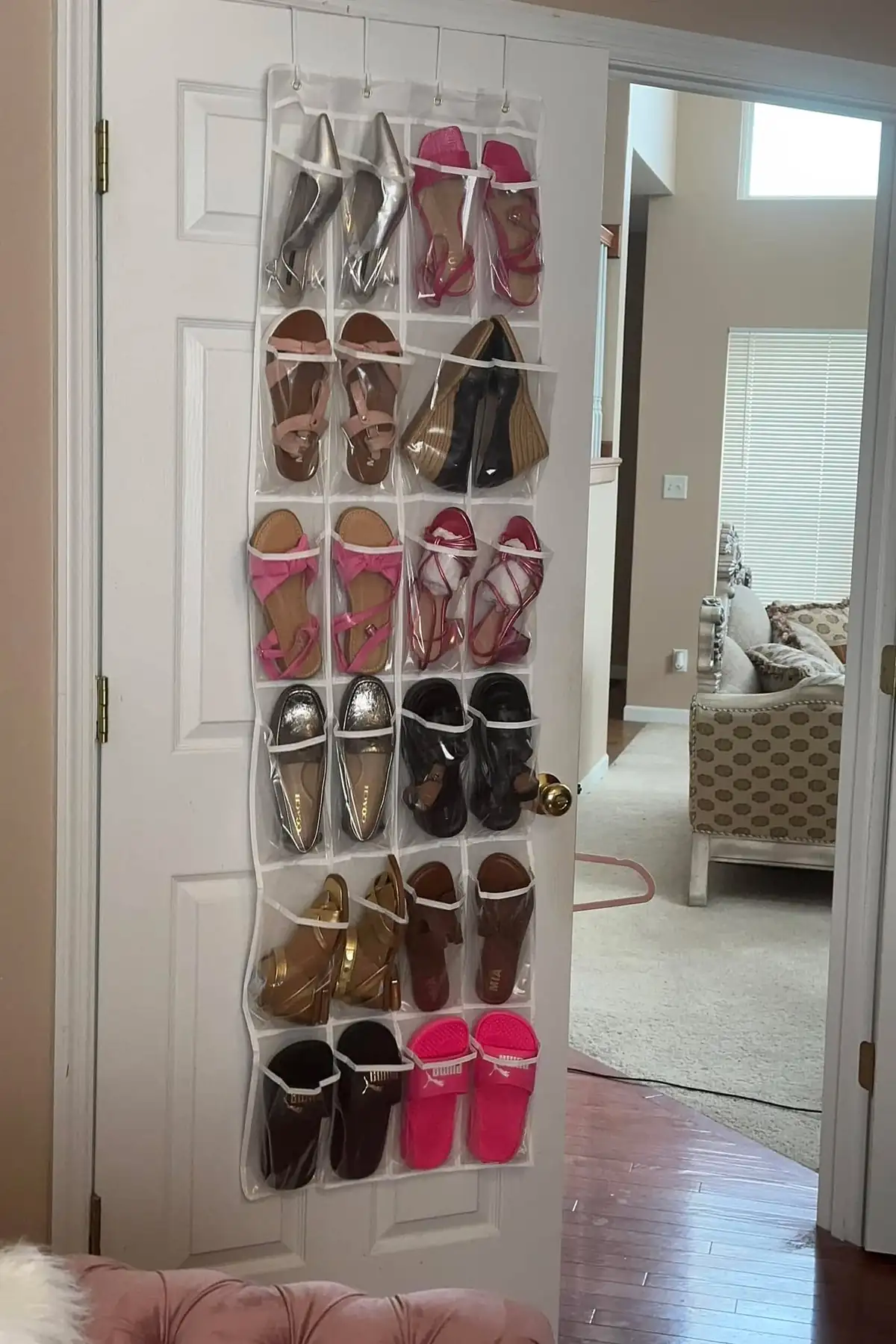
Behind your closet door hangs a wall of storage you both walk past every day, bare and wasted while your shoes crowd the floor below in a pile neither of you can sort in the morning. Hang a clear 24-pocket organizer over that door and the mess lifts off the floor in minutes.
Do: give each of you one side of the organizer, twelve pockets apiece, so your shoes stop migrating between rows. Put daily pairs at eye level and tuck the rarely worn ones down low.
Don’t: load the top pockets with heavy boots, since the weight pulls the hooks and stops the door closing. Keep boots on the closet floor and let the clear pockets hold flats, sandals, trainers, and small accessories like belts and scarves.
Do it this way, not that way
✅ Do
One side each, twelve pockets apiece, so your shoes stay on your own side.
Daily pairs at eye level, rarely worn ones down low.
Flats, sandals, trainers, belts and scarves in the clear pockets.
Don’t
Load the top pockets with heavy boots.
Keep boots in the organizer at all; they belong on the closet floor.
Let one person’s shoes spill into the other’s side.
8. A Hanging Shelf Organizer for the Knits That Hate Hangers
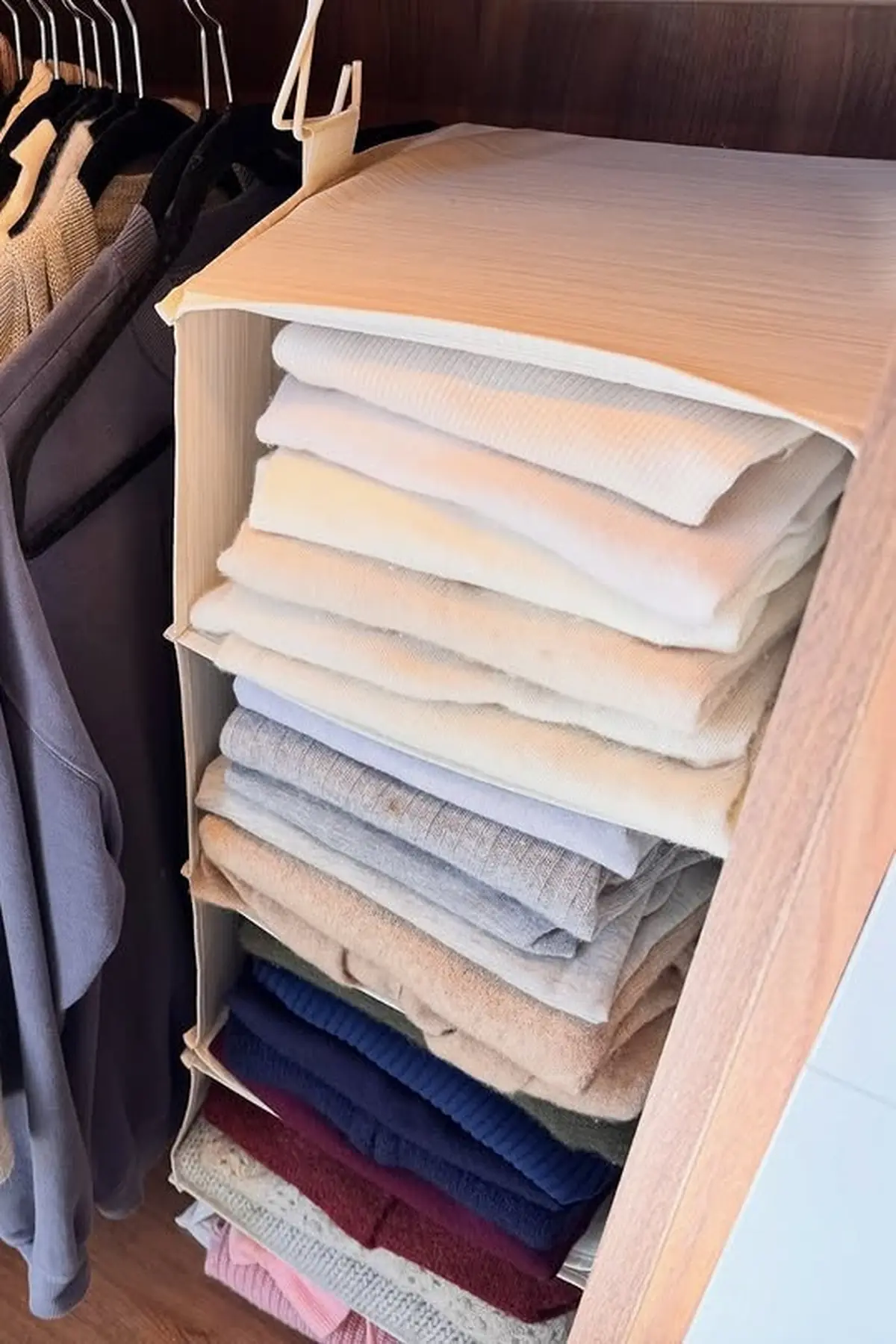
Heavy knits hung on thin hangers stretch out of shape, and the shoulders poke into sharp little points that never smooth back down. A hanging shelf organizer gives those same jumpers a folded home instead, with six soft cubbies that hook onto the closet rod and use the air below your shirts. Give each of you three cubbies, one for chunky knits, one for lighter layers, one for scarves and hats, so nobody has to dig through the other person's pile to find a favourite. The soft sides sag a little when a cubby holds only one thin jumper, and the unit sways when you pull something from the bottom, so keep heavier knits low and lighter ones high. Folded knits stay smooth, visible, and easy to grab on mornings.
At a glance
Holds
Six folded knits, two or three per cubby, in one narrow slice of rod.
Shares
Three cubbies each, so neither of you digs through the other’s pile.
Watch for
Soft sides sag and sway, so keep heavy knits low and light ones high.
9. Door Hooks for Belts and Scarves That Free Up the Rail
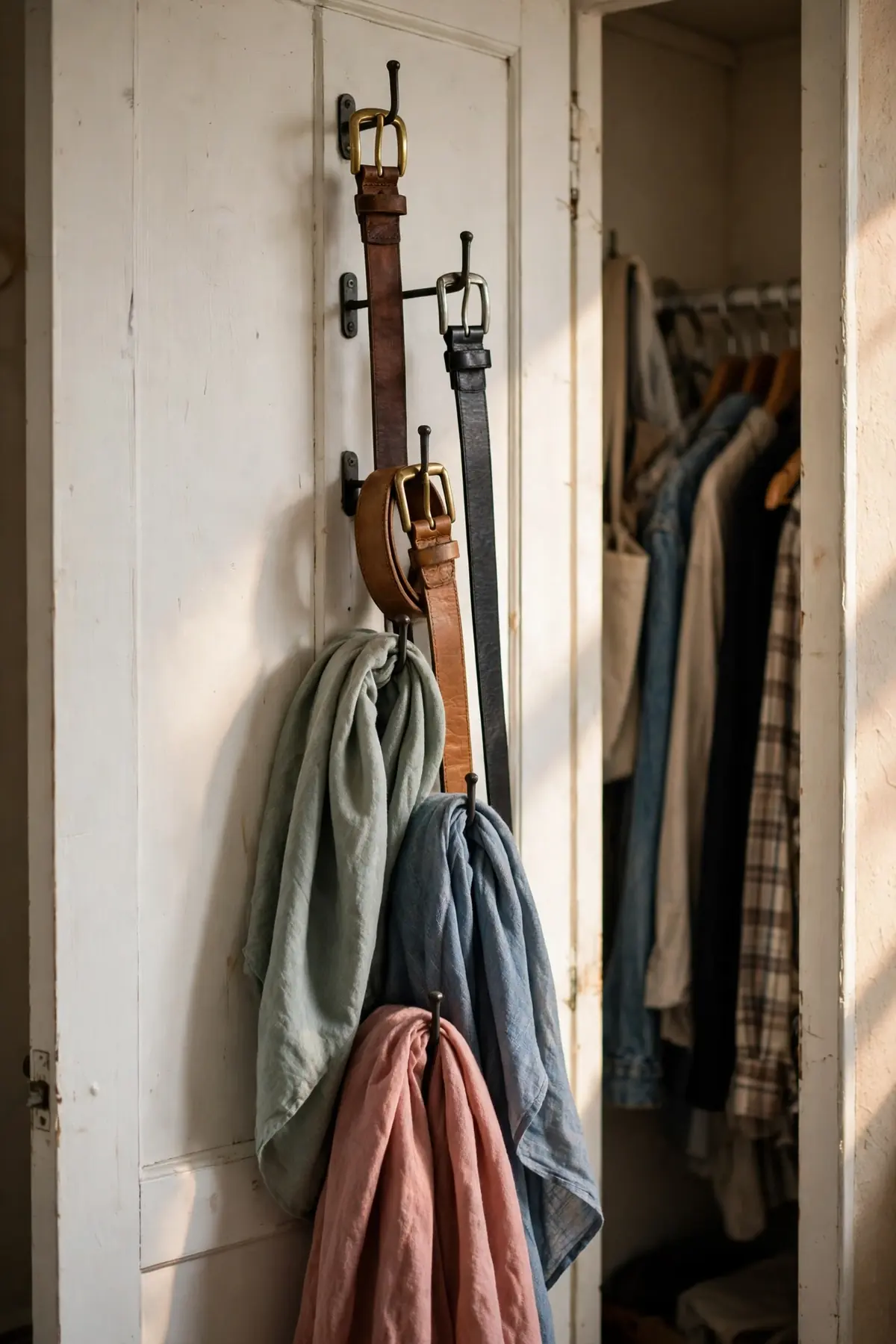
Belts coiled in a drawer and scarves stuffed in a bag are easy to forget, and neither of you reaches for them when getting dressed in a hurry. A row of hooks on the inside of the closet door turns that dead space into a home for both, with each belt hung by its buckle and each scarf draped over its own hook.
Give the top hooks to one of you and the lower hooks to the other, so nobody hunts through the other's things, and keep one hook free for the belt or scarf you wear most. Stick-on hooks suit a smooth door and leave no holes, while an over-door rack holds more weight. Your rail stays clear for clothes, and the accessories you wear stop hiding away.
Hang them like this
● Top hooks for one of you, lower hooks for the other, so each of you reaches for your own things.
● Hang each belt by its buckle so it stays straight and lifts off without a tug.
● Drape one scarf per hook so nothing tangles or hides behind another.
● Leave one hook free for the belt or scarf you grab most days.
10. Drawer Dividers That End the Shared-Drawer Tug of War
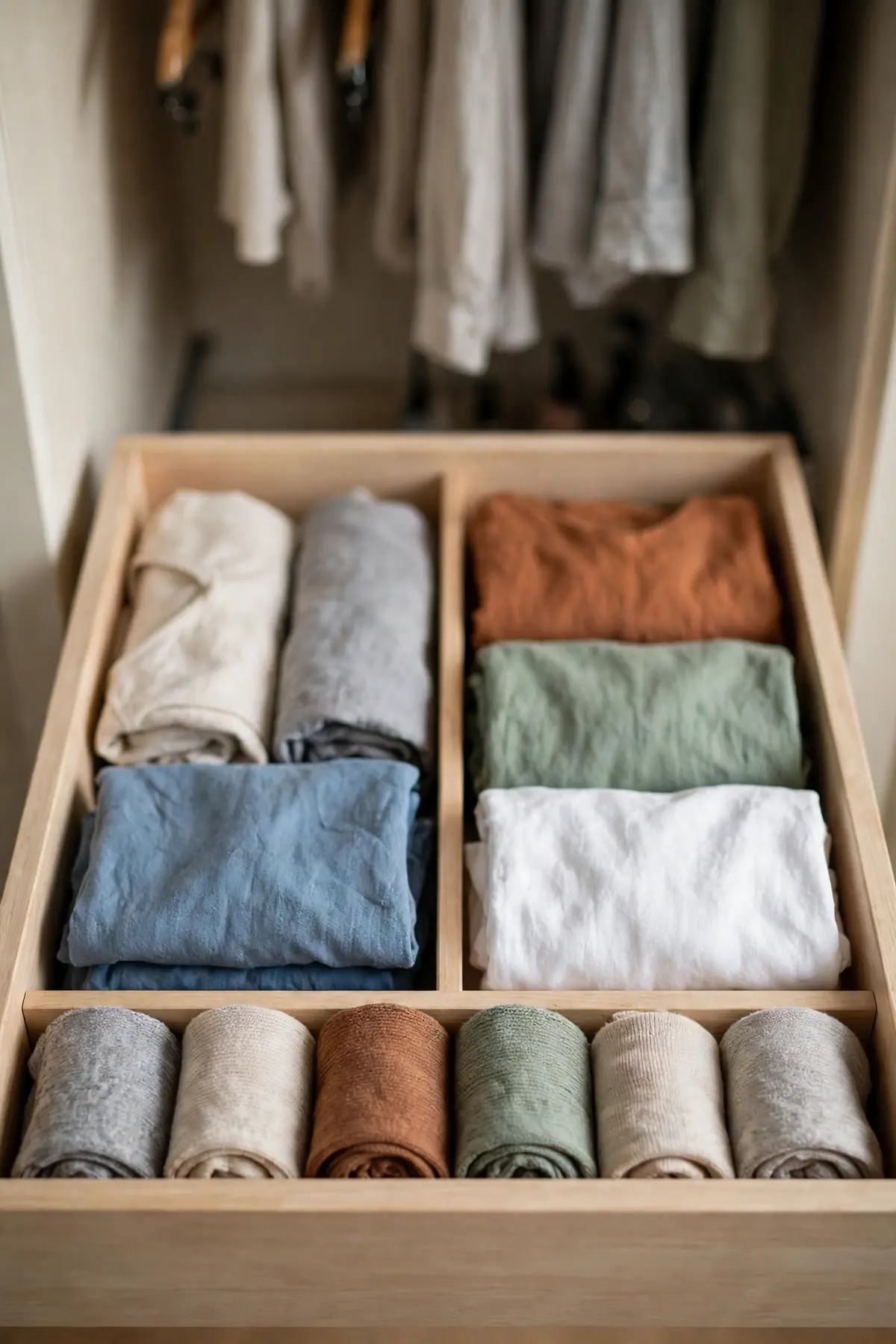
Your shared drawer slides open to a tangle of socks and tops, nothing belonging to either of you, and mornings start with digging. Why do dividers fix a fight that folding alone never solves? They draw a line you can both see, so your stack stops sliding into theirs. Measure the drawer, then fit two or three slim dividers across it, one side for each of you, with socks in a narrow strip at the front. Fold each top the same way, stand the folds upright, and sort by type first, then by person, so a glance tells you whose row is whose. When laundry comes back, each of you puts your own folds into your own section, and the drawer stays split without a weekly talk about it.
Before and after: one drawer, one line down the middle
Before
Socks, tops and small things piled in one heap.
Your folds slide into theirs by midweek.
Every search means digging through both piles.
After
✅ One slim divider marks the middle of the drawer.
✅ Your folds stand upright on your side, theirs on theirs.
✅ Socks live in a narrow strip at the front.
11. One Rotation Bin Each for the Season You Are Not Wearing
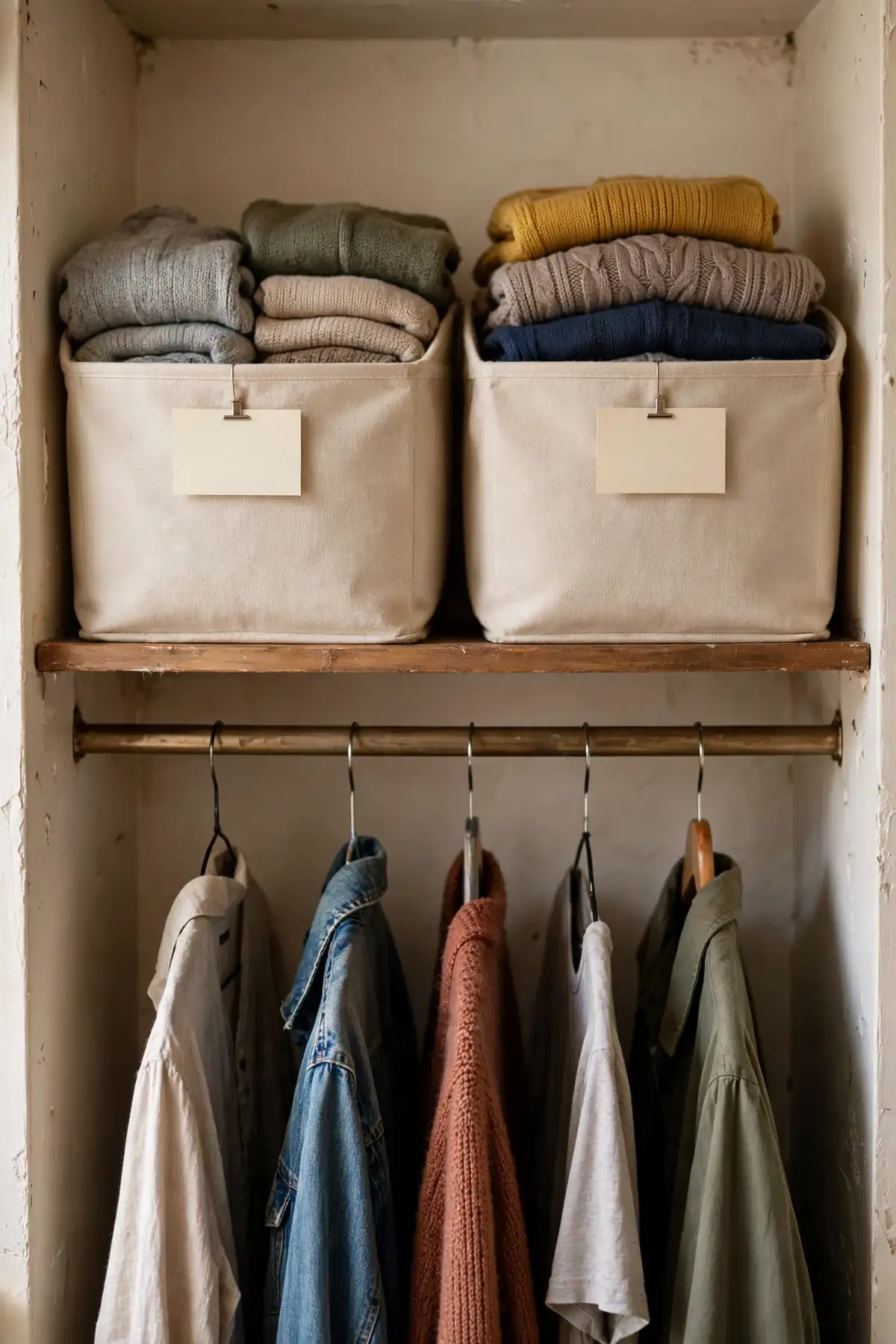
Heavy winter coats crowd the rail in May, while your summer clothes sit buried in a bag on the floor, and neither of you can find what you need in the morning. Give the season you are not wearing a home of its own, one bin each, up on the high shelf until the weather turns.
✅ Pick two matching bins that fit side by side, one labelled with your name and one with theirs. ✅ Fold out-of-season clothes flat and roll the soft knits, so each bin holds a full season without bulging. ✅ Slip a small card inside the lid listing what went in, so the swap takes minutes. ✅ Lift both bins down together on the same weekend, and swap them with the rail clothes.
12. Accessory Trays on One Shared Shelf, Jewellery Sorted at Last
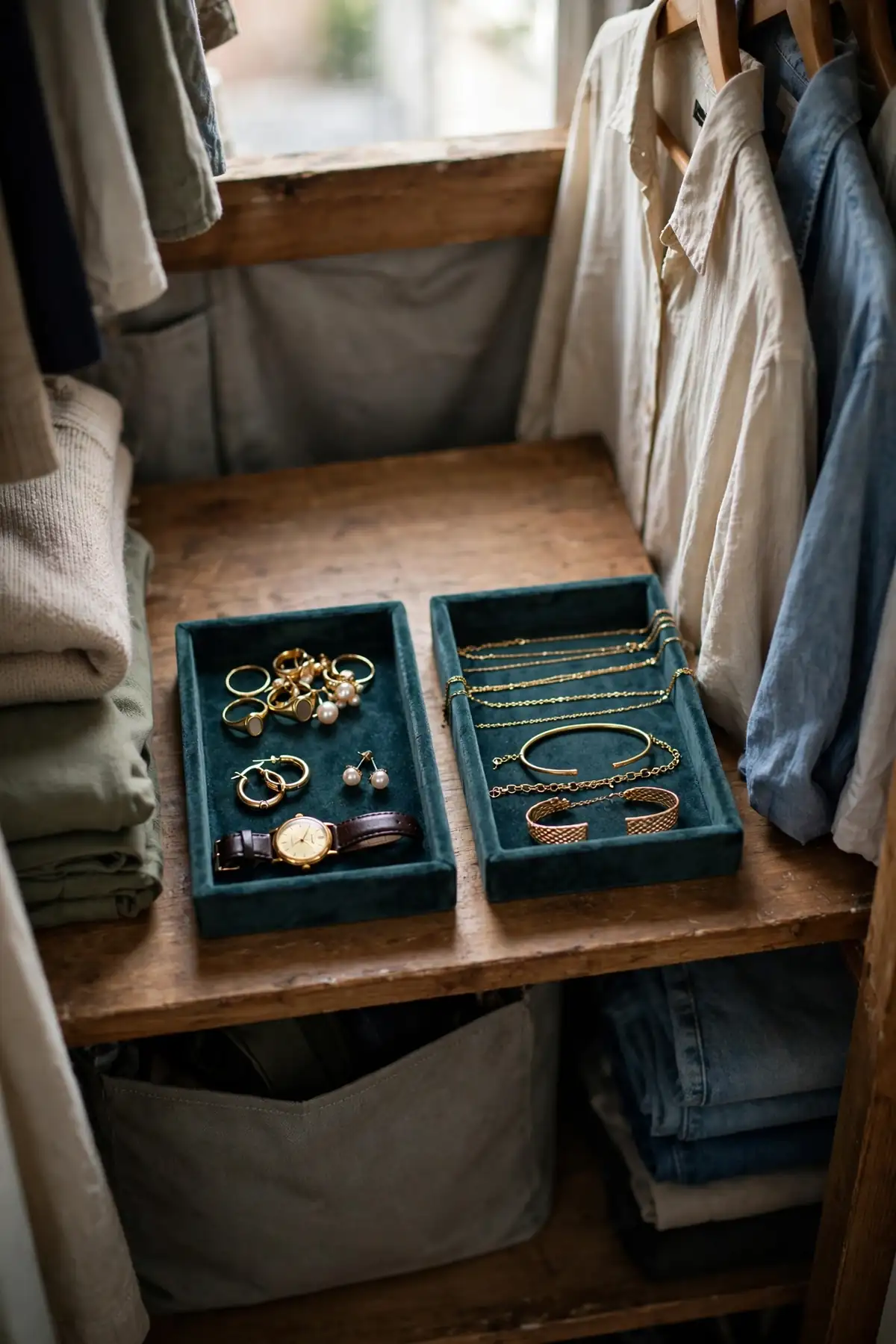
Chains knotted together in a drawer, earrings missing their pairs, and a watch face scratched by a bracelet buckle: that is the morning both of you keep repeating. Clear one shelf at eye level and set two shallow trays side by side, one tray per person, so neither of you digs through the other's pieces. Line the bottom of each tray with a soft cloth, then sort by type: rings grouped in one corner, earrings paired together, watches lying flat, necklaces laid straight in their own lanes. Keep the pieces you wear every week in the front rows and the rarely worn ones at the back. Each morning you reach for your tray, pick, and go, and the drawer stays a drawer again.
Two trays, one shelf, no more digging
Your tray
✅ Rings grouped in one corner, earrings paired together.
✅ Watch lying flat, away from chains and buckles.
Their tray
✅ Necklaces laid straight in their own lanes.
✅ Weekly pieces in front, rarely worn ones at the back.
13. A Worn-Once Hook Zone for Clothes Not Ready for the Wash
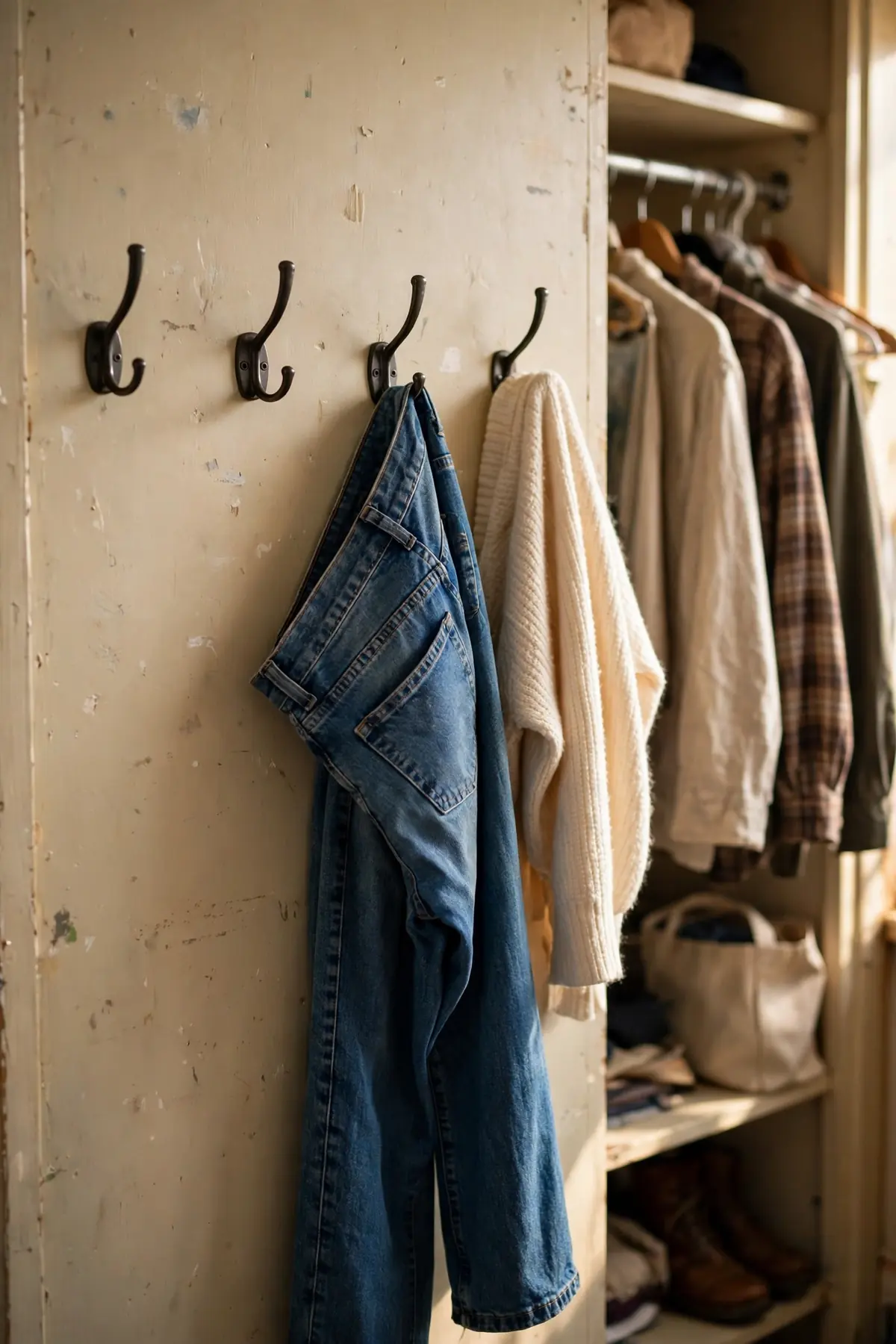
Jeans draped over the chair at the end of the day tell the same story in most shared bedrooms: worn once, still fine for another wear, with nowhere to go but the clean rail or the laundry basket. A row of hooks on your closet's inside wall gives those in-between clothes a home of their own, so the chair stays a chair. Give each of you two hooks, one for jeans and one for a top, and keep the row at shoulder height where you both reach it without thinking. When a hook fills up, that piece gets worn next or washed.
Tip: Agree that anything left on a hook for more than a week goes in the wash, so neither of you has to police the other's pile.
Keep the hook zone honest
✅ Two hooks each, and no more, so the row never grows into a second closet.
✅ Hang jeans by the waistband and tops by the hanger loop, so nothing slides off overnight.
✅ Air each piece for a few minutes before it goes on the hook, so it smells fresh on the second wear.
14. Top-Shelf Bins for the Out-of-Season Stuff You Rarely Reach For
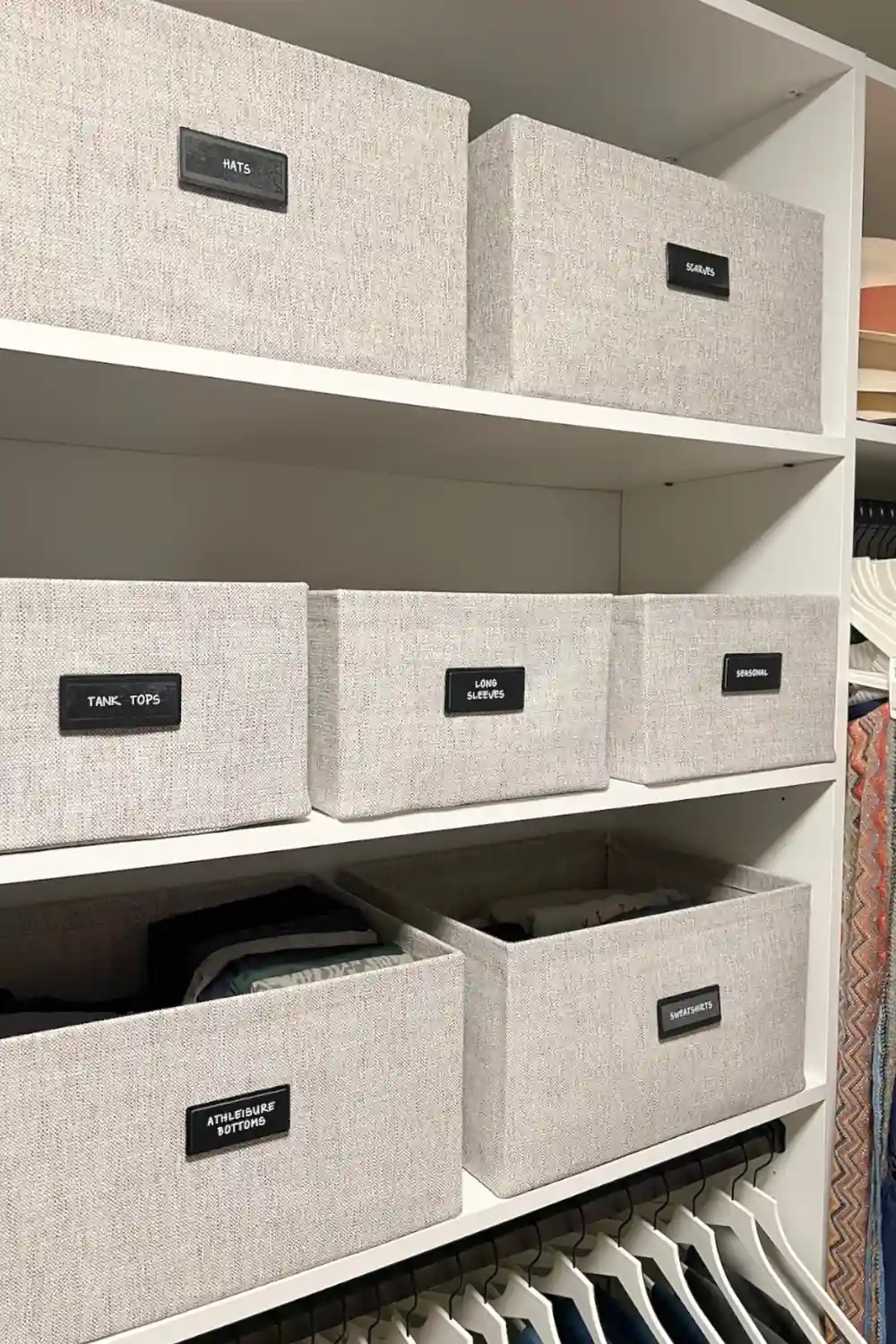
The top shelf sits in a dark gap above the rail, holding nothing but dust while your everyday clothes crowd the rod below. Give that shelf a job: one row of matching lidded bins with handles, holding the out-of-season stuff neither of you reaches for until the weather turns.
| Bin | Belongs to | What goes inside |
|---|---|---|
| Left bin | You | Heavy winter knits and your January coat |
| Middle bin | Your partner | Summer linen shirts, swim gear, and a festival hat |
| Right bin | Shared | Spare bedding, gift wrap, and spare bag straps |
Label every bin on the front, not the lid, so you can read it from the floor. Keep a small step stool beside the closet, and swap the bins twice a year when the seasons change.
Set up your top shelf in three moves
1. Measure
Measure the shelf height and depth, then buy matching bins that leave a finger-width gap on each side.
→
2. Label
Label each bin on the front with a plain word for its owner and what lives inside.
→
3. Lift
Lift the bins up together and keep the step stool beside the closet for the next swap.
15. A Left-Right Colour Code You Can Both Read at a Glance
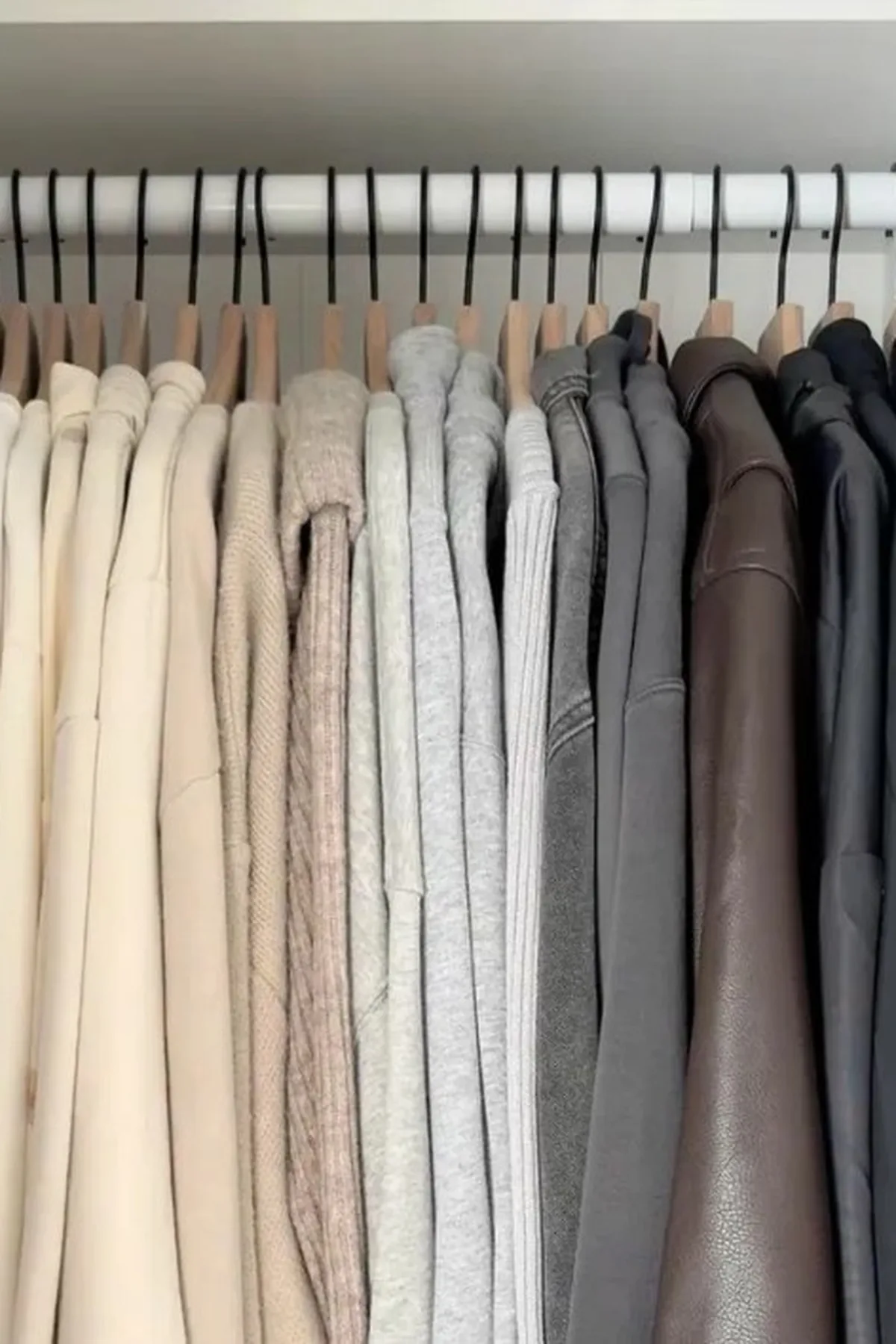
Seven in the morning, both of you half awake and reaching for the same crowded stretch of rail, your hands brushing past each other's sleeves while the clock ticks. A left-right colour code ends that tangle. Give each of you one side of the rail and one colour order to follow, light shades at the outer edge flowing to dark shades at the middle. Mark the border with one wooden divider or a different hanger colour for each of you, and rehang anything that drifts across the line the same night.
Do keep the order identical on both sides, so either of you can find a colour blindfolded. Do not sort by colour alone and forget the split, or the rail slides back into one shared jumble within a week.
| Zone | Colour order | How you mark it |
|---|---|---|
| Left side, yours | Whites and creams at the outer edge, darks toward the middle | Your hanger colour, wood for example |
| The border | Where light meets dark, right at the centre of the rail | ✅ One wooden divider or a strip of tape on the rail |
| Right side, theirs | Same order mirrored, whites at the outer edge | Their hanger colour, black for example |
Same order, both sides, and the border never moves.
16. A Capsule Edit Together, With a One-In-One-Out Rule
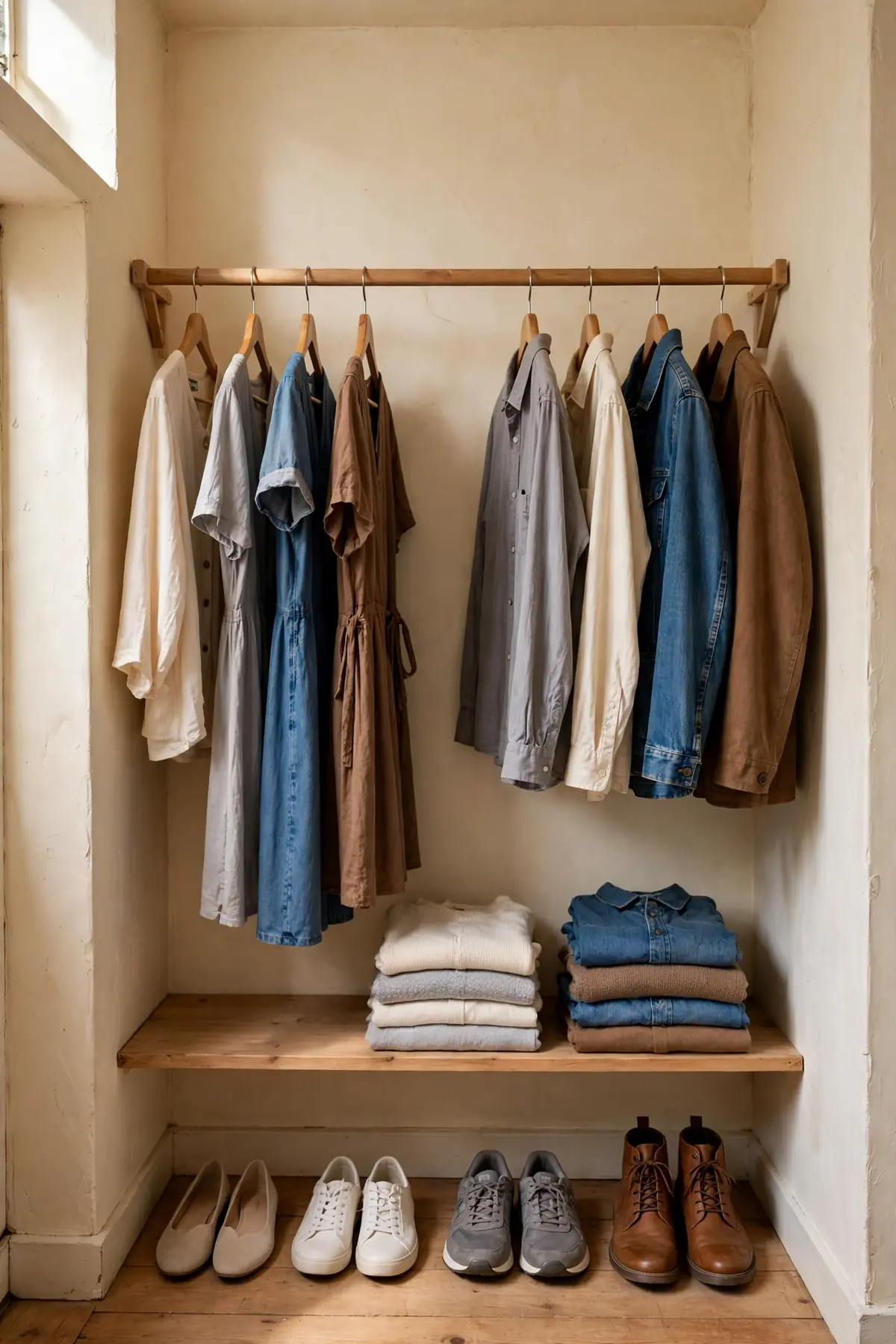
The rail is so full the hangers barely move, and the middle holds jackets and tops neither of you has reached for in months. Pull every piece out together and keep only what each of you has worn this season. What stays earns its hanger; the rest goes to donation the same day.
Pros: mornings get faster because every piece left is one you both reach for, and the rail has room, so clothes stop wrinkling against each other. The one-in-one-out rule holds the line: a new shirt means an old one leaves.
Cons: the edit takes a full evening and a few conversations, since one of you will want to keep the 'just in case' pieces. Sentimental pieces need their own box, or they creep back within a week.
✅ Do: keep only what you wore
Let every piece earn its hanger. When a new shirt comes home, an old one leaves the same day.
Don’t: let the “just in case” pieces back on the rail
Box the sentimental ones and store them out of sight, or they will be hanging beside your everyday clothes again within a week.
17. A Pull-Down Rod for the High Rail Neither of You Can Reach
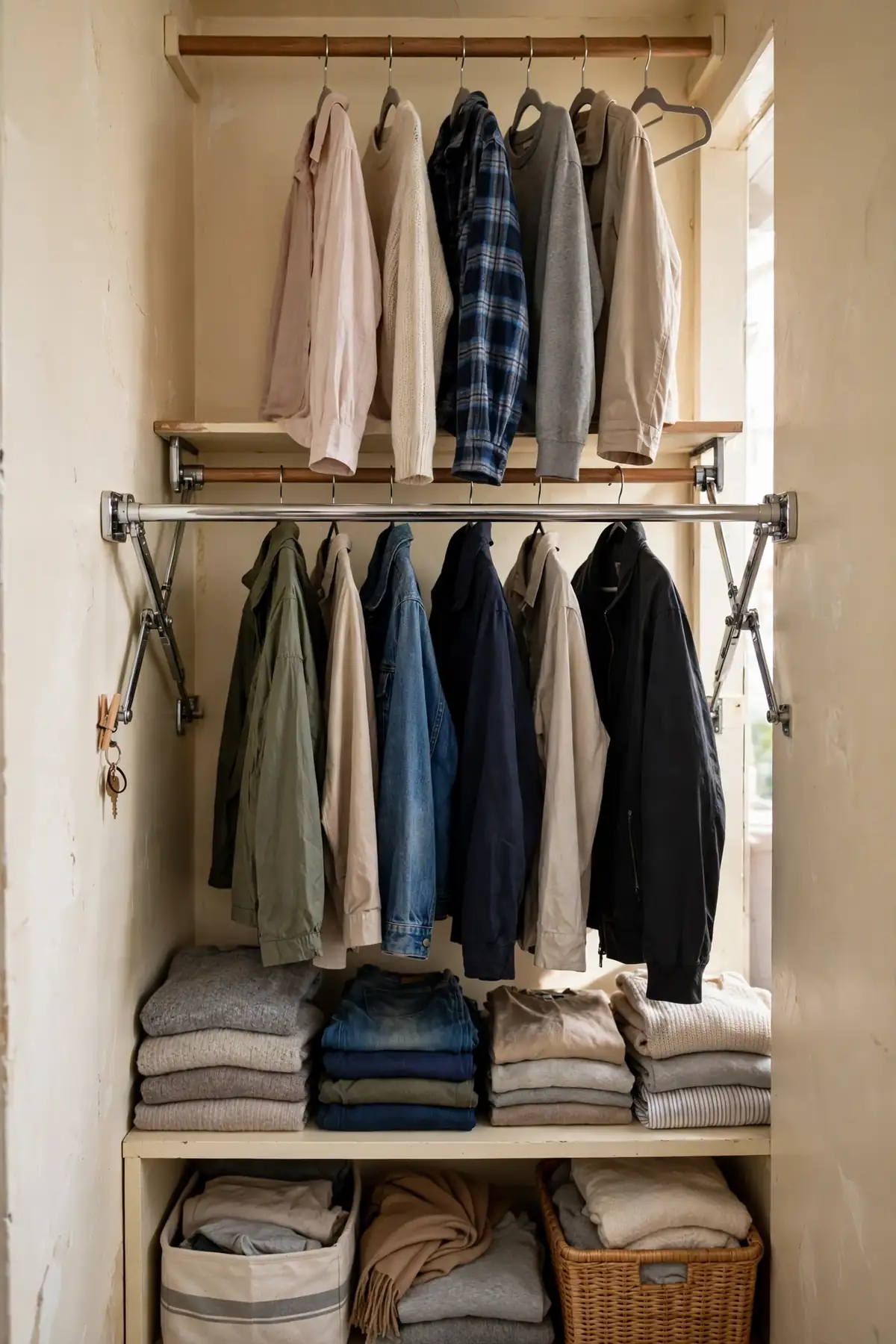
High above your heads, the top rail sits just out of reach, and the hangers up there gather dust while your everyday clothes crowd the lower rail below. You both stretch onto tiptoe for the same coat, then give up and leave it hanging there for weeks.
A pull-down rod changes that dead stretch into a rail you both actually use. Mount it high, load one person's out-of-season jackets on it, and tug the handle down whenever either of you needs something. Agree whose turn it is to hang things back up, and keep the load light so the spring lifts smoothly for the shorter of you both.
Before you buy the rod
1Measure the rail height and check the side walls hold screws firmly before you order.
2Split the lowered rod between you, one half each for your out-of-season clothes.
3Tug the handle down together the first time, so you both know how the spring feels.
18. A High Shoe Shelf Above the Door for the Pairs You Wear Least
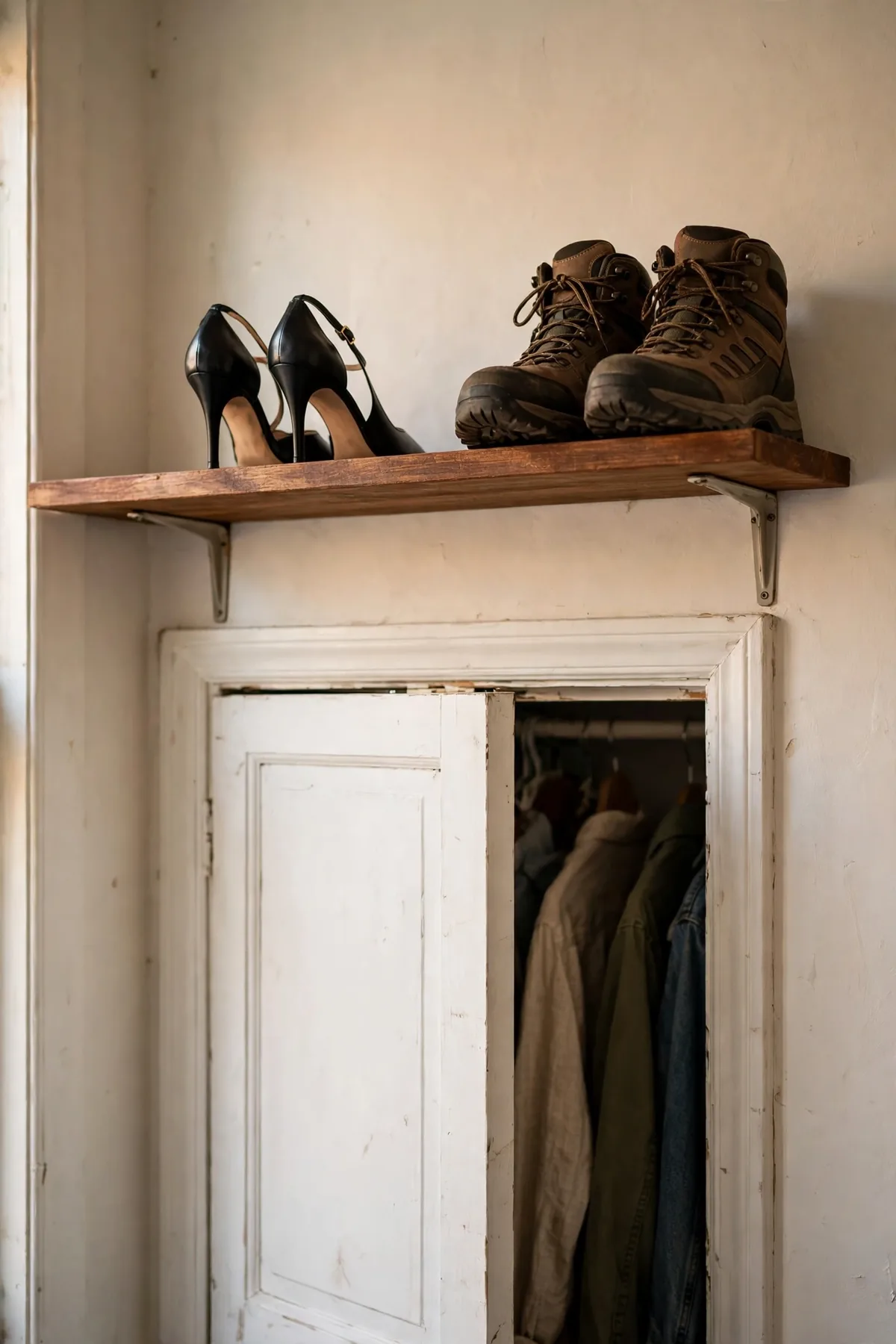
Your party shoes and their hiking boots sit on the everyday rail, in the way every morning.
Q: Where should they go instead? A: Up high, on a shelf above the closet door, where seldom-worn pairs stop crowding the rail. Give each of you one end so your party shoes and their hiking boots earn a spot there, and the everyday trainers and work shoes keep the floor and the rack to themselves.
Q: How do you stop it becoming a dumping ground? A: Keep a rule: if a pair has not been worn in three months, it lives up there or leaves. A step stool by the door makes the shelf easy to reach, and a wipe first keeps dust off the clothes below.
WHOSE END
Yours on the left, theirs on the right, so neither of you has to hunt for a pair.
WHAT LIVES UP THERE
Only the pairs you wear a few times a year, never the shoes you reach for daily.
HOW YOU REACH IT
A step stool kept beside the door, so the shelf stays useful instead of forgotten.
19. A Ten-Minute Sunday Reset You Both Do Together

Sunday evening finds the closet drifting toward chaos after a week of hurried mornings, so set a timer for ten minutes and reset it together. One of you takes the rail while the other takes the shelves, and you meet at the shoe pile.
✅ Rehang anything off its hanger, and push every hanger back to its own half. ✅ Refold the stacks pawed through, and straighten the piles so the edges line up. ✅ Return strays: belts on hooks, bags on the shelf, shoes paired and lined up. ✅ Toss worn clothes in the hamper, hang tomorrow's outfits on the door hooks, and flag anything needing a wash. ✅ Stand back, check both halves look even, then shut the doors on a closet ready for Monday.
Your ten-minute Sunday reset
A shared closet works when both of you can see where your things live and reach them without moving the other person’s pile first. You do not need a bigger closet, you need a fair split, a few cheap dividers and hooks, and a habit of putting things back where they belong. Pick one idea tonight, the split rail or the second rod, and try it before the week is out. Then add the next one when the first starts to feel normal. In a month your mornings will be calmer, your clothes will stay where you left them, and the closet will finally hold two wardrobes instead of one argument.
Frequently Asked Questions
How do two people share one small closet without arguing over space?
Split the rail down the middle, give each person a side, and keep the split visible with a marker on the rail or a different hanger colour each. Agree the split once, then stop renegotiating it every morning.
What is the cheapest way to double closet space for two people?
A second hanging rod under the first costs little and doubles the rail, and slim matching hangers free up a few extra inches too, since bulky hangers waste rail space. Both fit in a rented flat with no drilling into the walls.
How do we split a closet fairly when one of us has more clothes?
Split by what each of you actually wears, not by half the rail. The person with more clothes takes the longer side or the top shelf, and the other takes the shoe rack or the drawer space, so the trade feels even.
How do we keep folded clothes from toppling into each other's stacks?
Shelf dividers hold each stack upright, and labelled zones stop the piles from drifting together. Fold to the same width so the stacks stay even, and keep the stacks low enough that the top item cannot slide off.
Where should shoes go when two people share one closet?
A low rack on the floor with a side each works for the pairs you wear every day. Shoes you wear rarely go on a high shelf above the door, and belts, scarves, and small accessories move to the organizer on the door.
How often should we reset a shared closet?
A ten-minute reset once a week keeps the split honest and stops one side from creeping into the other. Swap the seasonal bins twice a year, and run the one-in-one-out rule whenever something new comes home.