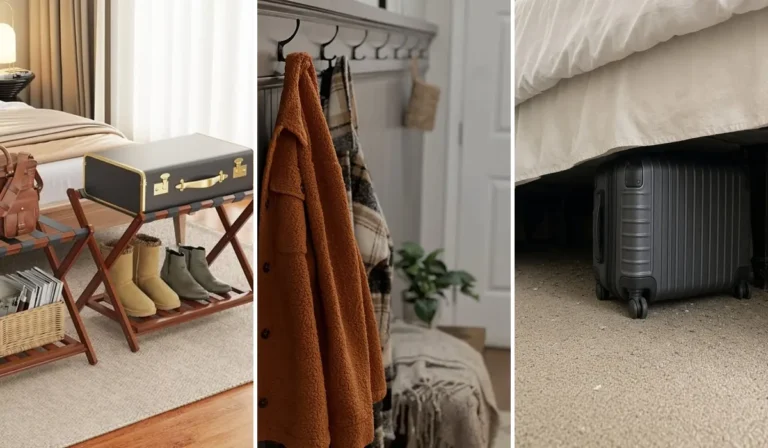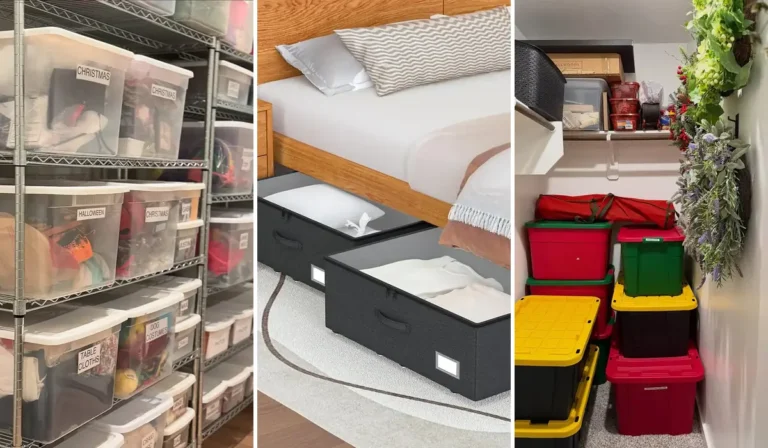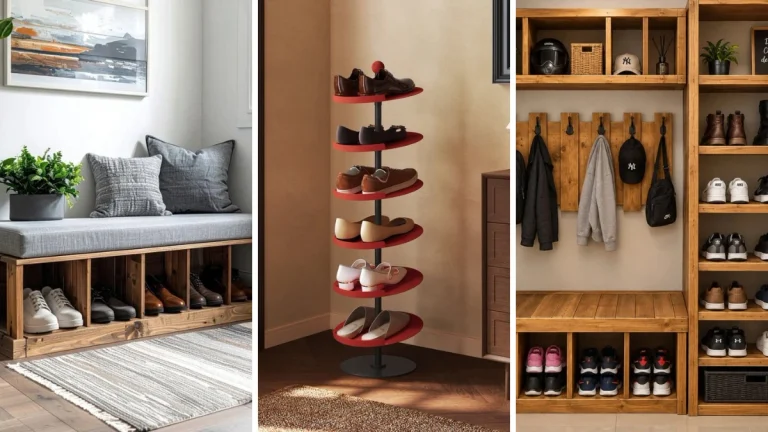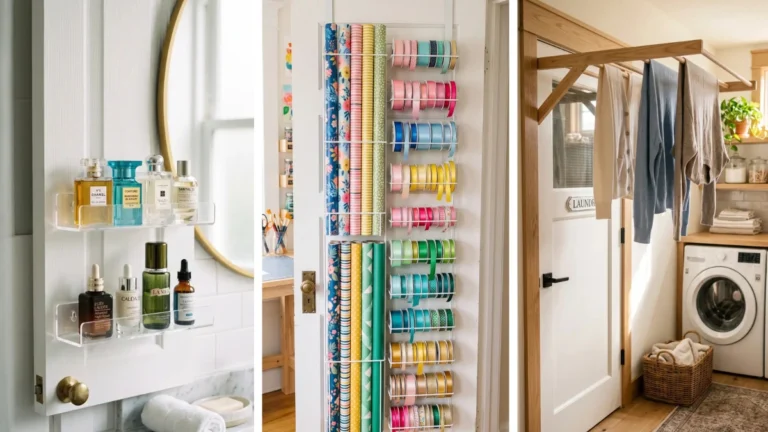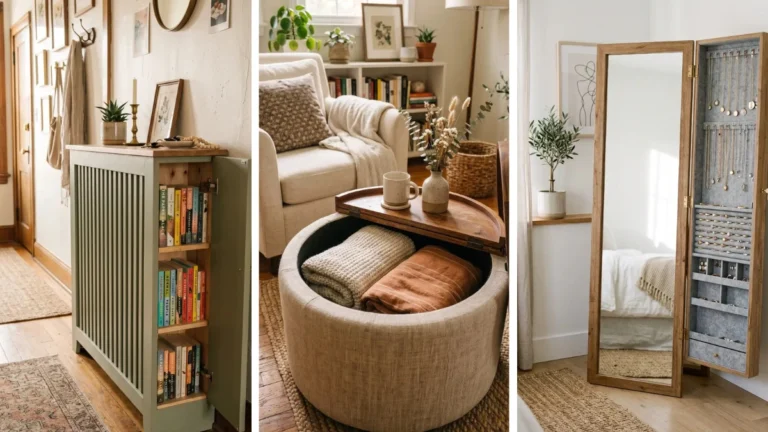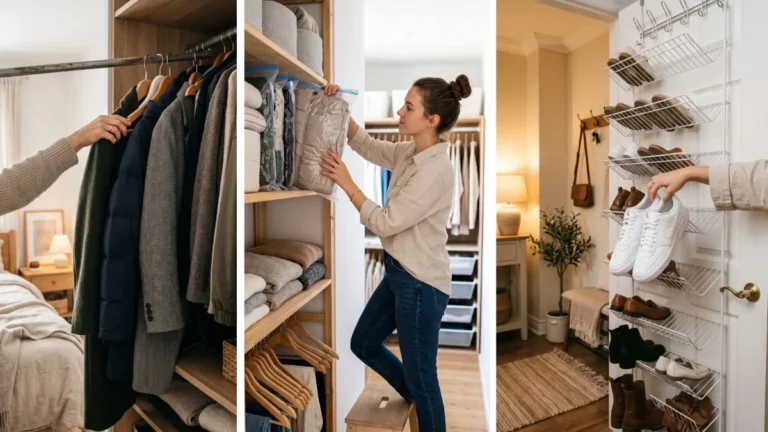
The closet gave up weeks ago, and now your clothes, shoes, and spare blankets are spilling out of the bedroom and into the hallway. This guide to under bed storage ideas turns the flat, forgotten space under your bed into the extra closet you never had: twenty-one ways to store what fits there safely, from low rolling bins to vacuum bags that flatten a winter coat. Start by measuring the gap under your bed. Everything else follows from that number.
1. Low Rolling Bins With Lids for Off-Season Clothes
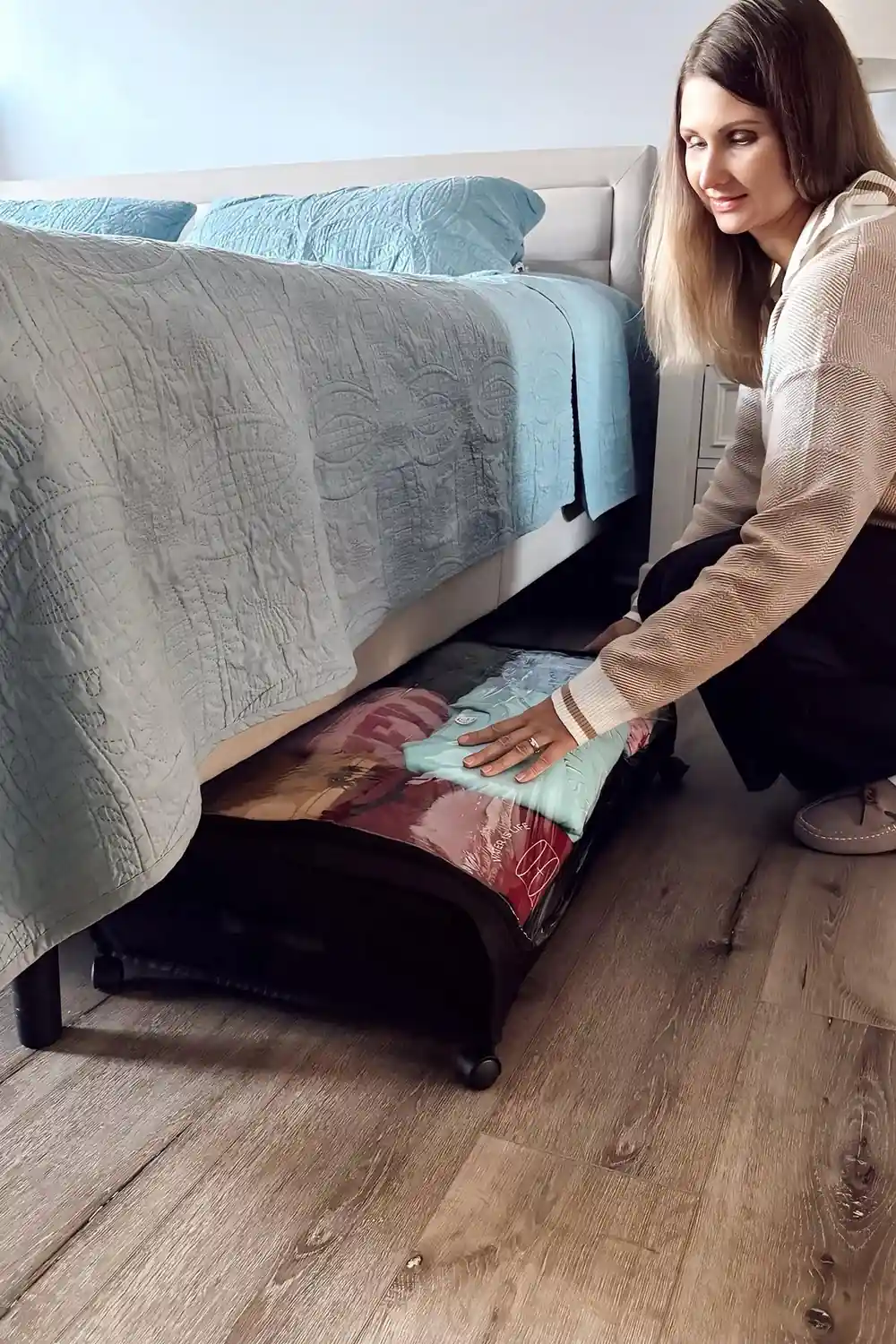
Your closet gave up weeks ago. The rail is packed shoulder to shoulder, the top shelf holds a leaning tower of sweaters, and the heavy coats you will not need until the cold returns are still taking up the middle of it all. A low rolling bin slides that problem out of sight, where you sleep.
Fold each piece flat, stack it in neat rows, and snap the lid shut before you roll the bin away. Label the end you can see from the doorway, and keep one bin per season so you never dig through summer tops to find a winter sweater. When the weather turns, pull the bin out, swap its contents with the clothes you are putting away, and roll it back in under the bed.
Quick Tip
Measure the gap under your bed before you buy, then pick a bin at least an inch shorter so the wheels roll freely and the lid never scrapes the frame. Roll the bin out over a rug or a folded towel if your floor is bare wood, so the wheels stay quiet and the floor stays free of scuffs. Keep the lid on even when the bin is half full, since dust settles fast in that low, still air.
Best for: off-season sweaters and coats · Cost: low · Effort: under an hour
2. Vacuum-Seal Bags That Flatten Bulky Winter Coats

Your heaviest winter coat eats half the closet while the lighter jackets you reach for every day get squeezed behind it. A vacuum-seal bag takes that bulk down to a flat slab you can slide out of sight until the cold returns.
- ☐ Wash and dry each coat fully, then fold it flat with the sleeves tucked in.
- ☐ Slip one coat per bag so the seal closes without straining.
- ☐ Zip the edge twice, then press along it to check for gaps.
- ☐ Suck the air out with a vacuum or hand pump until the bag stops shrinking.
- ☐ Slide the flat bag into its box and note what is inside on a small label.
Before You Seal the Bag
Empty every pocket and close every zip so nothing sharp pokes the plastic.
Fold the sleeves in and keep the bag flat, not rolled, while you seal it.
Run a finger along the zip twice: a crumb or a fold in the seal lets air creep back in.
Check the bag again the next day. One that has puffed back up needs a fresh zip and a second pass with the vacuum.
3. A Rolling Shoe Tray That Slides Out Like a Drawer
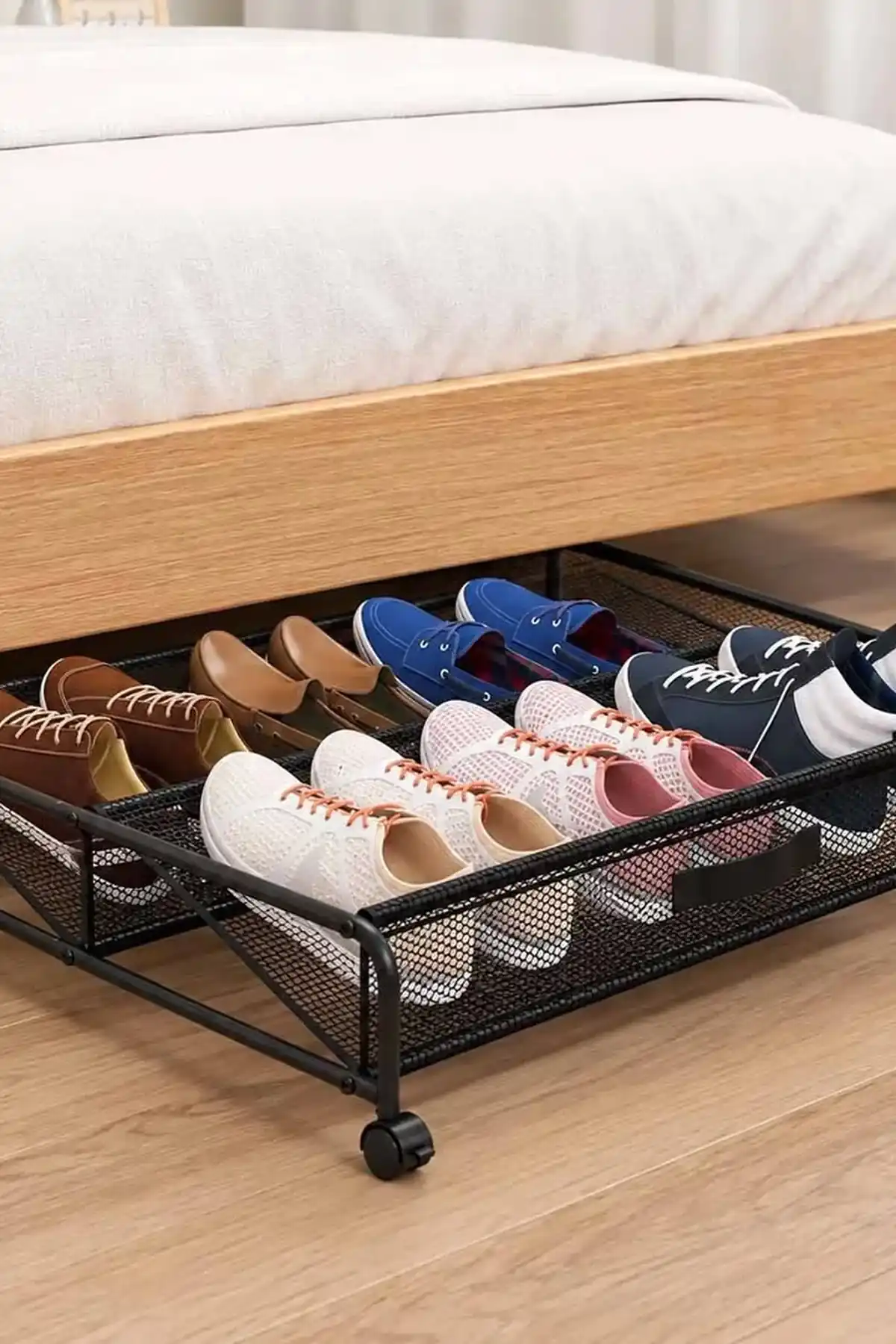
The shoe pile by the door grows a pair at a time until finding the right ones means digging through the heap every morning. A low rolling tray gives those everyday pairs a home that slides out like a drawer, so the pair you need is the pair you see.
- Measure the gap from the floor to the underside of your bed frame, then pick a tray at least an inch shorter so the wheels roll free.
- Load the tray with the pairs you wear most, toes facing out, one pair per slot so nothing stacks or hides.
- Slide it in after each wear and pull it straight out when you dress, keeping the front edge lined up with the bed frame so it never snags the bedding.
Set It Up in Three Moves
Measure first: floor to the underside of the frame, then subtract an inch for the wheels.
Pick a low tray with a front handle and four swivel casters, so it rolls straight out without tipping.
Park everyday pairs at the front and out of season pairs at the back, so the shoes you reach for are the first ones you see.
4. Clear Bins So You Can See What Is Inside
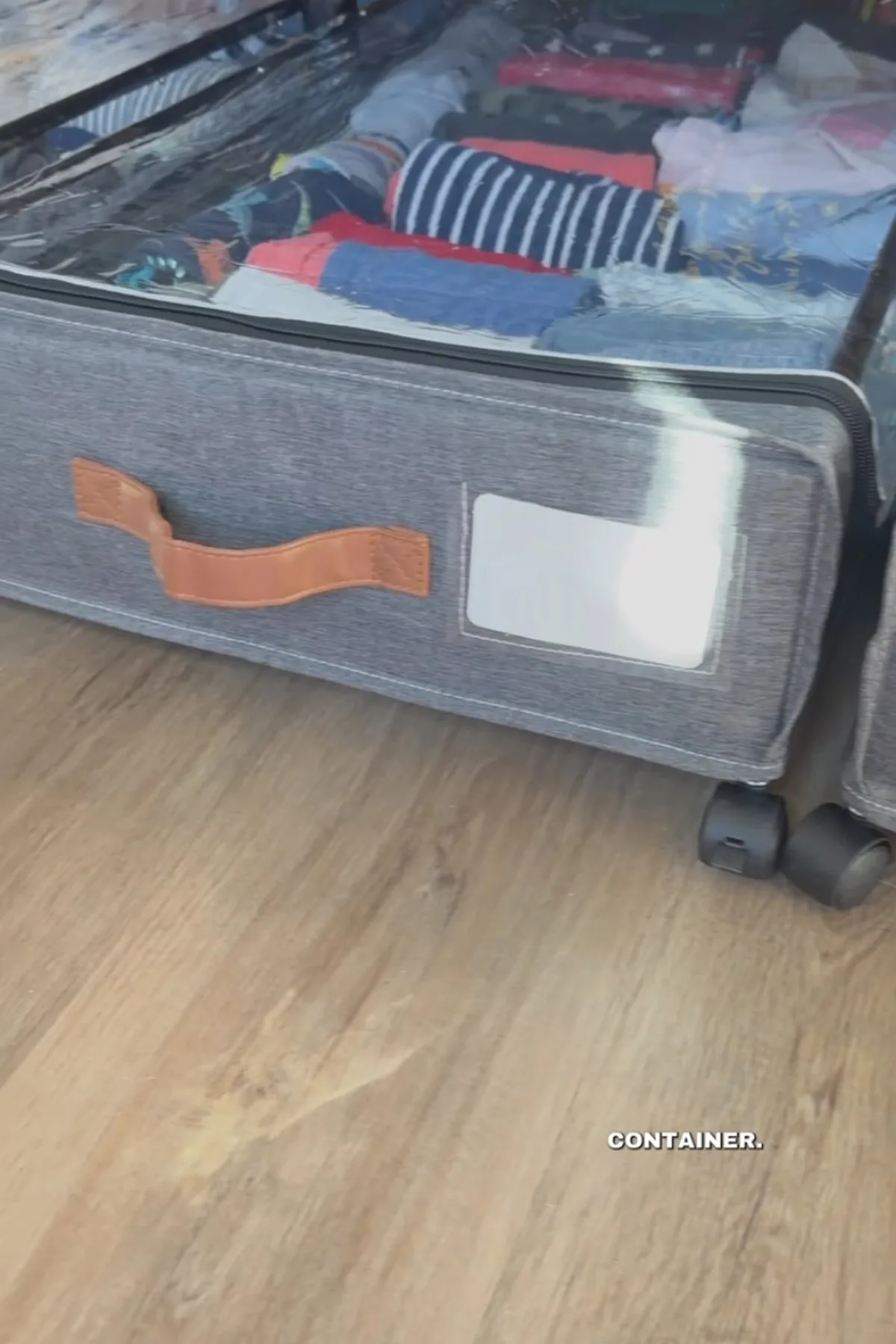
Your third time opening the same bin for one grey sweater is the moment solid plastic stops making sense. A clear bin lets you spot the sweater through the lid, so the hunt takes seconds instead of an unpack on the floor.
Do: roll clothes so each roll shows its colour through the lid. Do: keep one kind of thing per bin, most-used nearest the edge. Do: wipe the lid; a dusty lid hides as much as a solid one.
Don’t: pack a bin to the brim, or the contents press on the lid into a jumble. Don't: mix seasons in one bin, or you will open three bins for one sweater.
Clear Bins vs Solid Bins
| Clear bins | Solid bins | |
|---|---|---|
| Finding things | Spot contents through the lid without opening | Open each bin to check what is inside |
| Dust | Lid keeps dust off clothes; wipe the lid to keep the view | Lid keeps dust off clothes too |
| Looks | Neat rows show; loose packing shows as well | Hides clutter; plain from the outside |
| Cost | Often a little more than solid bins | Usually the cheapest option |
Rule of thumb: go clear for the bins you open weekly, and solid for the ones you open once a season.
5. Soft Fabric Bags With Handles for Spare Sheets
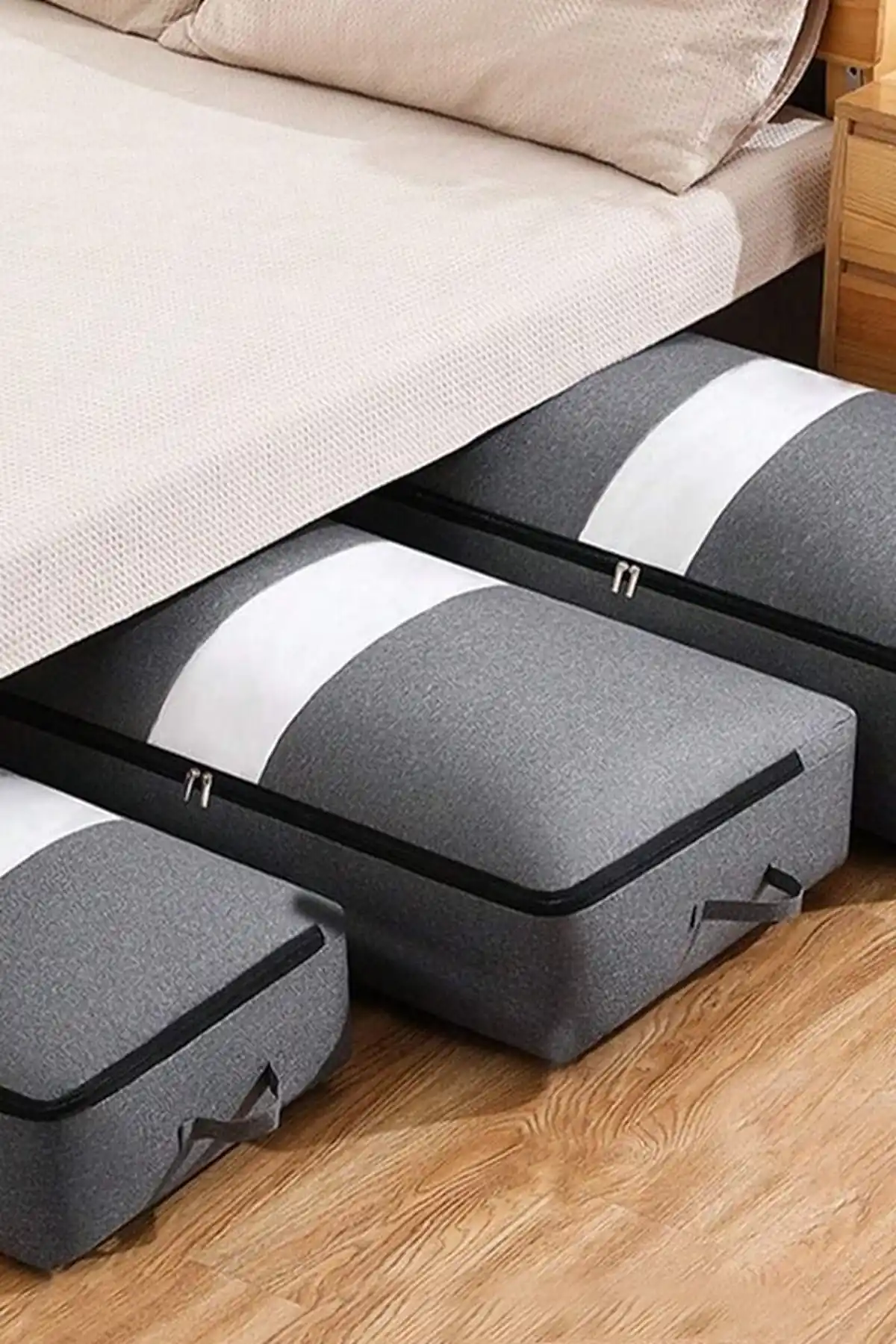
The spare sheets live in a wobbly stack on top of the wardrobe, and every reach for the fitted sheet sends the pile sliding toward you. A soft fabric bag with handles gives that stack a home that slides out of sight and pulls back out with one hand. Fold each set with its pillowcases tucked inside, and label the end.
Pro: the handles let you pull a full bag out without dragging it across the floor.
Pro: a zip top keeps dust off bedding, and the bag folds flat when empty.
Con: sides sag when the bag is half full, so a loose pack can slump and snag.
Con: you cannot see inside a plain bag, so label the end or you will open two to find your sheets.
Picking the Right Fabric
- ▸ Cotton canvas breathes, so sheets stay fresh; vinyl fronts trap damp air, so skip them in a humid room.
- ▸ Non-woven polypropylene is light and cheap, but it holds moisture, so air the bag out between swaps.
- ▸ A clear window or a sewn-on label saves opening every bag to find one set.
- ▸ Stitching at the handles takes the strain first, so check it before you load a bag full.
6. Bed Risers That Buy You Taller Bins
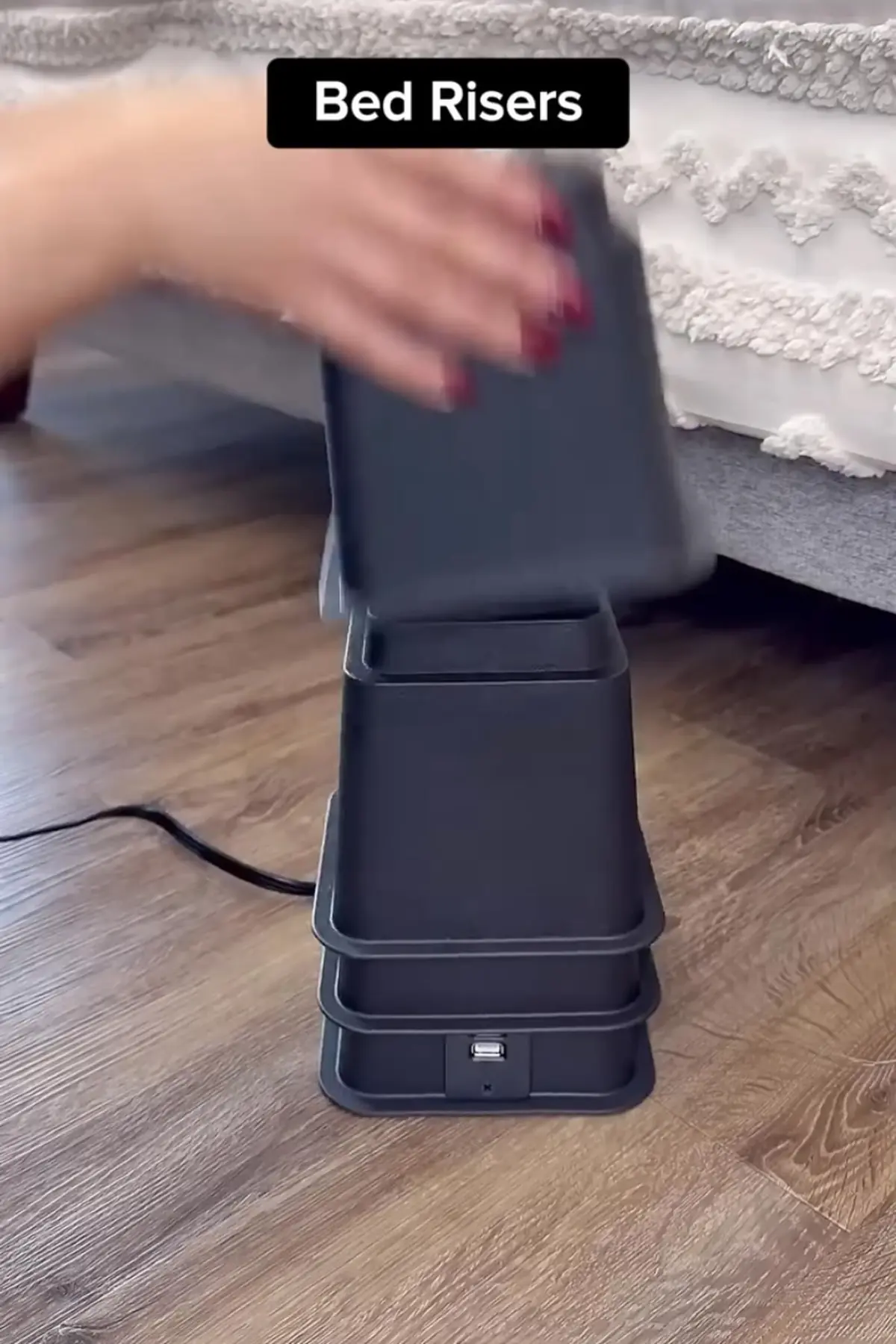
Six inches of wasted space sit under your bed right now, too shallow for the bins you want to use.
Q: How much height do risers add? A: Most sets lift the frame a few inches. Measure your bin first, then pick the lift that clears it by about an inch.
Q: Will the bed feel wobbly? A: Not if the risers fit the legs. Match round legs to round cups and square legs to square cups, set all four corners, then press each corner and check for rocking before loading anything underneath.
Q: What fits once the bed is up? A: Taller lidded bins that hold folded sweaters or spare sheets. Keep the heavy ones toward the back so the front stays easy to reach.
What risers add
A few extra inches of clearance under the frame, enough to move from flat bags to bins with real depth.
What fits after
Taller lidded bins for folded sweaters, spare sheets, and shoes, sliding out without a fight.
What to check first
Leg shape against the cup, all four corners level, and a firm press test for rocking before you load the bins.
7. A Zippered Flat Garment Bag for Suits and Dresses
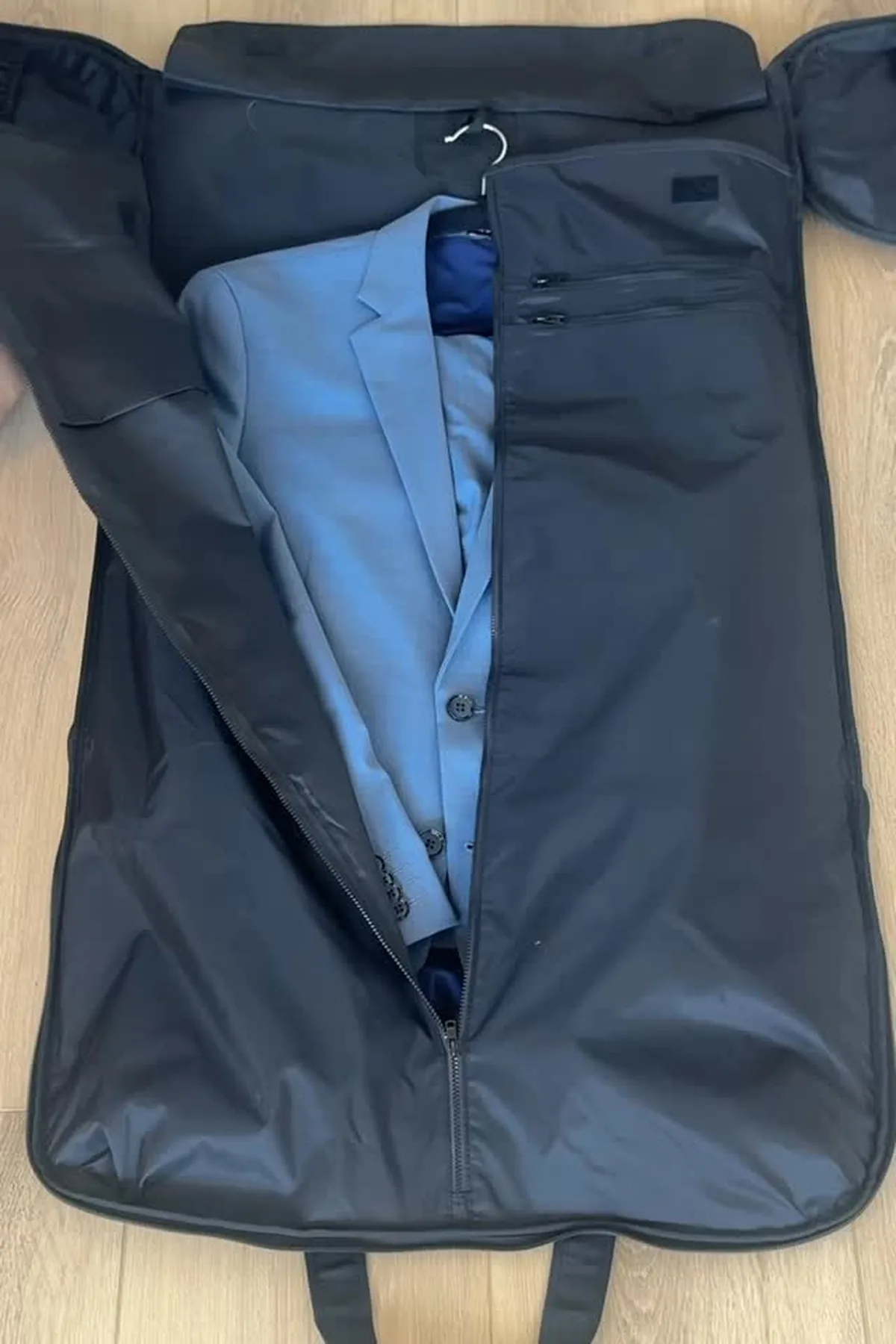
Your best suit comes out of a folded pile with a crease pressed right down the front, and the dress you saved for a wedding looks tired before you even put it on.
A zippered bag made for lying flat gives each piece its own smooth layer, so nothing folds against itself and nothing gets crushed by the stack above it.
| What goes in | How to fold it | How to keep it flat |
|---|---|---|
| One suit or two light dresses | Fold once at the waist, sleeves tucked in | Slide the bag in on its own, with nothing stacked on top |
| A heavy wool suit | Button it, then fold the trousers over the jacket | Keep the zipper side up so the bag pulls out by its handle |
BEFORE
The creased pile on the closet shelf
Your suit sits at the bottom of the stack, its folds pressed in by everything above it, while dust settles on the piece on top. You dig through the pile to reach one dress and disturb the rest.
Check: if the pile is taller than your hand is wide, the pieces at the bottom never stay smooth.
AFTER
The flat zippered bag sliding under the bed
The bag zips shut around one smooth layer, the handle sits at the end you reach for, and the whole thing slides out without dragging the rest of the room with it.
Check: slide the bag in empty first to test the fit, then fill it once you know it clears the frame.
8. A Lockable Flat Box for Documents and Valuables
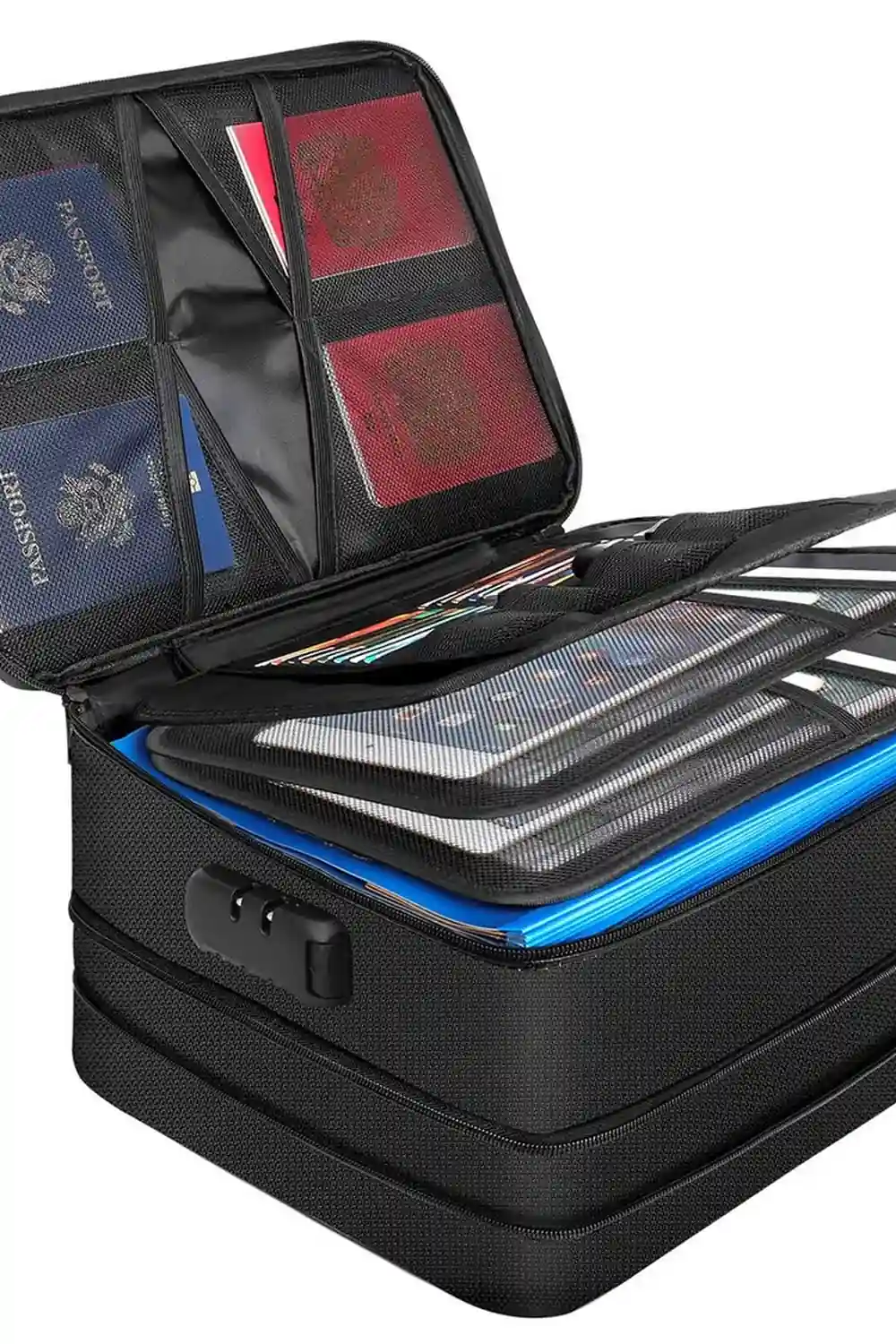
Your folder of papers has no safe drawer of its own, so it ends up balanced on a shelf, tucked behind books, or buried in a pile you swear you will sort one day. A flat box with a lock gives those papers a fixed address: passports, deeds, and spare keys live in one place, closed and latched, where only you can open it. Because the box is low and flat, it slides beneath the bed and out of sight, and the lock means a guest, a cleaner, or a curious child cannot flip it open by accident.
Tip: Keep a short list of what is inside taped to the lid, so you can find a document without opening the box and shuffling through everything.
9. A Rolling Craft Caddy for Hobby Supplies
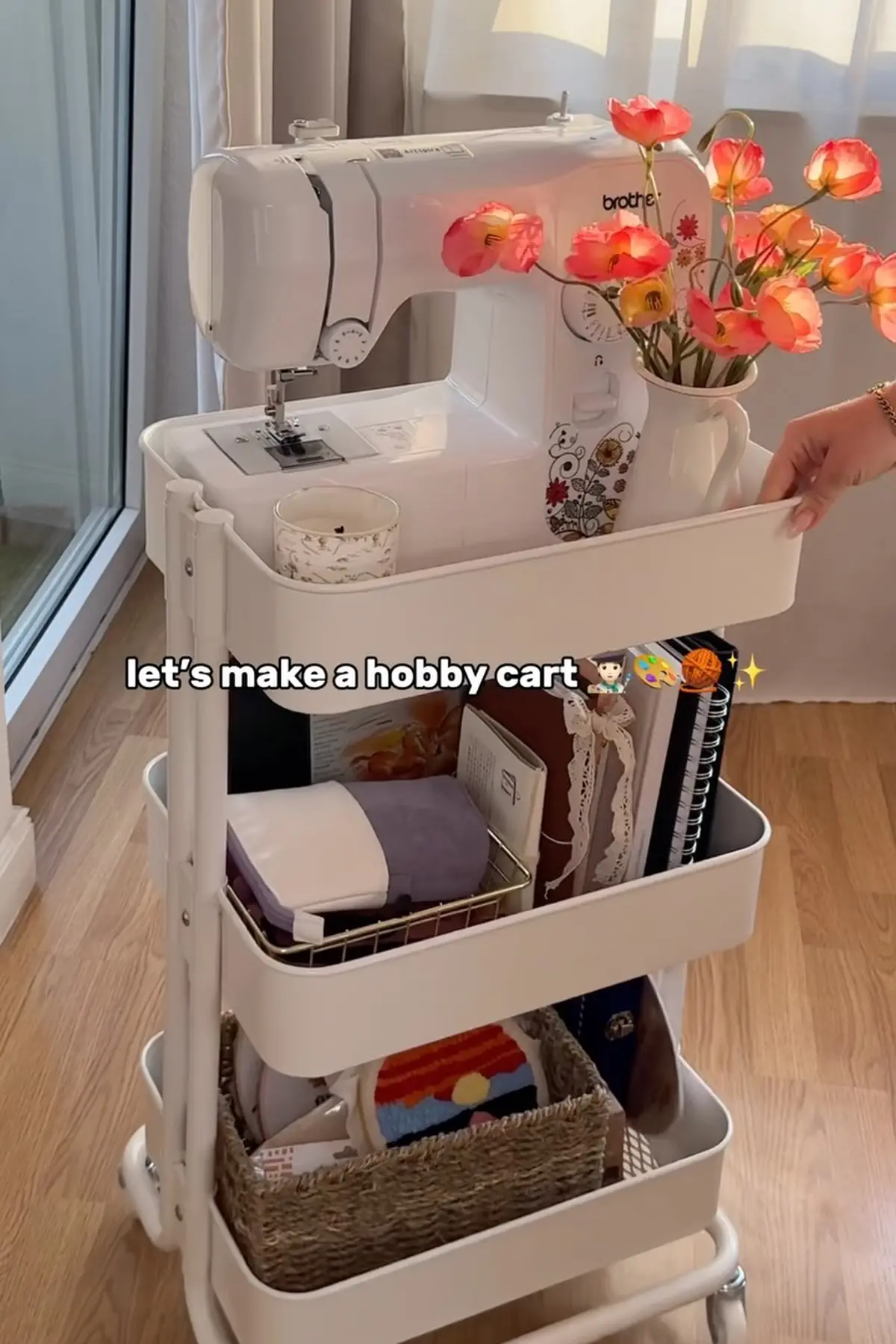
Yarn, paint tubes, and half-finished projects have taken over the dining table again, and clearing them away every night eats into the little crafting time you have. A slim rolling caddy gives every supply a fixed shelf, so you wheel the whole hobby to the table, work, and wheel it away when dinner needs the space.
Give the top tier to the project you are working on now, the middle to tools you reach for often, and the bottom to bulky extras like fabric and yarn. Measure the gap beneath your bed frame before you buy, since a tall three-tier cart only slides away under a raised bed, while a low caddy fits a standard frame.
Do this
One project per tier, heaviest supplies at the bottom so the cart rolls steady.
Lock the wheels once it is parked, so it stays put when you pull a drawer or tier.
Skip this
Piling loose supplies on the top tier, where they slide off every time you roll it.
Buying the cart before you measure the gap beneath the bed frame.
10. Flat Boxes for Handbags, Belts, and Accessories
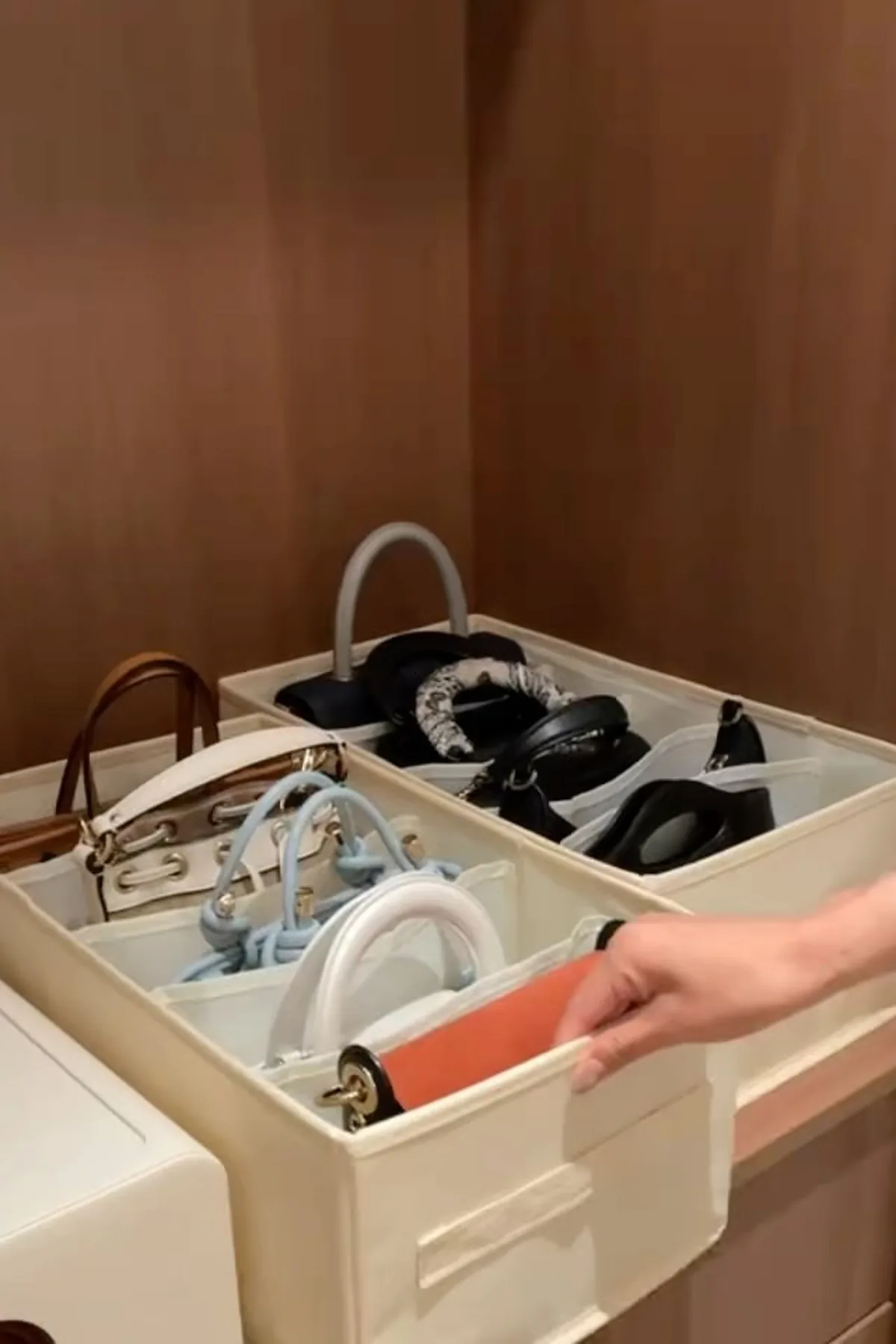
Your handbag collection has colonised the closet shelf, one tote leaning on the next until nothing stands upright and the bag you want is always at the bottom of the pile. A low, flat box with dividers gives every bag its own slot, so the pile becomes a row you can read.
- Measure the clear height beneath your bed frame, then pick a box that slides in with a finger of room to spare.
- Stand each bag upright in its own divider slot, handles up, with belts rolled along the front edge and clutches in the last slot.
- Label the end of the box, then slide it in handles first so you can pull it out and grab the bag you want without unloading the rest.
WHY THIS WORKS
Bags kept upright in their own slots hold their shape, so the tote you reach for comes out looking the way it went in, and you stop replacing bags you already own but could not find.
11. A Bed Skirt That Hides the Bins

The bins look fine to you because you packed them and you know what is in each one. Then a friend walks in and spots the plastic lids beneath your mattress. A bed skirt ends that moment. It hangs from the mattress base to the floor, so the room reads as finished while the bins stay put.
- ☐ Measure the drop from your box spring to the floor before you shop; skirts come in set lengths.
- ☐ Pick a washable fabric; the hem collects dust and scuffs.
- ☐ Leave one side easy to lift, with a split or hook-and-loop strip, so you can reach a bin without stripping the bed.
- ☐ Match the skirt to your bedding, not the wall.
“If the bed looks finished, nobody wonders what is hiding underneath it.”
Let the skirt do the hiding, and label each bin lid so you lift the skirt once, for the right bin, instead of checking them one by one.
12. Labels on Every Bin, Plus a Photo of the Contents
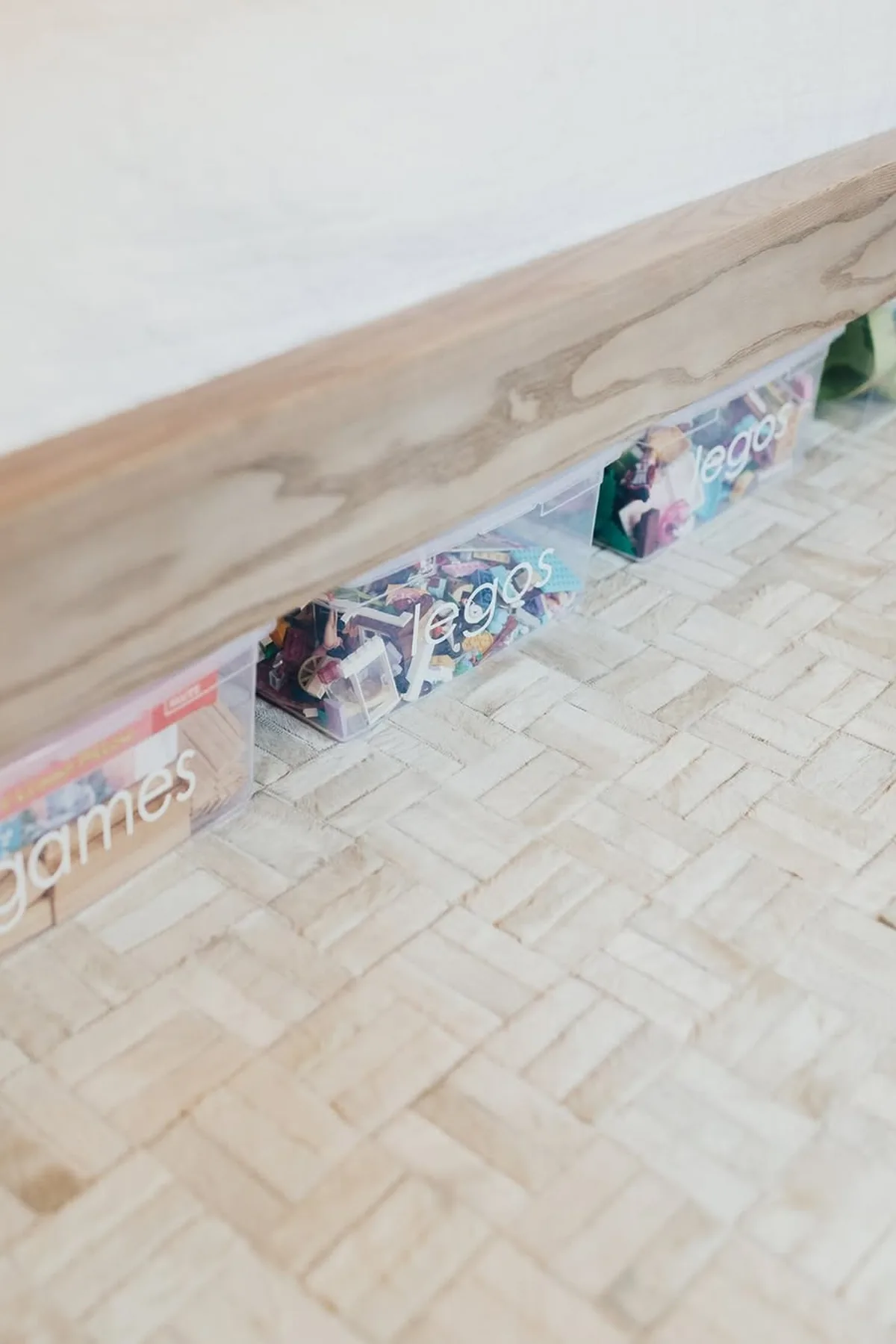
Your label maker is the cheapest organiser you will ever buy, and it earns its keep on the bins you slide out of sight. Print one short word per bin, big enough to read while you kneel, and stick it on the end facing the room. Then photograph each bin's contents with your phone and tape the photo to the lid, so you know what is inside without opening anything.
Do: label the end you see first, in plain words your household understands. Do: retake the photo every time you swap the contents.
Don’t: write a paragraph when one word will do. Don't: label the lid only, since lids get swapped between bins. Don't: trust your memory six months later, when every bin looks the same from the front.
Your bin, identified four ways
Label
One word on the end you see
Photograph
Contents shot taped to the lid
List
One line per bin in your notes
Swap
New photo each time contents change
Two checks beat one: the label tells you the category, the photo proves what is really in there.
13. Cedar Blocks and Silica Packets to Keep Things Fresh
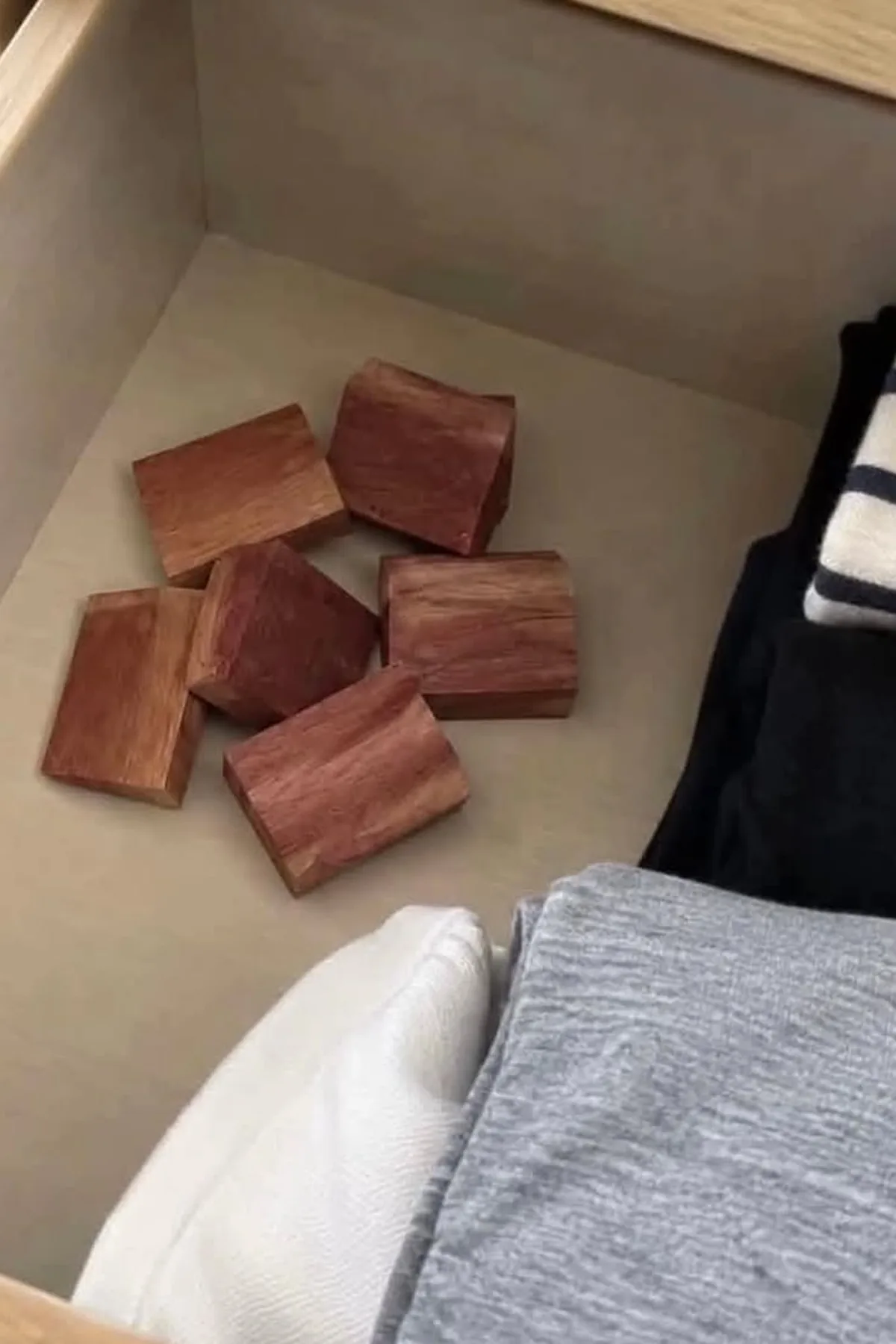
That whiff when you lift the lid at swap time tells you everything: the sweaters went in clean, yet months in a closed bin left them stale and damp. Cedar and silica fix both halves of that problem.
Q: Where do the cedar blocks go? A: In with the clothes. Tuck two or three blocks between folded layers and one near each corner, so the scent reaches the whole stack. Sand a block lightly when the smell fades.
Q: What do the silica packets do? A: They drink the damp air cedar cannot touch. Drop packets from shoe boxes into each bin, one per corner, and swap them for dry ones at each change. Keep them away from small hands and pets: the packets are not for eating.
Your swap-day routine
1. Wash and dry
Everything goes in fully dry. A fold that still holds dampness is what turns stale over the months.
2. Add cedar and silica
Blocks between the layers, packets in the corners. Write the packing date on a strip of tape on the lid.
3. Air on swap day
Open the bin a day before you need the clothes and let them breathe. Sand any faded blocks and swap tired packets for dry ones.
14. Measure the Gap Before You Buy Anything
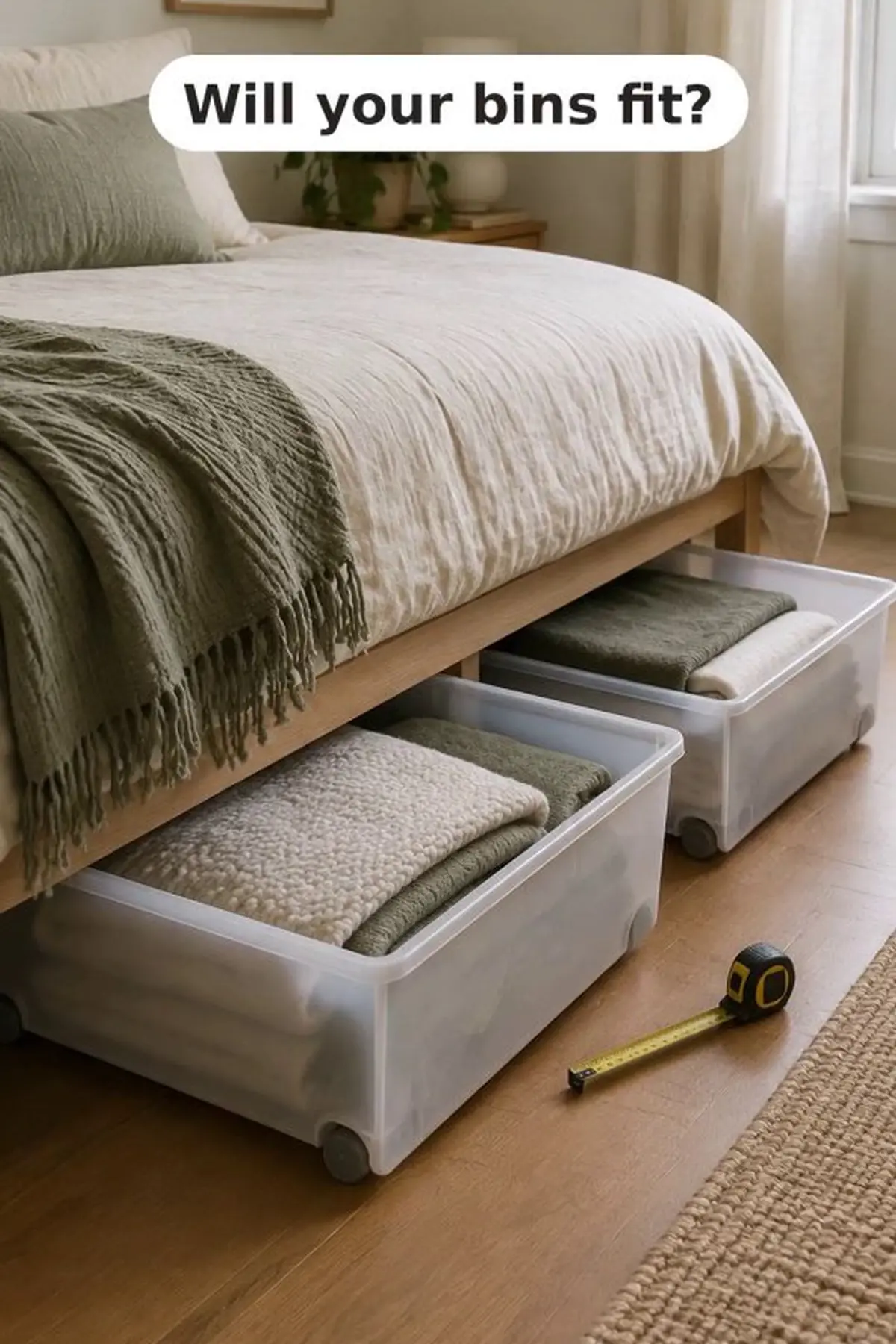
The bin that arrived one inch too tall sat in your hallway for a week before you admitted it would never slide in. Your bed frame leaves less room than your eyes guess, and a lid or a wheel can steal the last half inch. Grab your tape and measure the floor to the lowest rail, then the width between the legs, then how far back the space runs before it hits the wall or a center support. Write all three numbers on your phone and shop with them open. Tip: Measure twice, once at the head of the bed and once at the foot, since floors and frames are rarely level.
Measure the gap
Floor to the lowest rail, at both ends of the bed.
Measure the bin
Height with the lid on and the wheels down, not just the box.
15. A DIY Rolling Platform From a Board and Four Casters
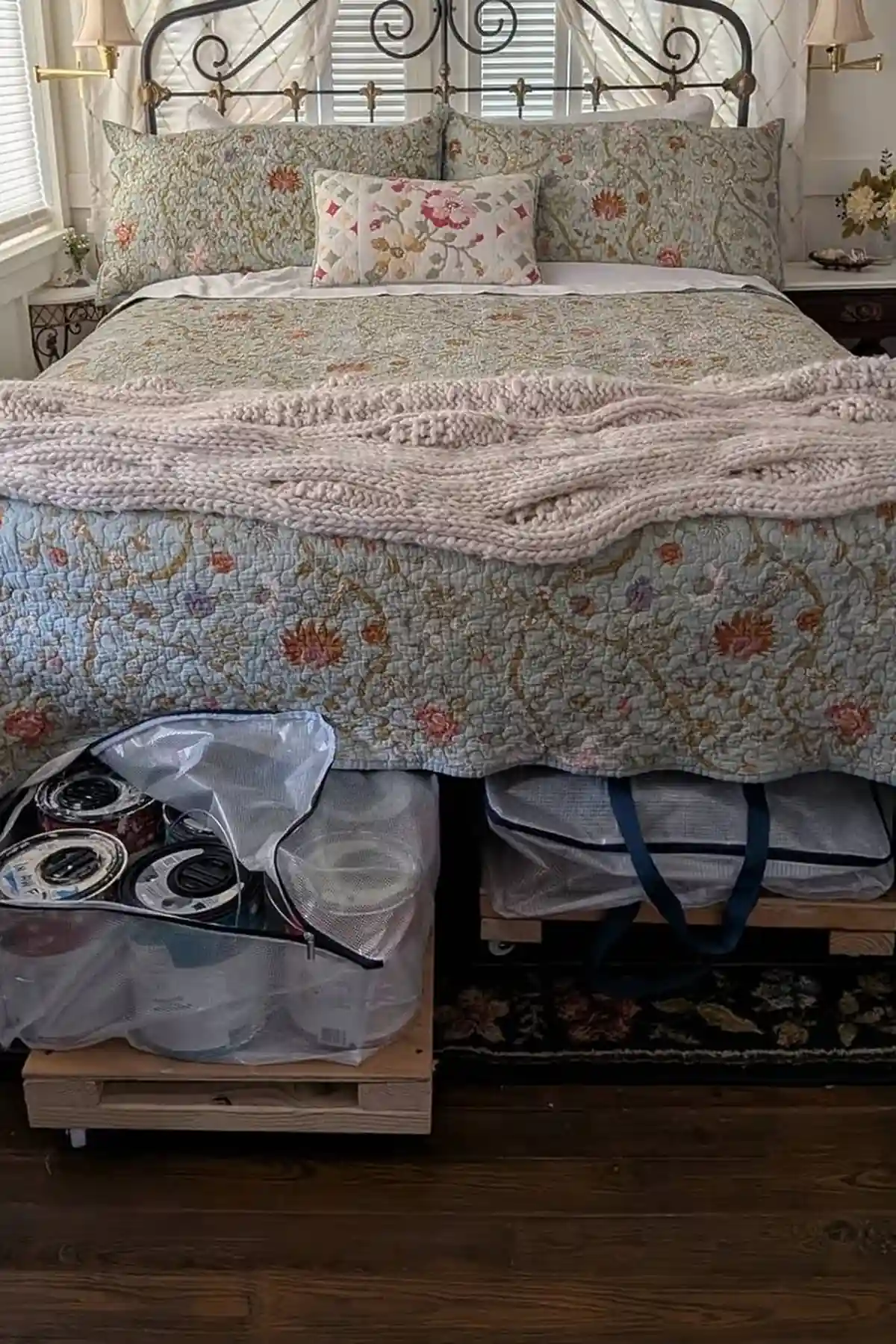
The board and casters from the hardware store are the whole project: a flat piece of plywood with four swivel casters screwed to the corners, edges sanded smooth so nothing snags your bedding. Measure the gap under your bed, then have the board cut to fit, leaving a little breathing room so it rolls out without scraping the frame.
Pro: It costs little, rolls out with one hand, and carries heavy books that would strain a fabric bag. Pro: You size it to your own bed, and it works with bins you already own. Con: A bare board has no sides, so tall items can slide off unless you add a low lip. Con: Cheap casters can mark hard floors, so pick soft wheels or add felt pads.
16. A Seasonal Swap Calendar: Two Moves a Year

Two swaps a year run the whole system, and the calendar remembers for you. Pick two weekends six months apart, one when the heavy layers stop getting worn and one when the light layers do, then keep them yearly so the swap turns into a habit instead of a project. Wash and dry everything before it goes away, fold it flat, and slide the labeled bins back where they belong. A try-on while you pack catches the pieces you skipped all season, and those go straight into a donation bag instead of into storage.
| Swap day | Moves out | Moves in |
|---|---|---|
| Late spring | Coats, heavy knits, boots, scarves | Tees, light layers, sandals, shorts |
| Early fall | Tees, light layers, sandals, shorts | Coats, heavy knits, boots, scarves |
Your swap in three moves
Pick a swap weekend. Choose the weekend after the first mild week, and block two hours so the job finishes in one sitting.
Wash, dry, pack. Launder every piece before it goes away, fold it flat, and keep one category per bin.
Label and slide back. Write the contents and the season on two sides of each bin, then slide it back where it lives until the next swap.
17. Spare Guest Bedding in One Grab-and-Go Bin
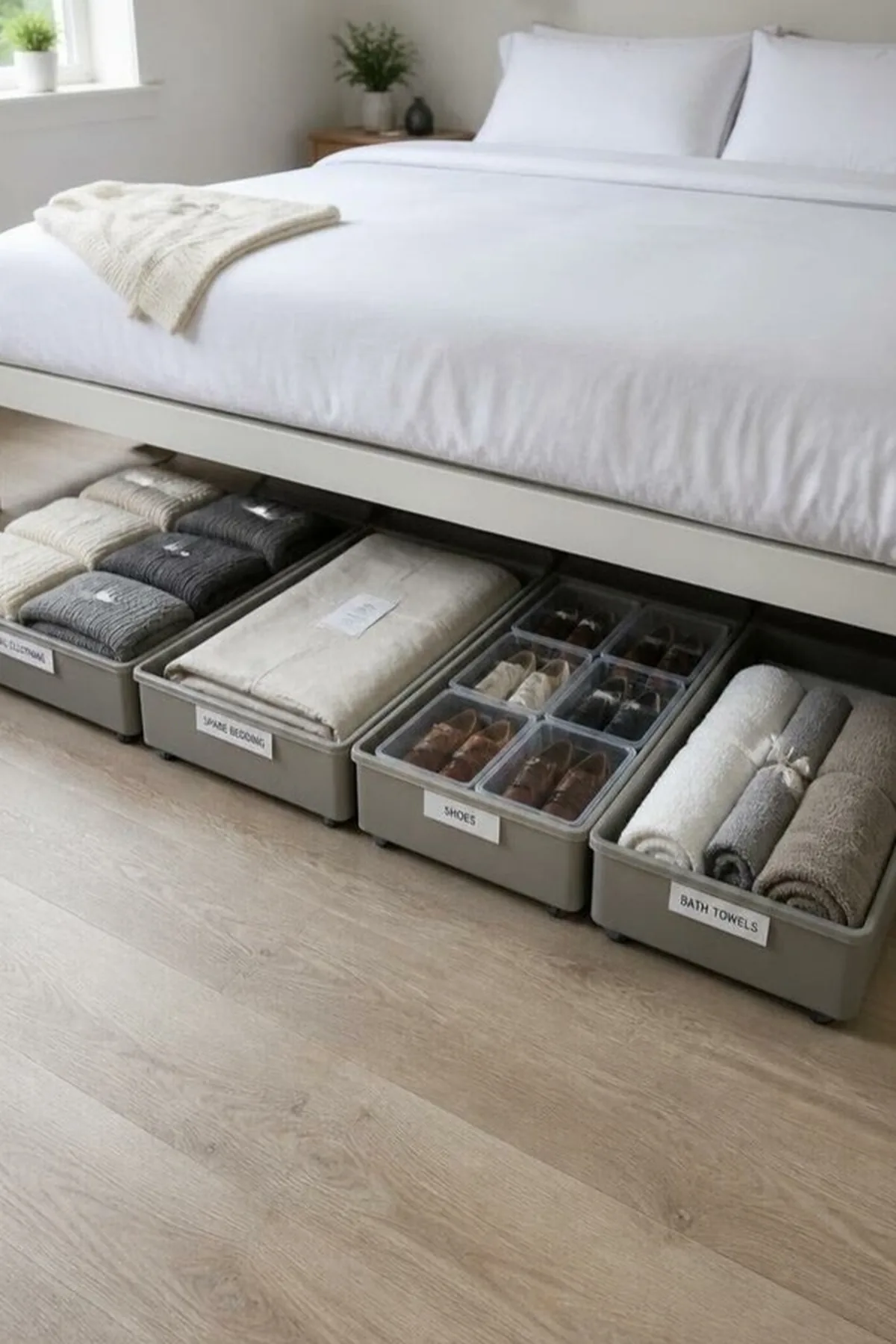
Your guest texts that they are an hour away, and you suddenly remember the spare sheets are buried somewhere in the hall closet behind the towels. You dig through the stack, find one fitted sheet with no match, and the pillowcase has gone missing entirely. One bin changes that whole scramble.
Pack a fitted sheet, a flat sheet, two pillowcases, and a light blanket into a single bin, then slide it out of sight beneath your own bed. Label the front so anyone can find it in the dark, and keep the pillow on top so the set stays together. When your guest arrives, you pull out one bin, hand it over, and the bed is made in minutes.
Full guest set
For a guest staying more than one night
Fitted sheet, flat sheet, two pillowcases, a light blanket, and a spare pillow, all folded into one bin.
Single overnight set
For one night on the sofa bed or air mattress
Fitted sheet, one pillowcase, and a light blanket, folded small so there is still room in the bin for a spare towel.
18. Open Trays for the Things You Reach For Weekly
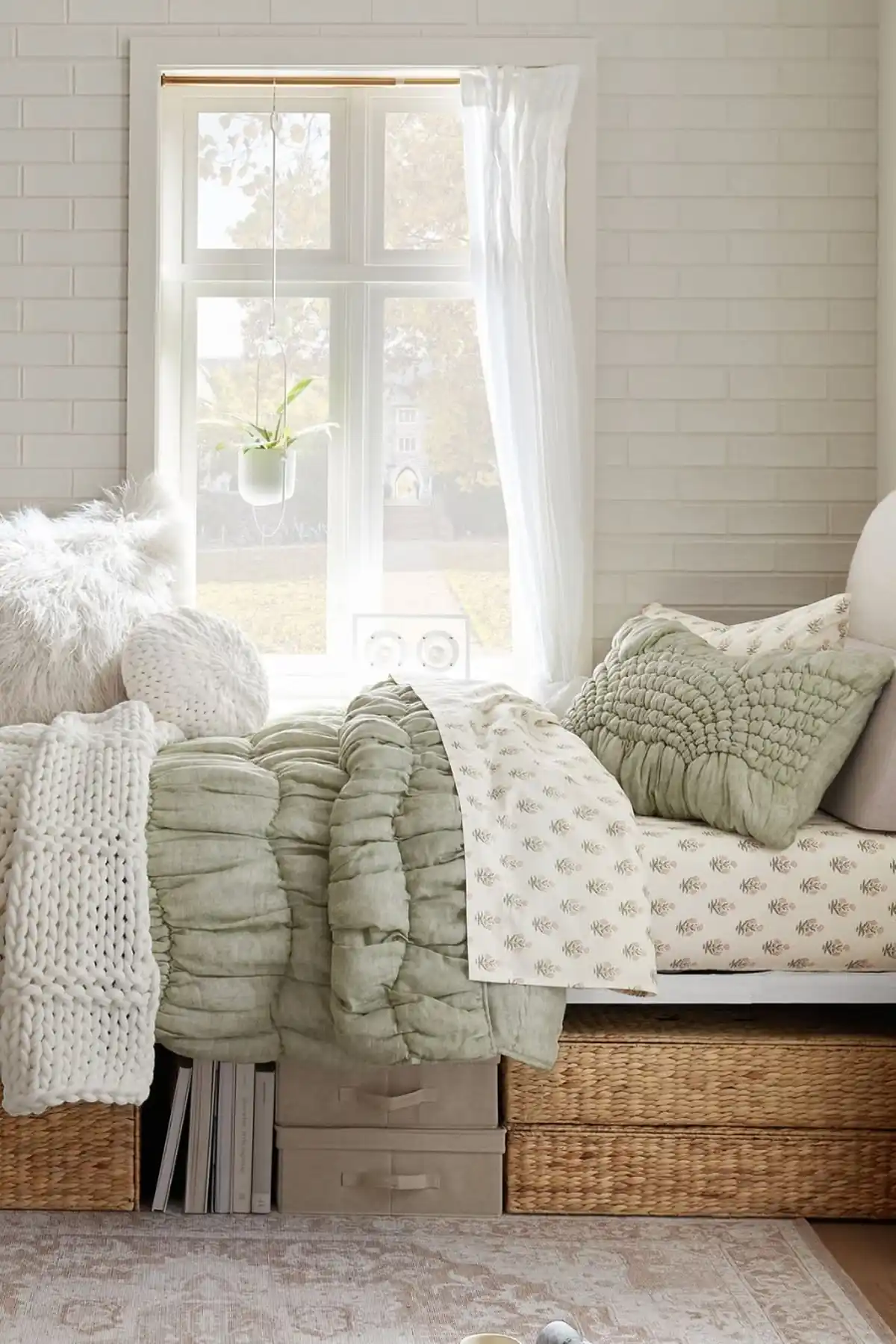
Your slippers, the book you are reading right now, and your phone charger all deserve the front spot, where your hand lands when you sit on the edge of the bed. 1. Slide one open tray to the front edge of the bed, on the side you get in and out of, and leave the deeper space behind it for lidded bins. 2. Give the tray a one-week rule: if you have not touched something in seven days, it moves to a closed box. 3. Wipe the tray out each Sunday when you change the sheets, since an open tray collects dust fast. Keep this spot for short-stay things only; anything you will not need for a month belongs in a lidded bin further back, where dust cannot reach it.
Watch Out
Dust settles on open trays fast, so wipe the tray weekly or everything in it wears a grey film.
Never put papers, photos, or anything damp in an open tray: dust plus dampness ruins them.
Keep medicines, small valuables, and anything a pet could chew out of open trays.
19. A Dust-Proof Lid Rule: Nothing Open Under the Bed
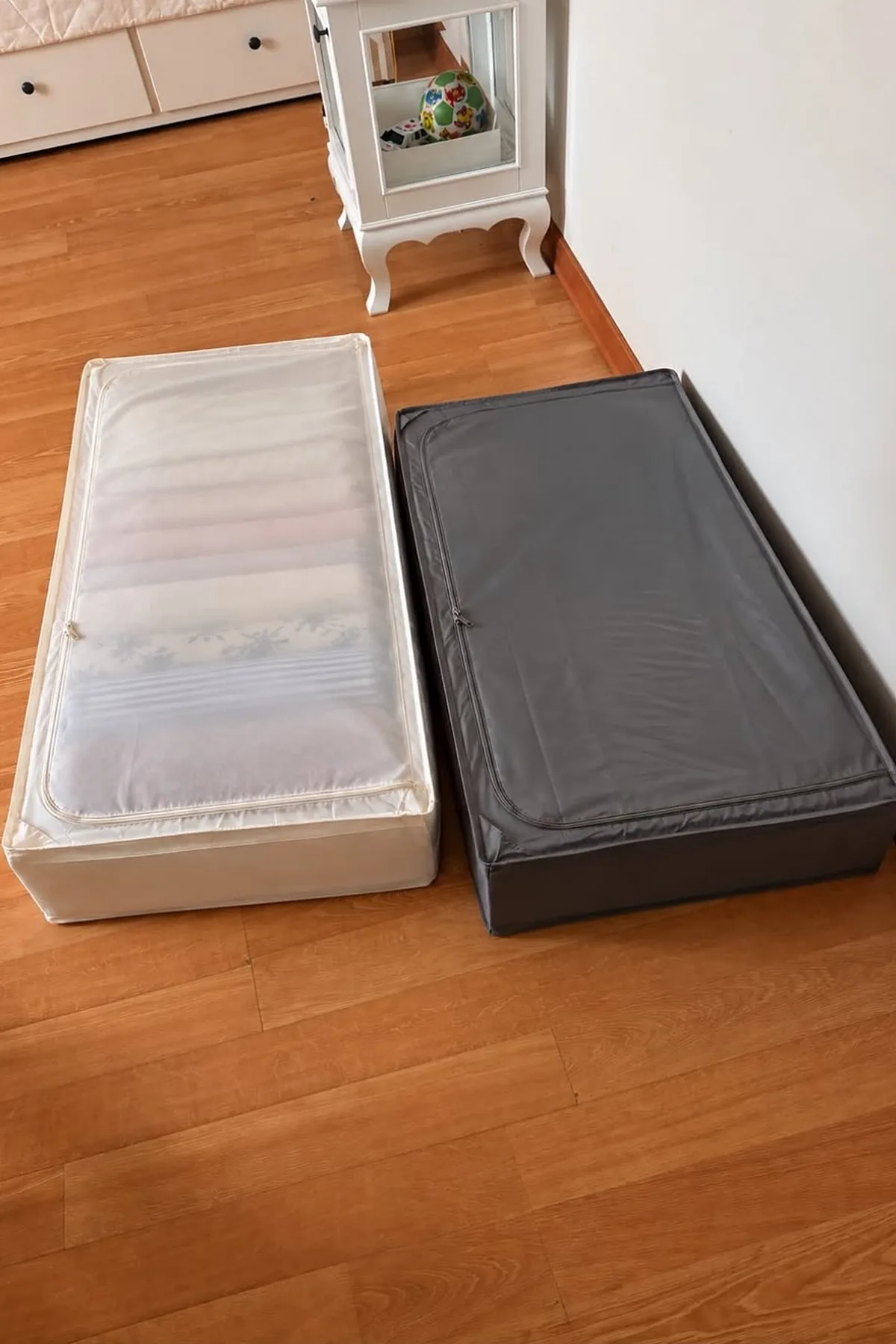
Pull one bin out after a month and look at the top of the lid. That grey film is the dust bunny census, and it settles on everything left open in that low, still air, even when the room looks clean. A lid turns that film into a wipe, not a wash.
- ☐ Put a lid on every single bin, no open tops, no exceptions for the bin you reach for most.
- ☐ Pick lids that snap or zip shut, and check the seal each time you slide a bin back.
- ☐ Wipe each lid when you pull a bin out, so dust never rides into the closet with clean clothes.
- ☐ Keep one spare lid on hand, since a cracked lid is the same as no lid at all.
Match the bin to the gap
| Gap under your bed | Bin that fits |
|---|---|
| Low frame, barely a hand fits | Flat zip-top bag, only a few inches tall |
| Standard frame, a shoebox of space | Low lidded bin that slides without scraping |
| Raised frame on risers | Taller lidded bin with room to spare |
Measure the gap first, then pick a bin a little shorter than it, so the lid never scrapes the frame when you slide it home.
20. Heavy at the Back, Light at the Front: Weight Order
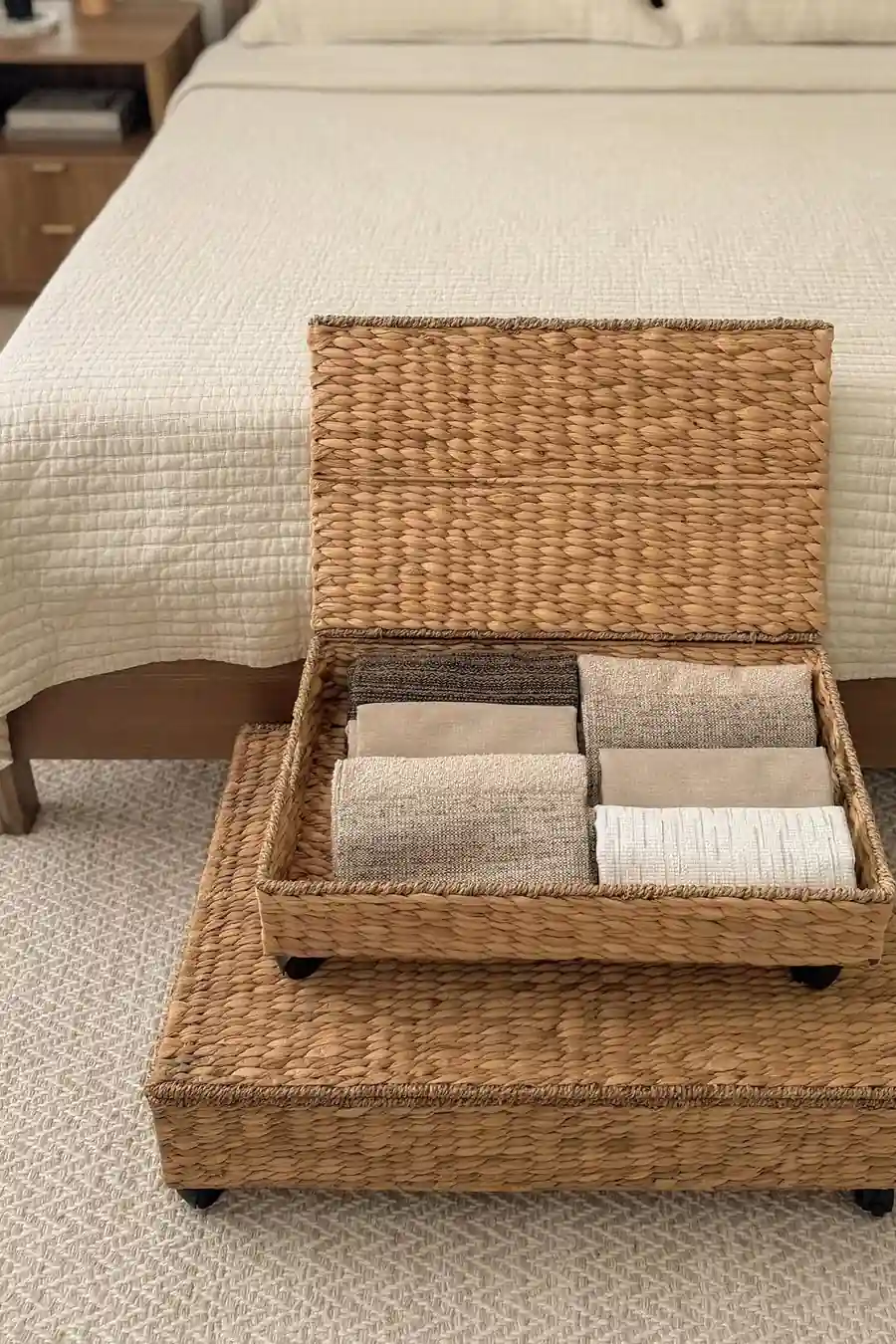
Your heaviest bin is the one that will not budge once it is full, so give it the back of the bed and leave it there. Load it with the things you reach for twice a year: spare blankets, outgrown clothes, and bulky coats.
Q: What goes in the deep bin at the back? A: The heavy, rarely used things. A full deep bin stays put for months, and you only slide it out for a seasonal swap.
Q: What goes in the shallow bin at the front? A: The light, everyday things. Spare sheets and the light layers you grab on a cold night. A shallow bin slides out with one hand, so nothing heavy ever blocks your way to it.
Where each bin earns its spot
Deep bin at the back
Holds: spare blankets, bulky coats, outgrown clothes
Moved: once or twice a year, for a seasonal swap
Lift test: needs two hands to shift when full
Shallow bin at the front
Holds: spare sheets, light layers, spare pillowcases
Moved: weekly, sometimes nightly
Lift test: slides out with one hand
Rule of thumb: if a front bin starts needing two hands, swap it to the back before it blocks the bin behind it.
21. What Never Goes Under a Bed
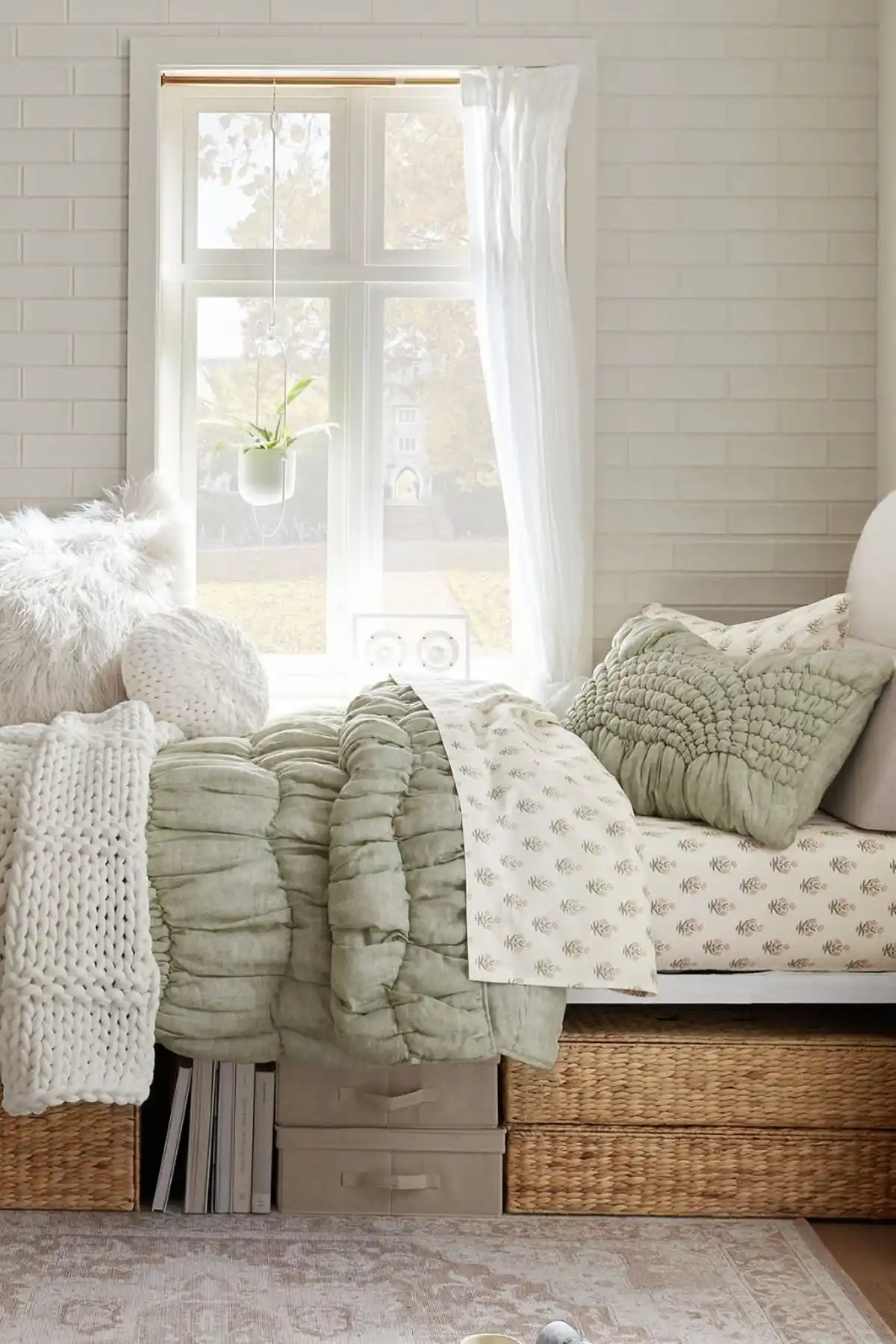
Food, damp laundry, candles, anything that leaks, heavy weights, and loose important papers all have no business in the space beneath your bed. That low, dark gap traps heat and moisture, hides spills until they stain, and makes every grab a crawl on your hands and knees.
Do: keep only sealed, labelled bins of dry, light things like spare linens. Do: slide bins out every few months to check for damp. Do: keep a small torch nearby so you can see inside. Don't: stash snacks or leftovers that attract pests. Don't: push damp clothes in there to deal with later. Don't: store candles or lighters near bedding. Don't: pile in weights or boxes you cannot lift out safely. Don't: leave passports or loose papers where a leak can ruin them.
Never store these under your bed
Five things that look harmless in a dark gap and cause real trouble later.
- ✕ Food and snacks – crumbs and wrappers invite pests into your bedroom.
- ✕ Damp laundry – wet fabric in still air turns musty and can mark the floor.
- ✕ Candles and lighters – any flame near bedding and fabric bins is a fire risk.
- ✕ Loose important papers – one small leak can ruin a passport or lease for good.
- ✕ Heavy weights and tools – dragging them out on your knees strains your back and scratches the floor.
Quick test before anything goes in: would a spill, a spark, or a damp patch ruin it? If yes, it lives somewhere else.
Frequently Asked Questions
What can I safely store under a bed?
Folded off-season clothes, shoes in trays, spare sheets and blankets, documents in a sealed flat box, and hobby supplies in lidded bins all do well down there, as long as everything is clean, fully dry, and in a container with a lid or a zip. Keep the things you reach for weekly at the front and the seasonal things at the back.
How do I keep things under a bed from getting dusty?
Use bins with lids or zippered bags, never open trays for anything you store long term. A bed skirt blocks most of the dust at the edges, and a quick vacuum of the space each time you swap the seasons keeps the rest down. Wipe the lids before you slide a bin back in.
How much clearance do I need under my bed?
Measure the gap from the floor to the lowest part of the frame, then buy bins at least an inch shorter than that number. Most low bins need six or seven inches. If your gap is smaller, bed risers add a few inches, and a flat garment bag or vacuum bag fits where no bin can.
Can I store clothes under a bed without them smelling musty?
Yes, if they go in clean and completely dry. Wash or air everything before it goes away, add a cedar block or a silica packet to each bin, and let the contents breathe on swap day. Damp clothes sealed in a bag are what cause the smell, so never pack anything straight from the laundry basket.
What should never go under a bed?
Food, damp laundry, candles, anything that leaks, and heavy weights that could damage the floor or the frame. Important papers need a sealed, lockable box, not a loose folder. If you would not leave it in a closed car on a hot day, do not leave it under the bed.
How do I organise under-bed storage in a rental?
Everything should slide, not screw in. Rolling bins, a bed skirt, bed risers, and labels are all renter friendly and leave nothing behind when you move out. Keep a phone photo of each bin's contents so you never have to drag everything out to find one thing.
That is the whole system: measure once, pick containers that slide, label everything, and swap twice a year. Under bed storage ideas work best when the space stays boring and organised, not stuffed: the things you reach for sit at the front, the off-season things sit at the back, and nothing damp, heavy, or edible lives down there at all. Start with one bin for the thing that bothers you most, the coats or the shoes or the spare sheets, and see how much closet comes back. Then add the next bin only when the first one earns its place.