
15 Small Entryway Ideas That Keep Apartments Organized
The entryway is the smallest room in the apartment.
It’s also one of the most important.
Not because it’s large — it rarely is. Not because it has impressive architecture — it usually doesn’t. But because it’s the first thing you see when you come home, and the last thing you see when you leave. It is the daily transition between the world outside and the life you’ve built inside.
When the entryway is organized — shoes in their place, bags on their hooks, keys exactly where they always are — arriving home feels like arriving somewhere that’s been waiting for you. Something in the body relaxes. The evening starts differently.
When the entryway is chaotic — shoes on the floor, bags abandoned wherever, mail in a pile, the full accumulated evidence of every rushed departure — even the most beautiful apartment beyond it suffers.
The entryway doesn’t need to be large to work beautifully. It needs to be intentional.
Whether you have a dedicated entry room, a narrow hallway strip, or simply a corner beside the front door — these 15 ideas create a drop zone that functions flawlessly and looks genuinely welcoming.
Save this. Your front door deserves a better first impression.
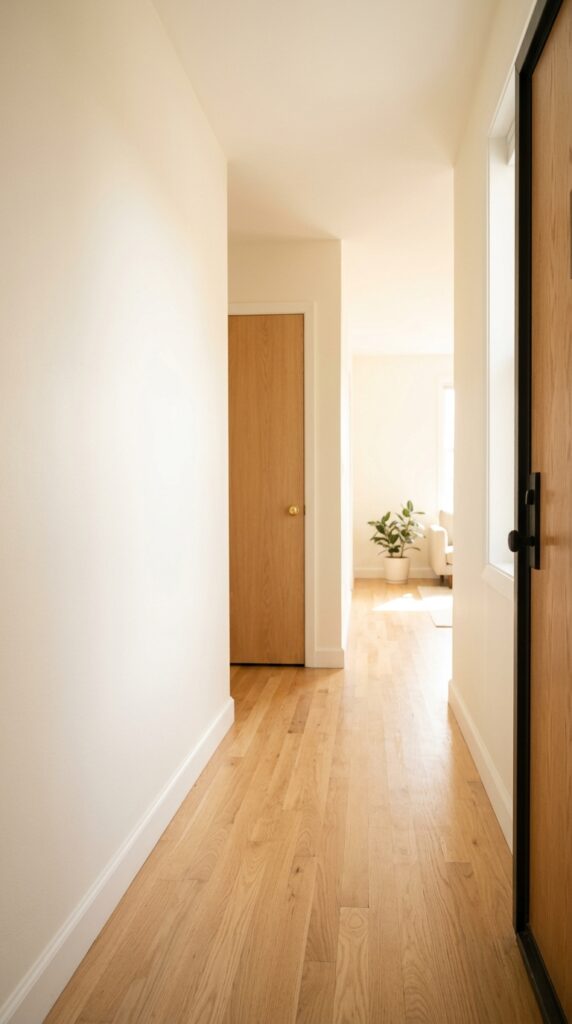
1. The Entryway Edit — Less Is Always More Here
The entryway is the room where the minimalist principle applies most urgently — because it has the least space to forgive accumulation.
Before installing a single hook or purchasing a single basket — edit.
The edited entryway creates the organizational foundation. Every system installed after the edit works better — because it’s serving fewer items.
The entryway that holds less functions more beautifully than any entryway that holds more.
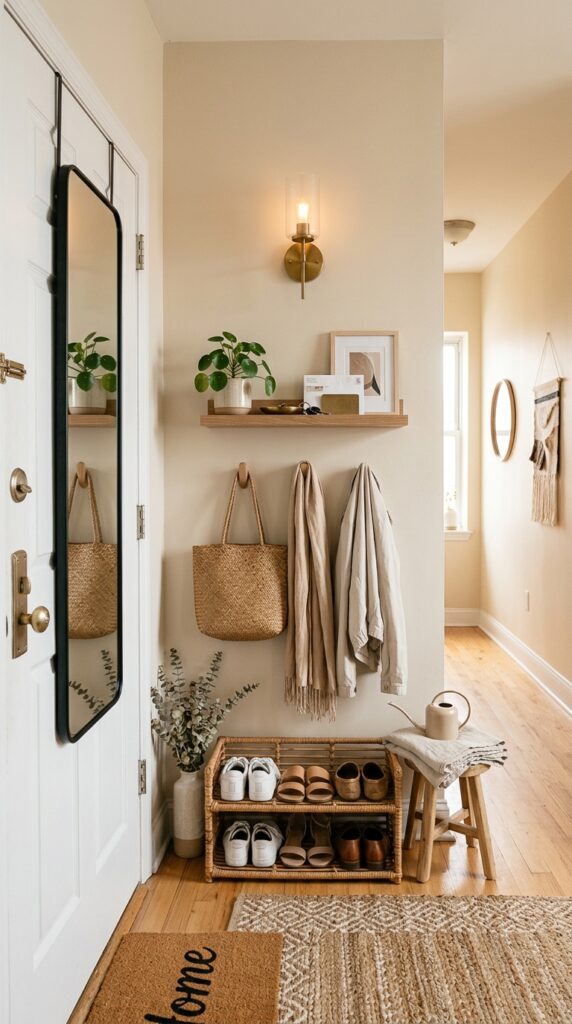
2. The Floating Shelf System
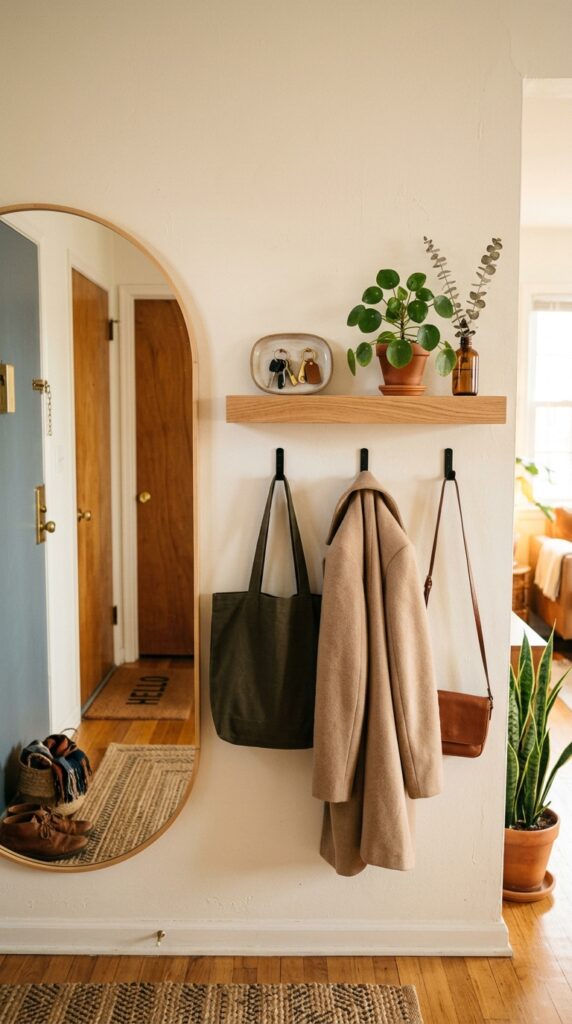
The most space-efficient entryway solution available — because it takes nothing from the floor.
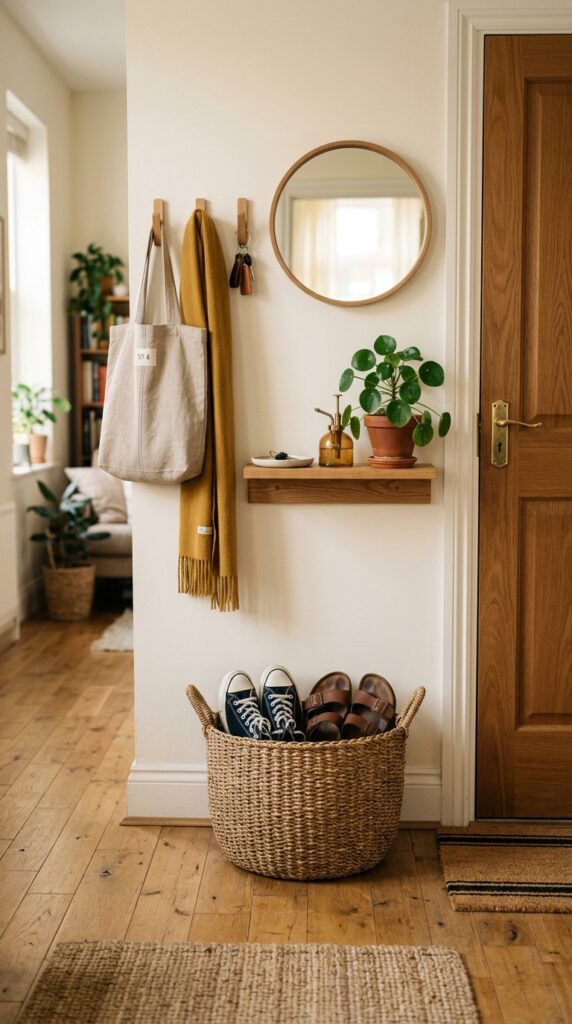
A floating shelf mounted at shoulder height on the entryway wall creates the surface, the display moment, and the organizational foundation of a proper entryway — in eighteen inches of wall space and zero inches of floor space.
For the smallest entryways:
This entire system — one shelf, three hooks, one mirror — fits in twenty-four inches of wall width. It replaces the function of a console table, a hook rail, and a mirror stand — without touching the floor.
A floating shelf with hooks below is the complete entryway system in zero square feet of floor space.
3. A Hook Rail That Works for Everyone
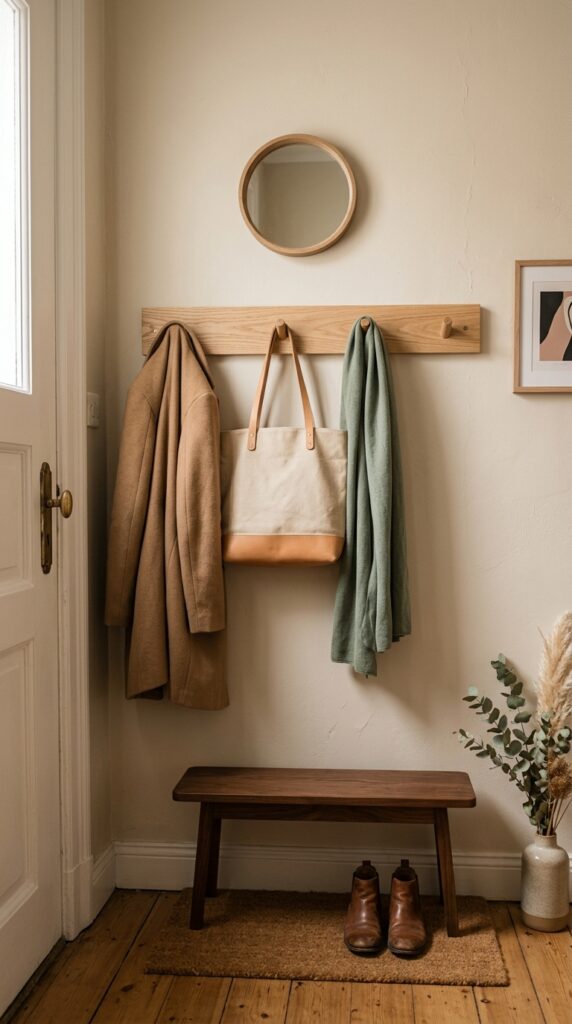
The hook rail is the single most functional piece of entryway hardware — and the one most worth investing in properly.
Not three hooks randomly placed. A proper rail — wood or metal, spanning the relevant wall section — with individual hooks spaced to hold everything the entryway needs to hold.
When hooks are crowded — items stop being returned to them. The system breaks. The floor accumulates.
One hook. One item. One consistent habit.
A hook rail works when every hook has one designated item. The moment hooks share — the system starts failing. Also Read: Small Space Living Ideas
4. The Narrow Console Table Moment
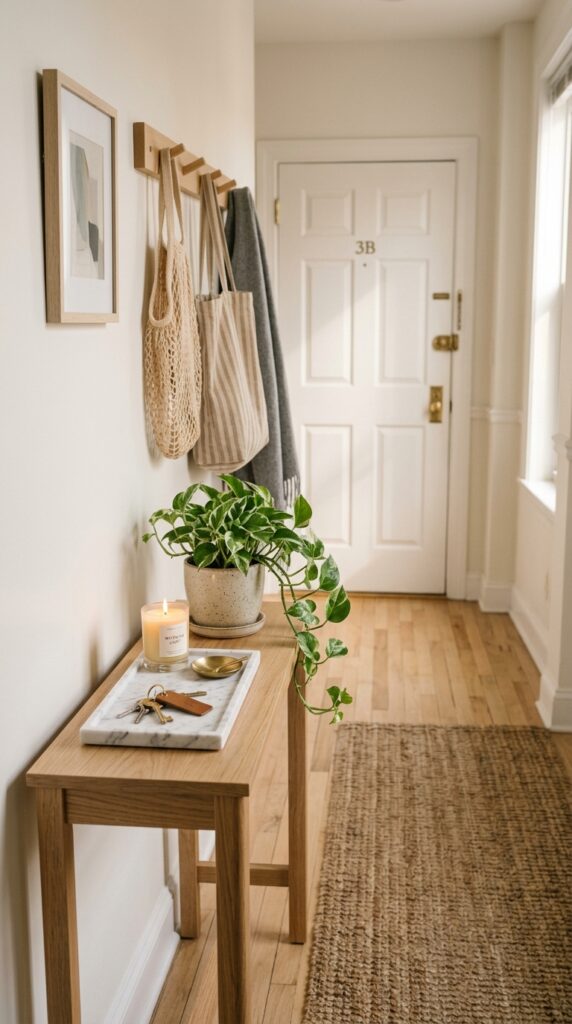
When the entryway has six or more inches of depth to spare — a narrow console table transforms it from a corridor into a room.
The console surface that holds more than three objects stops looking like a styled entryway and starts looking like a surface where things were put down.
A narrow console transforms any entryway into a proper arrival moment. Three objects on the surface. That’s the whole rule.
5. Shoe Storage That Disappears
Shoes on the floor are the fastest way to make any entryway feel chaotic — and the most universal entryway organization failure.
The solution isn’t hiding shoes behind closed doors necessarily. It’s containing them in something that looks as intentional as the shoes are practical.
The shoe rule:
Only currently-worn shoes live in the entryway. Everything else — seasonal footwear, occasion shoes, sports shoes — lives in the bedroom closet.
The number of shoes in the entryway should equal the number of pairs worn this week — nothing more. More Inspiration: Renter-Friendly Small Apartment Ideas
6. A Mirror That Opens the Space
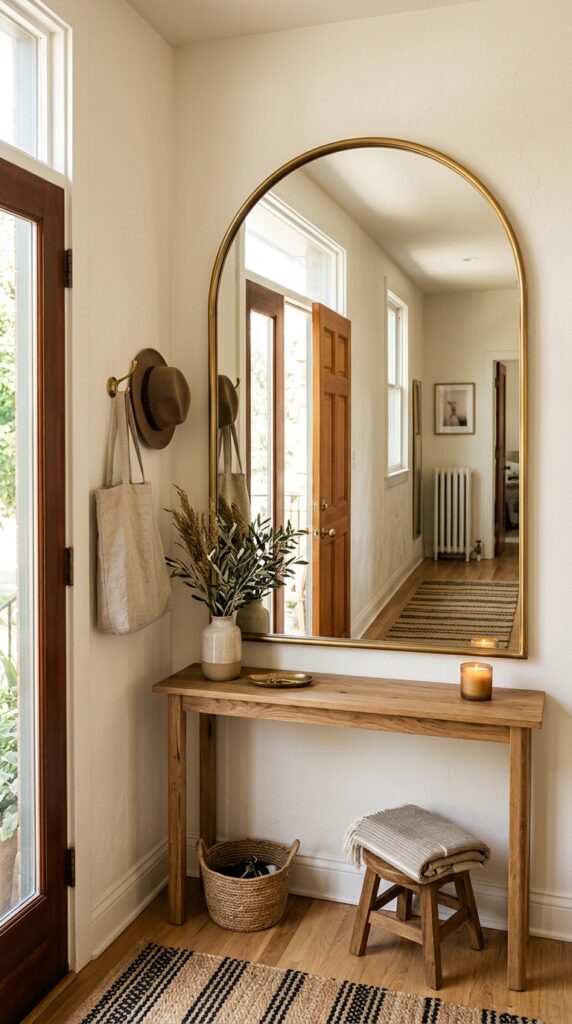
The entryway mirror is doing more organizational and design work than it appears.
It reflects light — making the smallest entryway feel brighter and less cramped. It creates depth — the eye perceives the space behind the reflection as additional room. It provides the last-check moment before leaving. And it adds a decorative focal point that makes the entryway feel finished.
The mirror rule:
Go larger than instinct suggests. A small decorative mirror in a small entryway does almost nothing. A large mirror in a small entryway changes the entire spatial experience.
One large mirror in a small entryway makes the space feel twice its size. Size matters here.
7. The Drop Zone Tray
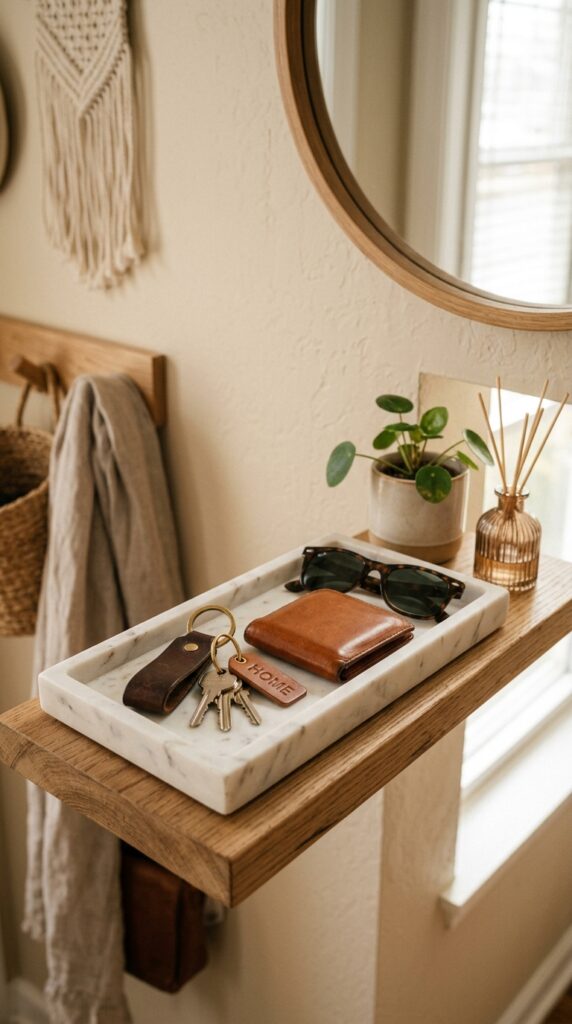
The drop zone tray is the smallest organizational tool in the entryway — and one of the most powerful.
The tray rule:
The tray holds five items maximum. When more than five items accumulate — the system is being asked to do more than a tray should do, and something needs to relocate.
The tray is not a staging area for everything that doesn’t have another home. It is a dedicated zone for the five things that leave with you every single day.
The drop zone tray is the one organizational detail that ends the morning key search permanently. Keep Reading: Space-Saving Furniture Ideas
8. The Over-Door Opportunity
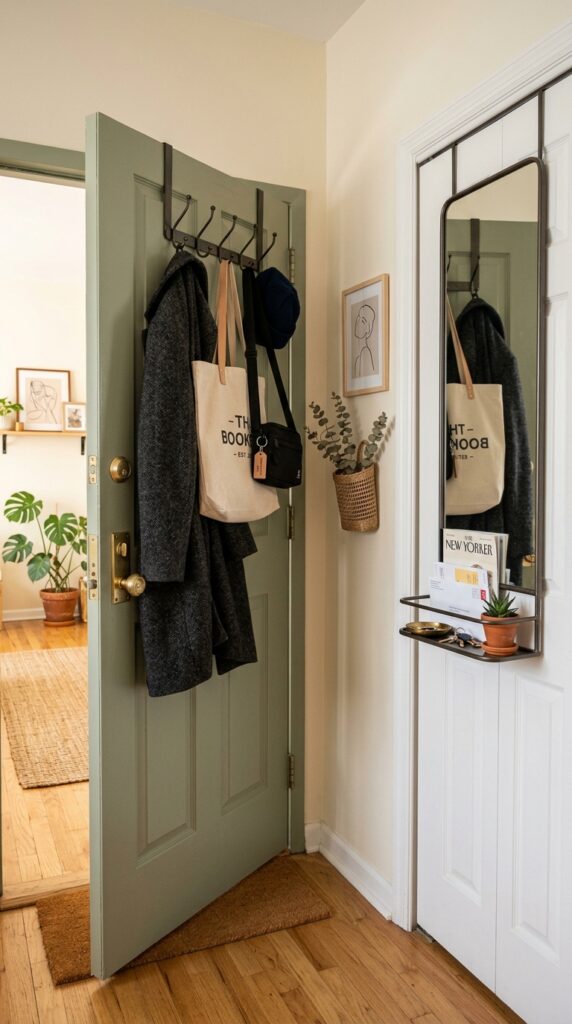
The back of the entryway door — or the wall immediately beside it — is the most consistently wasted surface in a small apartment entry.
Used intentionally, it becomes a genuine storage zone without consuming any floor space or visible wall space.
For renter-friendly installation:
Over-door hooks and organizers require no drilling. They hang over the door frame and are entirely deposit-safe. The heaviest items supported by these systems can be surprisingly substantial when the hook quality is sufficient.
The back of the entryway door is free storage. In a small apartment, free storage is worth everything.
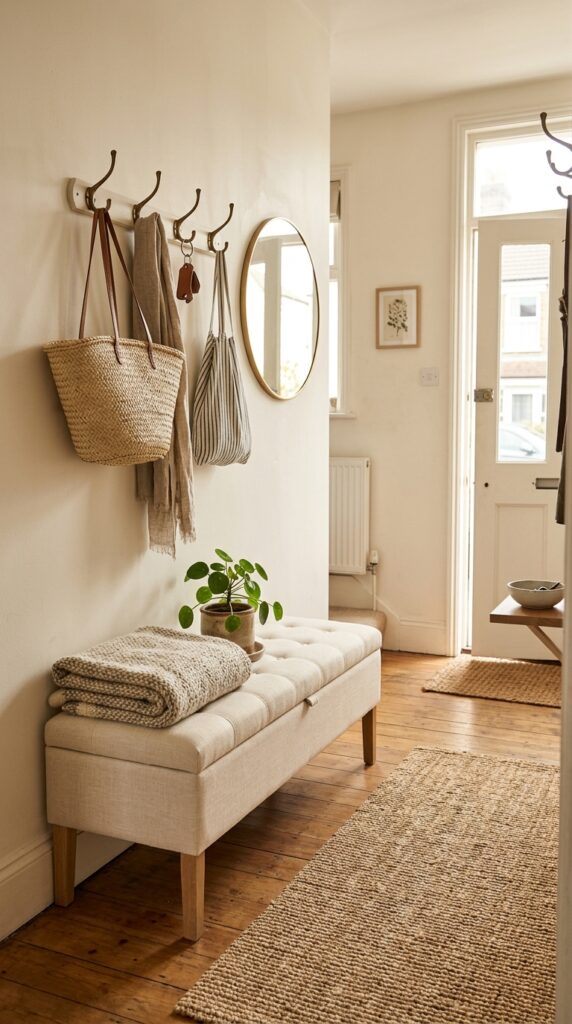
9. A Bench That Earns Its Place
In a small entryway, every piece of furniture that takes floor space must justify that floor space with exceptional function.
Bench specifications for small entryways:
- Depth — 14 to 16 inches — shallower than a standard bench, designed for narrow halls
- Length — scaled to the wall section available
- Material — upholstered in neutral linen or cream, or natural wood
- Storage — lift-lid interior preferred, or open cubby below
An entryway bench with storage earns every inch of the floor space it occupies — four times over. You May Also Like: Small Space Living Ideas for Families
10. Vertical Storage Up the Wall
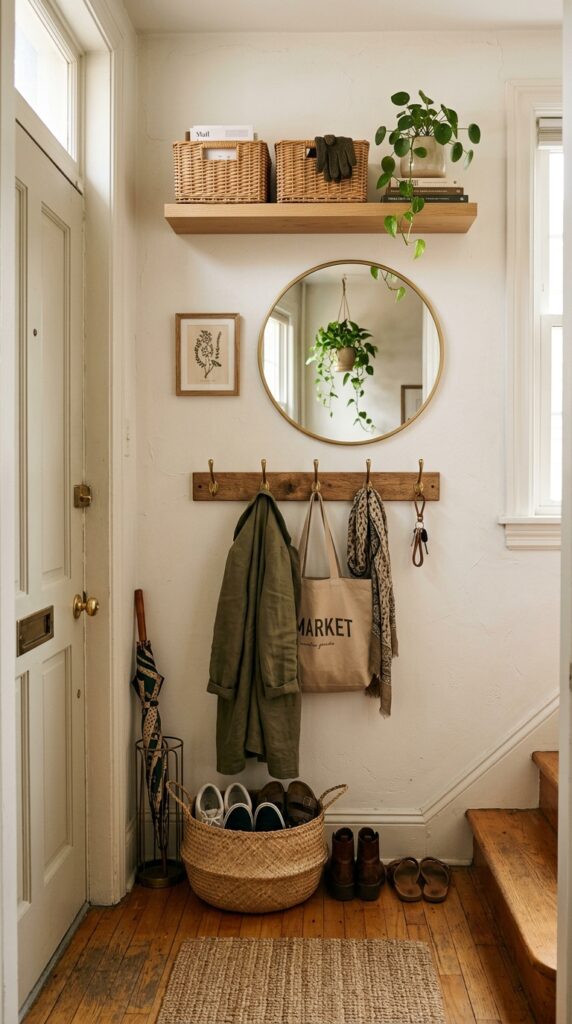
When the entryway floor is limited — the wall is the storage.
Most small entryways use two to three feet of vertical wall space. The remaining six to eight feet above that — from the top of the hook rail to the ceiling — is completely wasted.
Using all four levels of the entryway wall — from floor to ceiling — turns a narrow corridor into a genuinely high-capacity storage zone without any increase in floor footprint.
The ceiling height of the entryway is free storage. Use every foot of it.
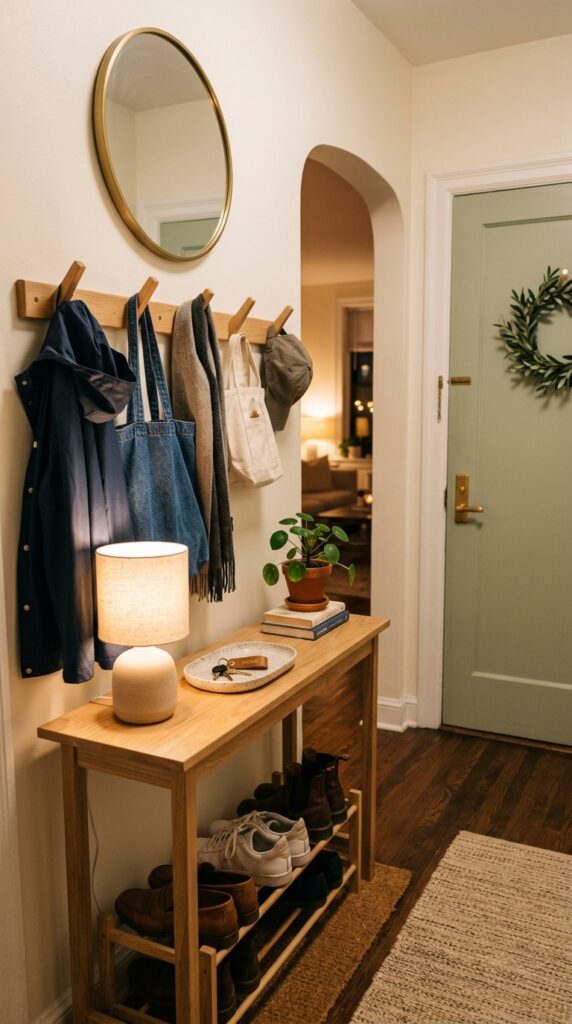
11. Lighting That Makes It Feel Welcoming
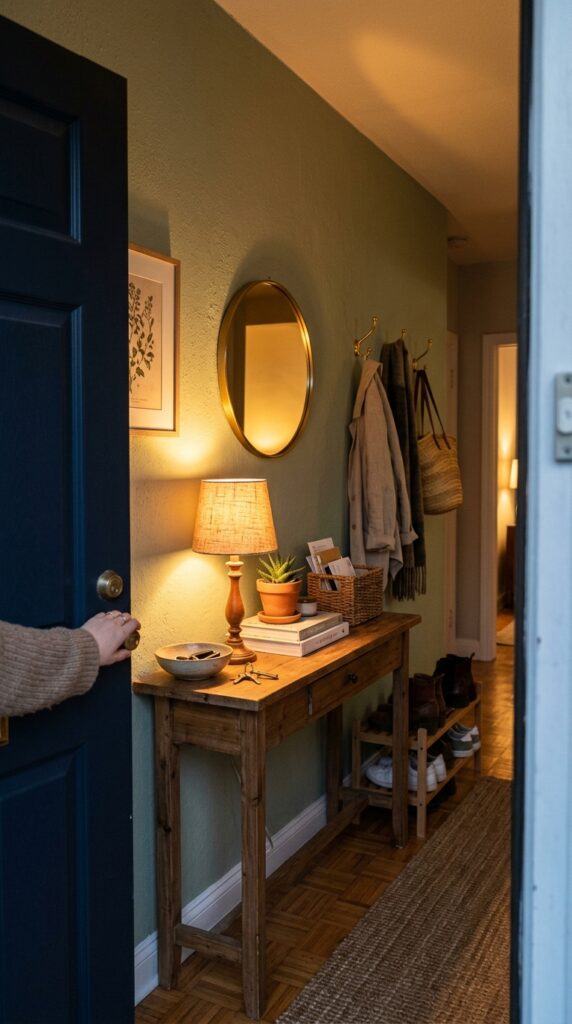
The entryway is frequently the darkest, most poorly lit space in the apartment — which makes it feel uninviting regardless of how organized it is.
The right lighting transforms the entryway from a transitional functional space into a warm, welcoming arrival moment.
The warm-lit entryway is the difference between an apartment that waits for you and one that welcomes you.
A warm lamp in the entryway means the apartment is always glowing when you open the door. That changes everything. Explore Next: Interior Design Ideas for Small Living Spaces
12. One Plant — The Living Detail
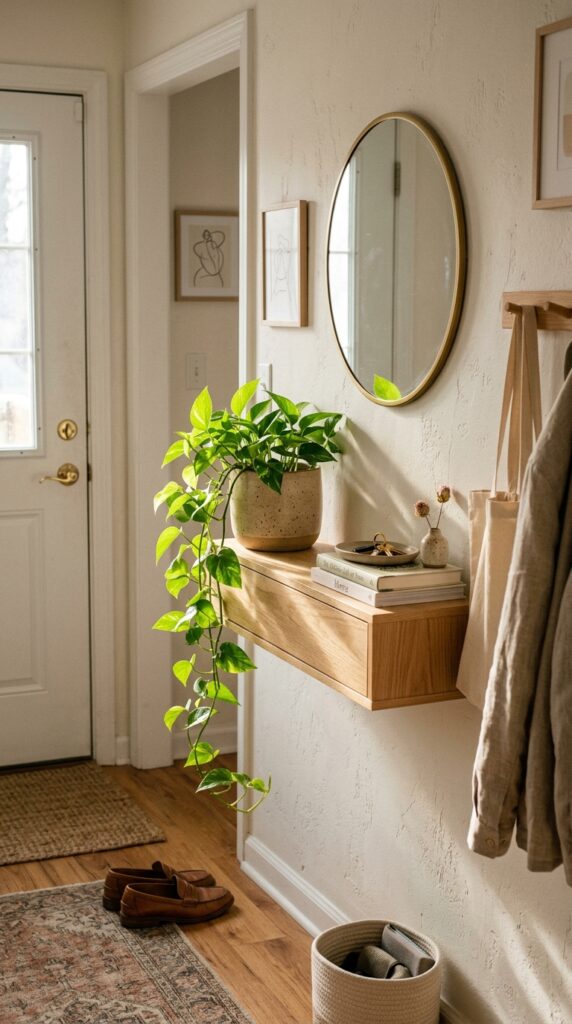
The entryway plant is the detail that makes the organized space feel genuinely alive.
Not a collection. Not a shelf of plants. One plant — chosen deliberately, positioned intentionally, tended consistently.
The entryway plant communicates that the space is tended. That someone cares for it. That what happens inside the apartment door matters.
One plant in the entryway tells every visitor — and every homecoming — that this space is cared for.
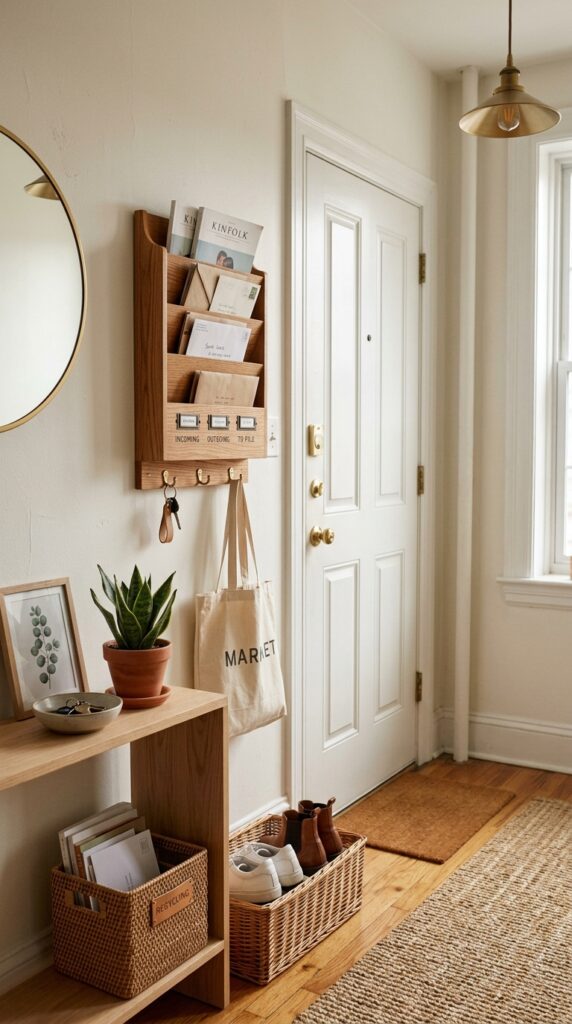
13. The Mail and Paper Station
Mail is the entryway’s most persistent organizational challenge — because it arrives daily without a natural destination and spreads to every surface within reach of the door.
The mail and paper station in the entryway intercepts the problem at the source.
The mail rule:
Mail processed at the door never becomes a pile. Mail carried to the kitchen counter becomes a pile within three deliveries.
The mail station doesn’t need to be large. A single wall-mounted pocket — mounted at arm height beside the door — is enough to contain the daily mail until the weekly processing habit deals with it.
Mail sorted at the door never becomes the kitchen counter pile. The mail station makes this possible.
14. The Renter-Friendly Entryway
Every upgrade in this article has a renter-friendly version — because renters deserve a beautiful, organized entryway as much as anyone.
The one renter exception:
A single command hook — the heaviest-rated available — can typically hold a hook rail by its ends if the existing wall is smooth. Alternatively, an over-door hook system creates the full hook rail function without any wall contact.
Every renter entryway on this list is achievable. Every single one leaves no trace when the lease ends.
Renters deserve a beautiful entryway. Every system here is deposit-safe.
15. The Daily Reset Habit
The organized entryway requires one habit — and only one — to stay organized indefinitely.
A two-minute daily reset. Every evening. Before the apartment wind-down begins.
Two minutes. Every evening. Without exception.
The entryway that begins each morning organized is the one that was reset the night before. The morning that begins with an organized entryway starts differently — faster, calmer, with less friction between waking up and walking out the door.
That two-minute investment the night before pays dividends every single morning.
Two minutes every evening. The entryway wakes up organized every morning. The morning starts differently.
The First Room and the Last
The entryway is where every day begins and every day ends.
It deserves more thought than it typically gets — because the daily experience of passing through it, both leaving and returning, shapes the emotional tone of everything on either side.
An organized entryway doesn’t just hold coats and keys. It communicates something to the person who lives there every single day:
This is a home that has been thought about. This is a space that works. This is somewhere worth arriving.
That’s what fifteen good decisions and a two-minute daily habit create.
Save this to your small space living board. Come back when you’re ready to start with the edit.
Which idea are you implementing first? Tell me in the comments.

