Dark, cave-like rooms can make even a well-decorated apartment feel cramped and uncomfortable. When a room lacks natural daylight, relying on a single overhead ceiling fixture usually makes things worse by casting heavy shadows into every corner. Fixing a dim layout does not require hiring an electrician or knocking down walls.
By layering glow at different heights, bouncing light off pale ceilings, and highlighting hidden wall seams, you can completely change how large your home feels. These practical small space lighting tricks show you how to eliminate shadow pockets, free up precious nightstand surfaces, and give tiny rooms a bright, open atmosphere.
From under-cabinet toe-kick LED strips to upward plant lighting and clear glass lamp bases that visually vanish, every idea is easy to set up on a real-world budget. Here is how to use simple fixtures to double your perceived floor space today.
1. Cascading Vertical Fairy Lights Behind Sheer Curtains and Vines

Hanging thin fairy light strands vertically behind wall vines draws the eyes straight toward the ceiling.
- Tuck light wires behind sheer curtains or trailing plant leaves to soften the glow.
- Let extra light strands pool softly along floorboards to bounce warmth across low surfaces.
- Stick to warm yellow bulbs rather than bright blue-white tones to keep the room soft.
This creates a floating backdrop effect that makes a tight sleeping nook feel much deeper.
2. Backlit Open Shelving Combined with Layered Lamp Heights

Sticking to one overhead ceiling light leaves room corners in shadow, which shrinks a small space fast. Mounting thin LED light strips under open bookshelf planks washes every display shelf in warmth. Combine that with a slim floor lamp and matching table lamps to spread light evenly across the middle zone.
When your eyes see balanced light at three different heights across the living room, the side boundaries feel wider and less crowded.
3. Floor Up-Lighting Behind Tall Foliage to Cast Wall Shadows

Placing a small floor light directly behind a large potted plant turns a dark reading nook into a focal point.
- Position a low spotlight or puck light on the floor right behind the plant pot.
- Angle the bulb upward so the beam shoots through the leaves toward the ceiling seam.
- Keep nearby wall art simple so the leaf shadow patterns have space to stretch out.
The upward shadow patterns draw attention high onto the wall, making low ceilings feel noticeably higher.
💡 Quick Tip
Use a cool-to-touch LED puck light so close plant leaves do not get scorched by heat from traditional halogen bulbs.
4. Perimeter String Lights to Blur Glass Window Boundaries

Draping warm globe string lights along a balcony railing and glass window frame pulls the eye beyond the indoor walls. Reflections in the window glass double the glowing bulbs, making a narrow balcony seating spot feel extended into the night sky.
- Globe string lights along the railing edge
- Cluster of pillar candles on a low side table
- Small glowing accent light mounted on the back wall
| Single Center Fixture | Perimeter String Lights |
|---|---|
| Casts shadows into outer edges | Outlines the full width of the balcony |
| Creates harsh glare on dark glass | Bounces soft reflections across window panes |
5. Tracing Sloped Rooflines with Warm String Light Lines

Low sloped ceilings and attic angles can make a seating area feel boxed in if left unlit. Running a line of warm string lights directly along the slanted ceiling joint highlights the architectural angle instead of hiding it in shadows.
Pairing this overhead line with a woven rattan pendant light and low floor lanterns fills both top and bottom zones evenly. The room ends up feeling intentional and open rather than tight and attic-like.
Dark shadows gather along the slant, making the ceiling feel lower.
Light along the seam draws the eye upward, celebrating height.
6. Under-Cabinet and Toe-Kick LED Strips That Lift the Floor

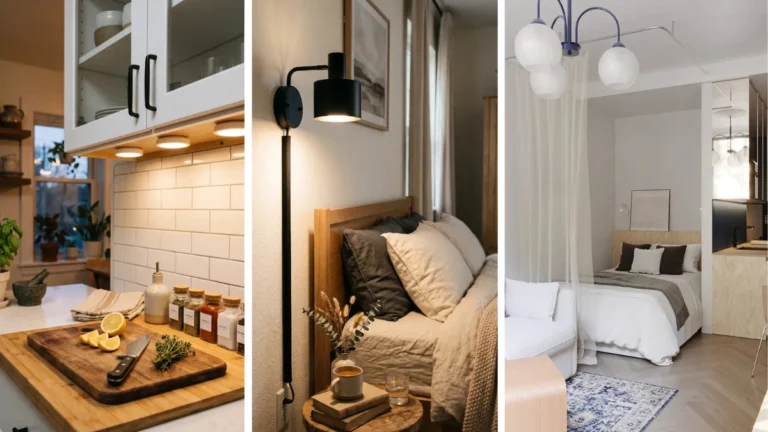
Dark baseboards and cabinet bottoms make a small kitchen or living area feel grounded and heavy. Running warm LED tape under lower cabinets and along toe-kick spaces creates a soft floating glow that lifts the entire floor plane.
The light stays out of eye line so it never feels harsh, yet the room suddenly reads taller and cleaner.
Recreate this glow
7. Plug-In Swing-Arm Wall Sconces That Clear Surfaces

Table lamps eat precious surface space on nightstands and side tables. A pair of plug-in swing-arm sconces mounted beside the bed or sofa keeps light exactly where you need it while leaving the tabletops free for books or a drink.
- Mount the sconces at seated or lying eye level.
- Swing the arms inward for reading, outward when you want ambient fill.
- Choose fabric or frosted shades so the glow stays soft against the wall.
You gain usable surface area and still get focused task light without hardwiring.
Pick plug-in models with long cords so you can reach an outlet easily.
Install at the height you actually read or sit so the light falls correctly.
Use a cord cover or paint the cord the wall color for a cleaner look.
8. Mirror-Backed Picture Lights for Double the Wall Wash

A slim picture light mounted above art only lights the artwork. Adding a mirror directly behind or beside the frame lets that same fixture bounce light back into the room, washing the wall twice as far.
Compare a regular picture light alone versus one paired with a mirror: the mirrored version pushes glow deeper into the space and makes the wall feel farther away.
| Picture Light Alone | Picture Light + Mirror |
|---|---|
| Lights only the artwork | Bounces extra glow into the room |
| Wall still feels flat | Wall gains depth and width |
9. Hidden LED Tape on a Sheer Curtain Rod

Most curtain rods only hold fabric. Sliding a thin LED strip into the rod channel or clipping it along the back edge turns the entire window into a soft glowing panel at night.
The sheer fabric diffuses the light so you get an even wash instead of hot spots. During the day the strip disappears completely.
📌 Good To Know
Choose a cuttable LED strip rated for indoor use and hide the tiny controller behind the curtain bracket so nothing shows when the drapes are open.
10. Low Battery Lantern Clusters for Ground-Level Glow

Tall lamps leave the floor dark. Grouping three or four small battery lanterns or LED candles at different low heights on the floor, a tray, or a low stool builds a second layer of light that fills the bottom third of the room.
The staggered heights create depth without cords, and you can move the whole cluster whenever you rearrange furniture.
Only overhead or table light, floor stays in shadow and room feels cut off at the bottom.
Low lantern cluster fills the floor plane and makes the whole room feel taller and more layered.
11. Single Dimmable Floor Lamp Bounced Off a Light Ceiling

One well-placed floor lamp aimed upward at a white or light ceiling can replace several smaller fixtures. The bounced light spreads evenly across the room and removes harsh shadows that shrink visual space.
Choose a lamp with an opaque shade that directs all light up, and put it on a dimmer or smart plug so you can lower it for evenings.
Upward light bounced off a pale ceiling turns the whole ceiling into a giant soft fixture, washing walls evenly and making the room feel larger.
12. Bias Lighting Strip Behind the TV or Headboard

A thin LED strip hidden behind a television or bed headboard creates a soft halo that reduces eye strain and pushes the wall outward. The glow separates the dark screen or headboard from the wall so the surface no longer feels flat and close.
Stick the strip to the back edge, aim it toward the wall, and choose warm white for evenings. The room instantly feels deeper without any visible fixture.
Bias lighting basics
13. Low-Hung Pendant Trio That Zones a Small Table

Hanging three small pendants 28–34 inches above a dining or coffee table creates a pool of light that defines the zone without walls. The lower height keeps the glow close to the surface and leaves the upper room airy.
Choose lightweight shades so the fixtures do not feel heavy. The focused light makes the table area feel intentional and the surrounding floor space feel larger by comparison.
Measure 28–34 inches from tabletop to the bottom of each shade.
Space the three pendants evenly across the table length.
Put them on a dimmer so the zone can go from task to soft ambient.
14. Ceiling-Line Cove LED for Soft Upward Wash

Mounting a continuous LED strip in a simple cove or on top of a tall cabinet throws light upward onto the ceiling. The ceiling becomes a giant reflector that fills the room with even, shadow-free glow.
This is especially effective in rooms with low or flat ceilings because the light source itself stays hidden.
Single ceiling fixture leaves corners dark and walls flat.
Hidden upward light turns the whole ceiling into soft illumination.
15. Clear Glass and Acrylic Lamps That Vanish Visually

Solid lamp bases add visual bulk. Switching to clear glass, acrylic, or Lucite bases lets the eye travel straight through the fixture so the room feels less crowded.
Pair a transparent base with a simple white or linen shade. The light still does its job while the lamp itself almost disappears.
- ▸Clear bases keep sight lines open across the room
- ▸Works especially well on small nightstands and consoles
- ▸Choose warm bulbs so the glass does not look cold
- ▸One clear lamp can replace two bulkier ones
16. Open Closet or Niche Puck Lights Left Slightly Ajar

A dark open closet or wall niche becomes a black hole that shrinks the room. Adding two or three battery or plug-in puck lights inside and leaving the door or curtain partially open turns the recess into a glowing feature.
The extra depth and light make the main room feel larger by comparison.
💡 Quick Tip
Use warm battery pucks with adhesive backs so you can place them without wiring. Aim one toward the back wall and one toward any shelves for even fill.
17. Tunable Smart Bulbs That Mimic Daylight Then Warm Down

Cool white light (4000K–5000K) during the day makes walls recede and details look sharper. Warm light (2700K) at night keeps the same room cozy. Smart bulbs let you switch color temperature with your phone or voice so one fixture does both jobs.
Place them in existing ceiling sockets or lamps. The daytime cool setting alone can make a small room feel noticeably more open.
Cool daylight tones push walls back and increase perceived space; warm tones keep the same room comfortable after dark.
Brightening up a cramped room comes down to placing light where shadows usually gather. Instead of relying on one harsh overhead bulb, combining two or three low-cost fixtures at different heights instantly pushes your walls outward and lifts low ceilings.
Try adding LED strips behind a TV, bouncing a floor lamp off the ceiling, or hanging swing-arm sconces to free up your side tables. Small changes in bulb warmth and fixture placement make a massive difference in how open your home feels every evening. Save these small space lighting tricks to your home decor boards on Pinterest so you can reference these layout setups whenever your rooms need a quick refresh.