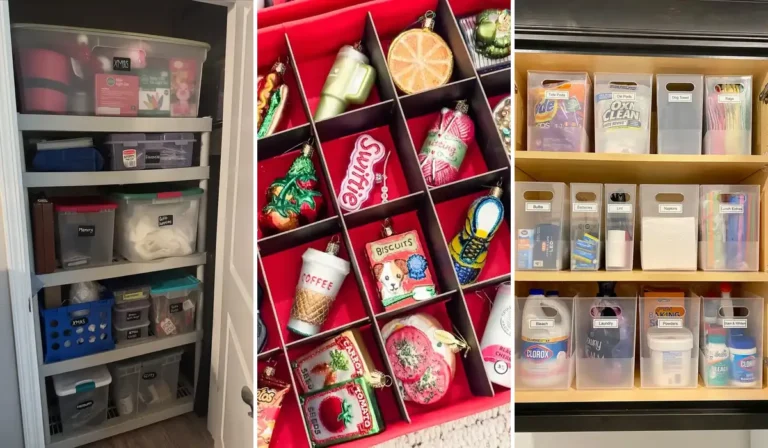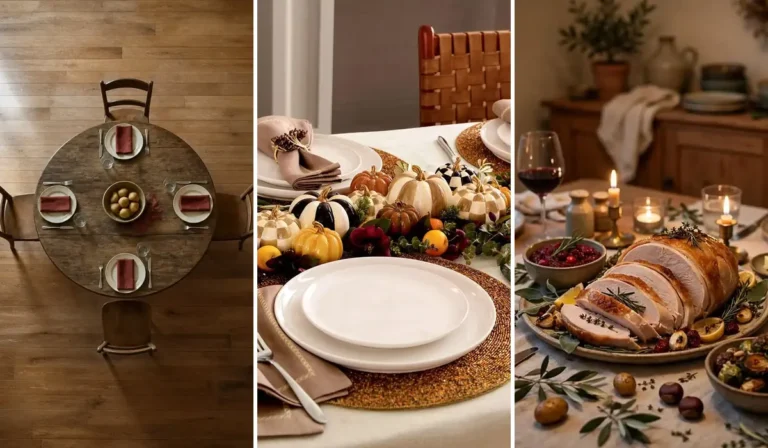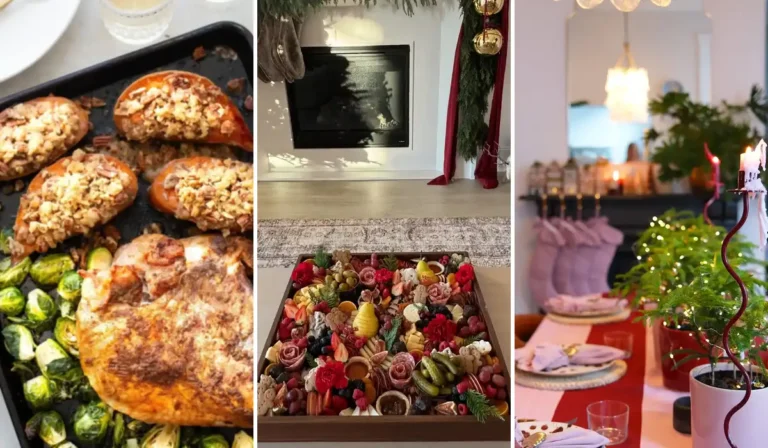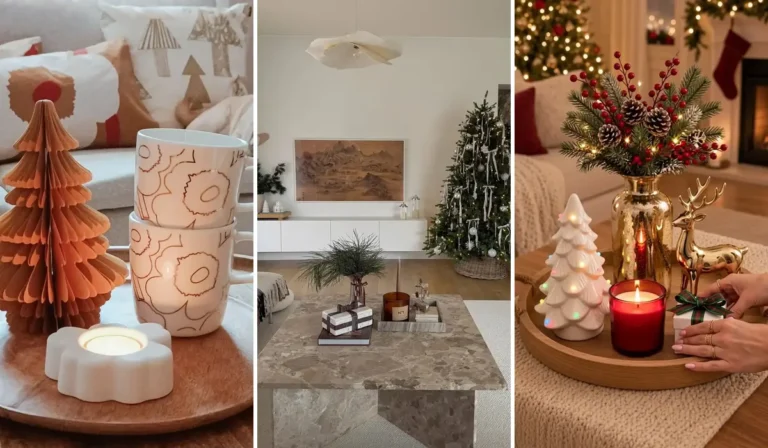
Your front door opens onto three feet of floor, and by February that floor has disappeared under coats, boots, and wet umbrellas. The mess is not a lack of effort. It is a lack of places for winter gear to go. These 19 winter entryway decor ideas give every coat, boot, and umbrella a spot that looks like it belongs there, so the first thing you see when you come home is a tidy entry, not a muddy pile. Start with the spot that bothers you most.
1. A Row of Slim Wall Hooks That Takes Coats Off the Floor
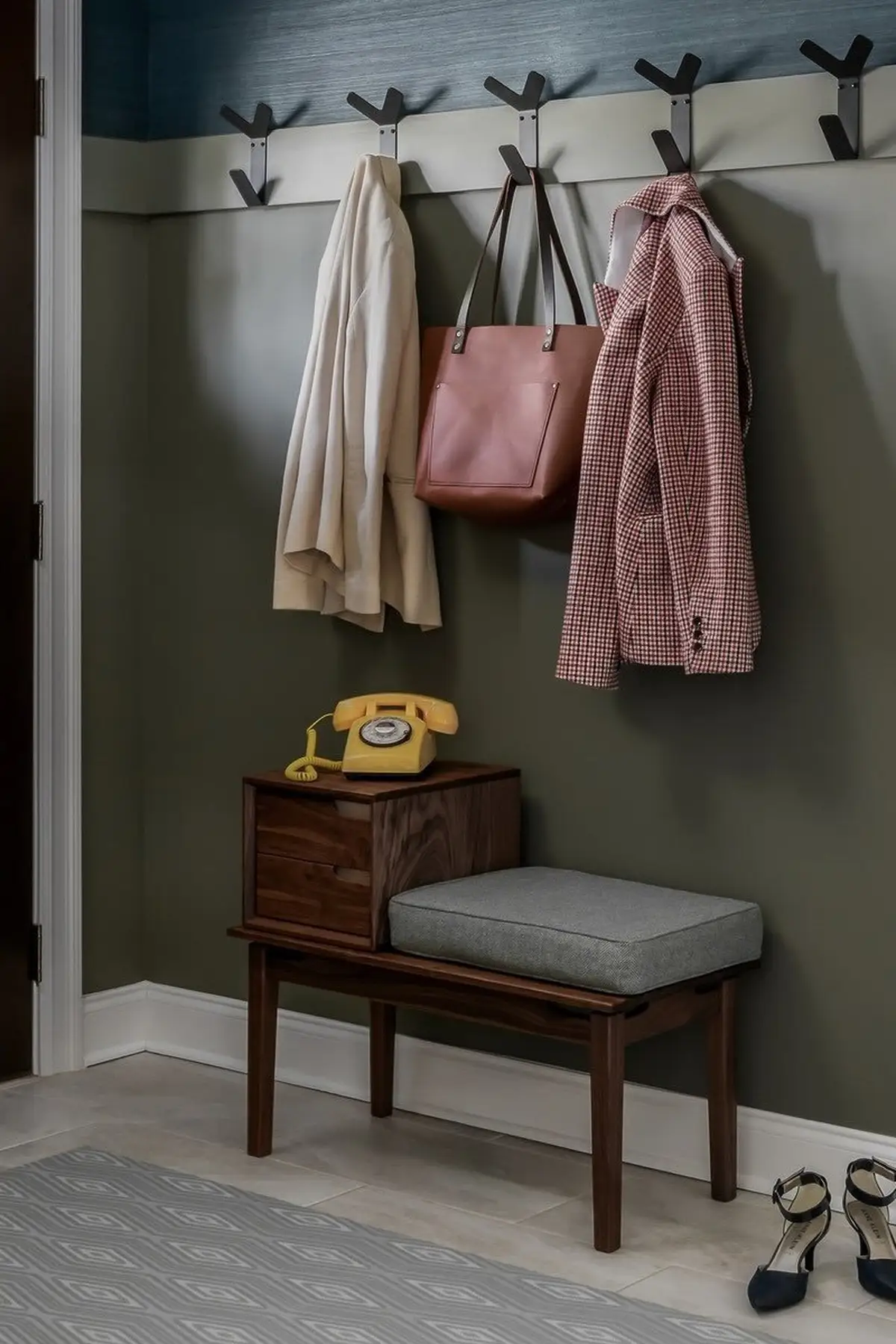
By the second week of January, the coat pile by your front door has a life of its own. Your parka lands on top of your partner's jacket, the scarves slide off the heap, and every time you step inside you have to nudge the whole mess aside with your boot just to close the door behind you.
A row of slim wall hooks stops the pile from ever forming. Mount five or six hooks on a rail at shoulder height, one coat per hook, and the wall does the work your floor used to do. Your coats hang flat against the wall instead of pooling on the tiles, the walkway stays clear, and grabbing your parka on the way out takes two seconds instead of digging through the heap.
Quick Tip
Space the hooks about 15 centimetres apart so bulky winter coats do not crowd each other, and keep one hook free near the door for the coat you reach for most. If your lease forbids drilling, look for a rail that mounts with heavy-duty adhesive strips and test it with your heaviest parka before trusting it overnight. Hang the longest coat at the end of the row so its hem does not brush the coats beside it.
Best for: entryways with no coat closet · Cost: low · Effort: under an hour
2. A Boot Tray With a Lip That Keeps Slush Off the Floor
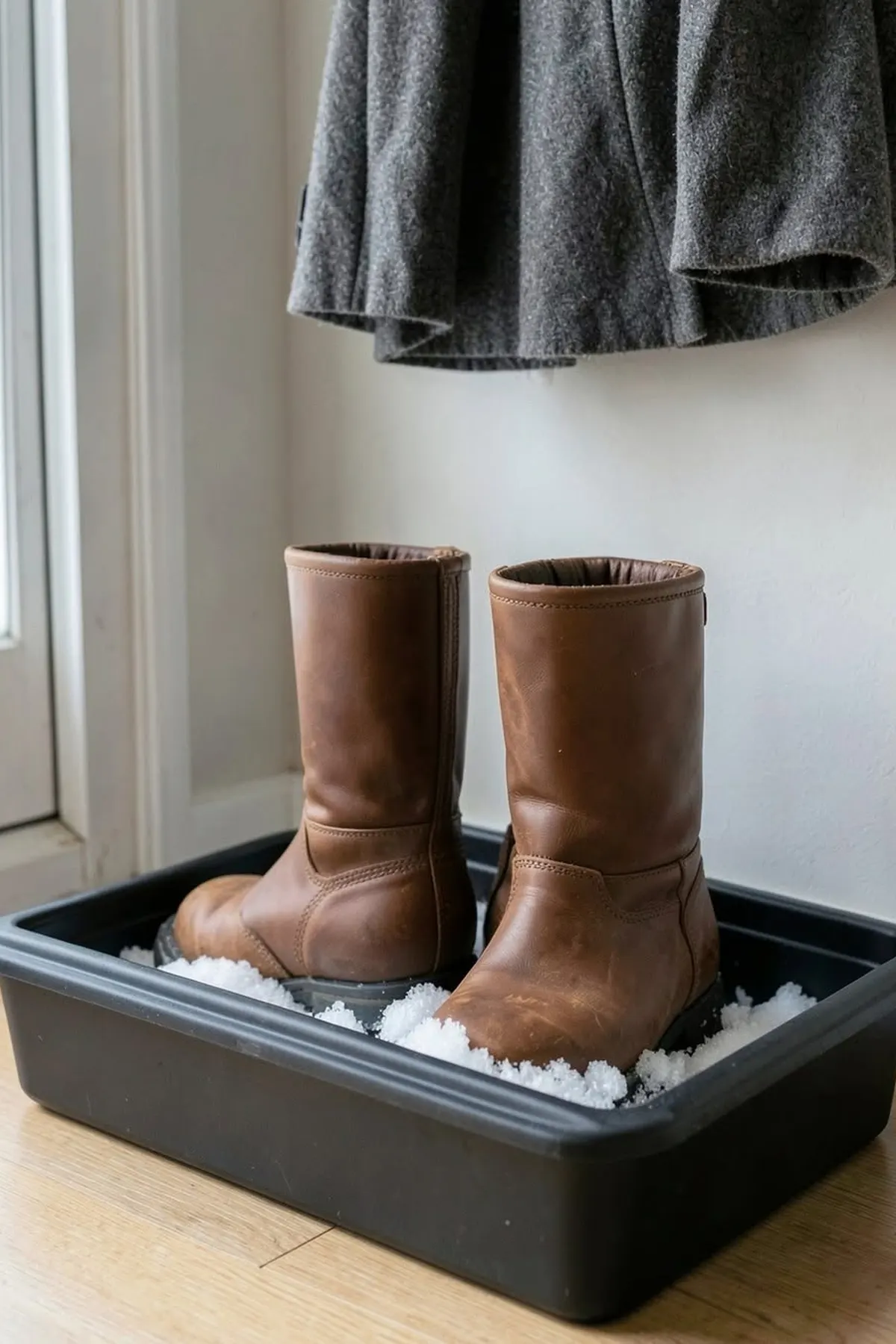
Every snowy evening ends the same way in your entryway: boots come off, snow melts, and a gray slush puddle creeps across the floor toward the rug. A boot tray with a raised lip stops that spread before it starts. The lip holds the meltwater inside the tray while your boots dry, so the floor stays dry and the salt never reaches the boards.
Check before you buy: – Lip at least an inch high, so a full evening of meltwater stays inside – Wide enough for two pairs, so nobody parks boots on the bare floor – A ribbed or textured base, so boots grip instead of sliding – Easy to lift and rinse in the sink once a week
Keep the Tray Working All Winter
✓ Set the tray tight against the door, so boots land on it before they touch bare floor.
✓ Tip the meltwater out each night, so the tray starts dry every morning.
✓ Keep a folded old towel beside it for wiping soles before boots go on the tray.
✓ In spring, rinse it, dry it, and slide it behind the coats until next winter.
3. A Tall Umbrella Stand That Ends the Wet Umbrella Puddle
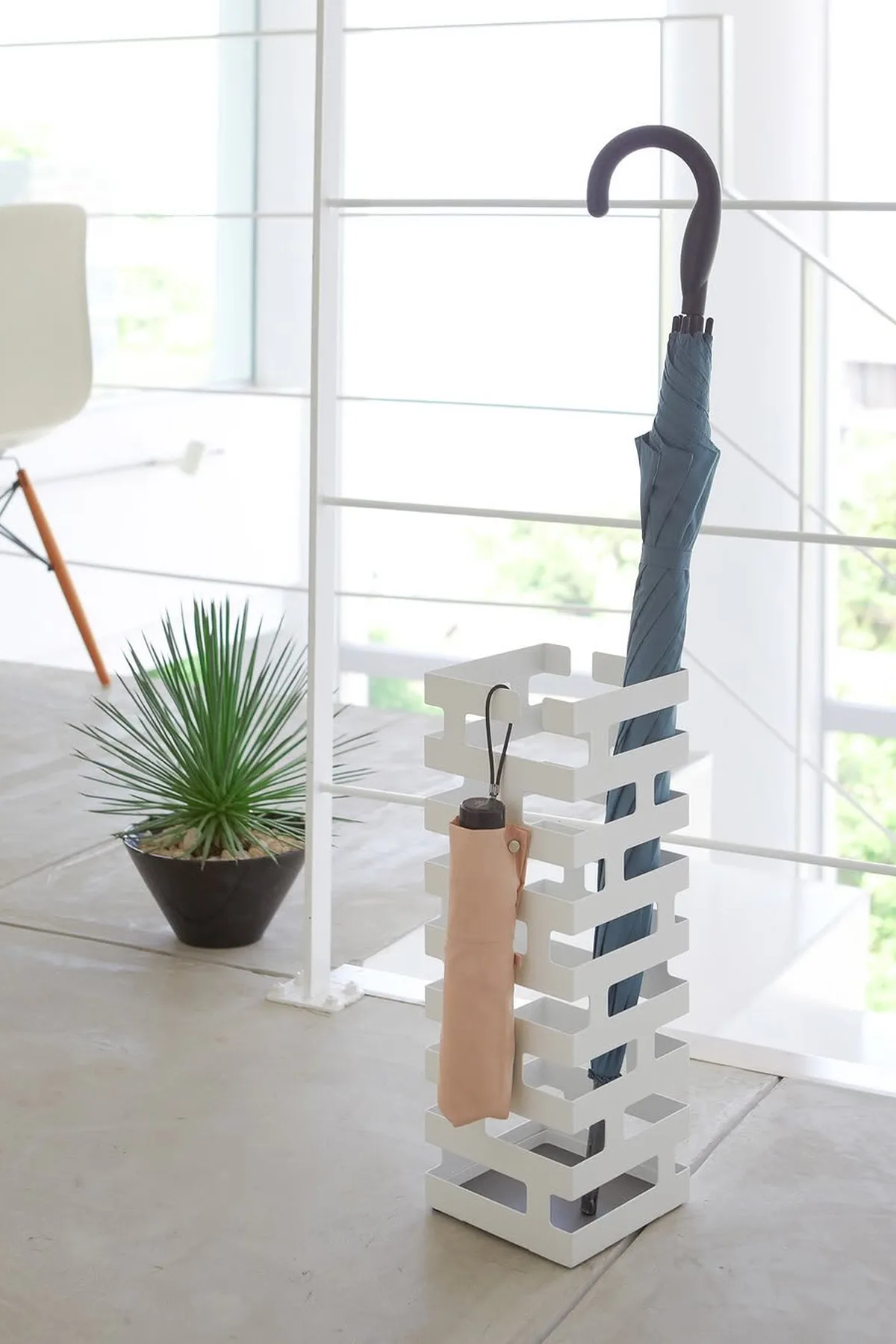
The wet umbrella you lean in the corner by the door drips down the wall all evening, and by morning there is a dark streak on the paint and a damp ring on the floor. A tall umbrella stand ends that routine in one move.
- Set the stand in the corner nearest the door hinge, where your hand lands as you step inside. 2. Drop each wet umbrella in handle-up so the water runs down into the base instead of across the wall. 3. Leave the folding umbrella in its case hooked over the rim, and empty the base once a week so standing water never sits. Your umbrellas dry upright, the wall stays clean, and the corner looks like a choice instead of a holding spot.
Set It Up in Three Moves
Park it by the hinge. The corner your door swings toward is the spot your hand reaches first, so the stand gets used instead of ignored.
Handles up, tips down. Long umbrellas go in handle-up so water runs to the base, and the folding umbrella hangs from its case on the rim so it dries apart from the rest.
Empty the base weekly. Tip the collected water into the sink before it sits, and wipe the inside dry so the stand never smells stale.
4. A Narrow Bench With Shoe Space Underneath for Lacing Up
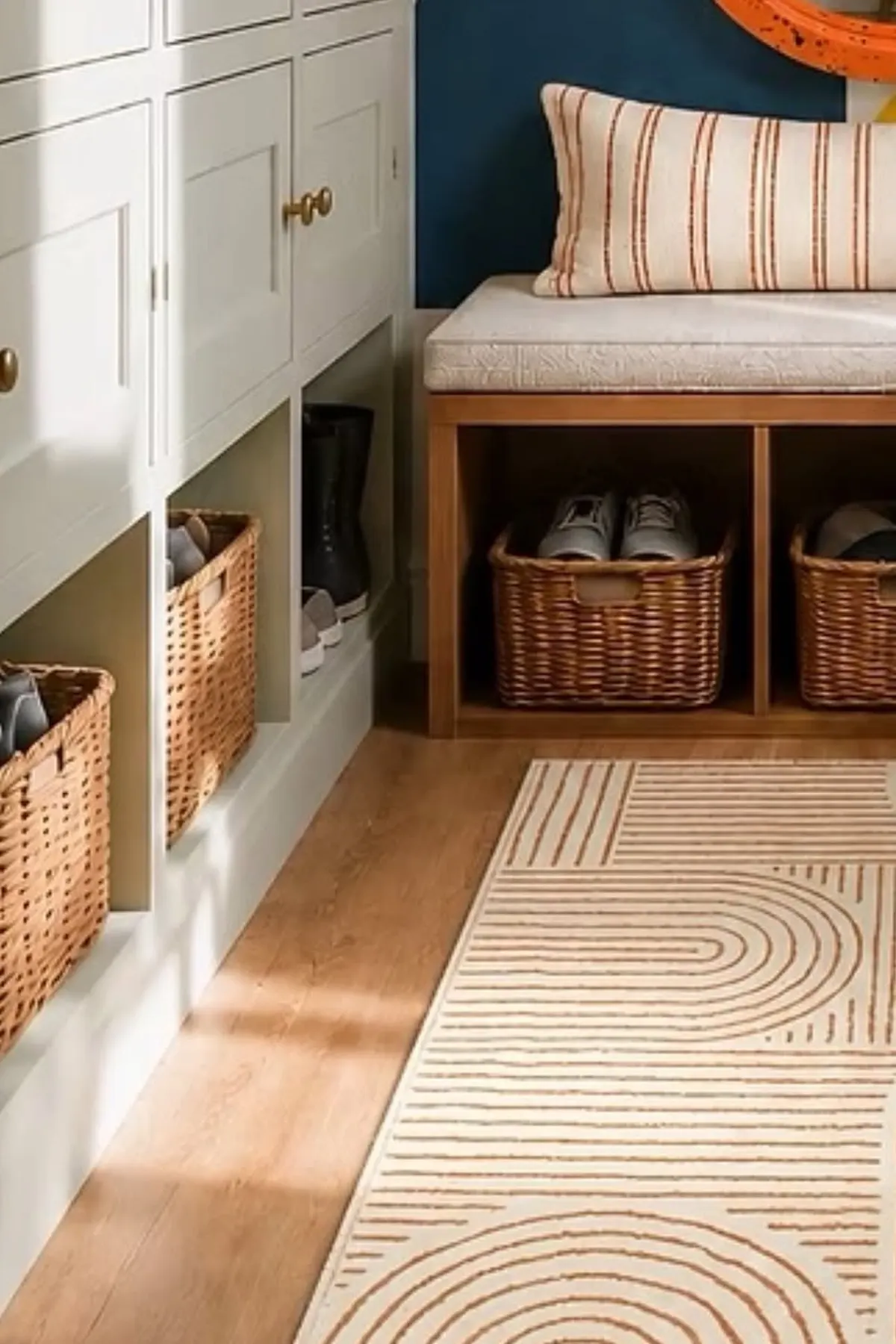
Shoes kicked off at the door end up scattered across the floor because there is nowhere to sit down and take them off. A narrow bench changes that in one move: you sit, you unlace, and the shoes slide into the space underneath instead of piling up by the skirting board.
Do choose a bench shallow enough for your wall, with open space or low baskets underneath so every pair has a visible home. Keep one basket per person so the pairs stay separate. Don't pick a bench with a solid front or a hinged lid you must lift while balancing on one foot, and don't let the bench become a dumping ground for bags and parcels, or shoes drift back onto the floor.
Bench check: what to look for before you buy
| Feature | Worth having | Skip it |
|---|---|---|
| Depth | Slim enough that the door still swings clear | So deep the walkway narrows to a shuffle |
| Shoe space | Open shelf or low baskets you can reach while seated | Solid front that hides shoes and collects dust |
| Seat | Cushioned top you can sit on with wet boots on | Hard, narrow top that nobody actually sits on |
| Finish | Wipeable wood or sealed finish for wet boots | Raw fabric that soaks up slush |
5. A Shelf Above the Hooks That Holds Hats and Gloves
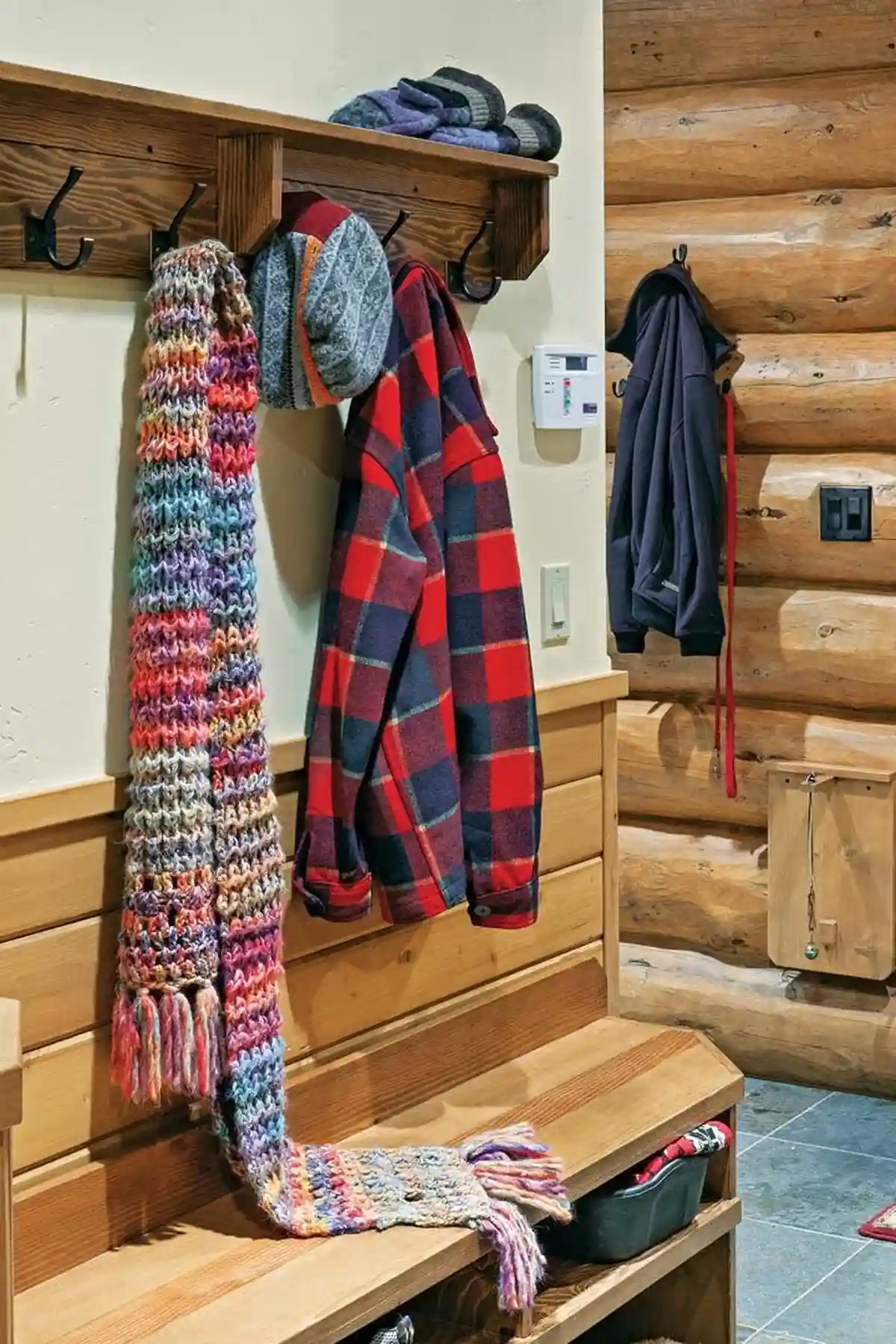
Your gloves vanish every morning because they have no spot. One is in a coat pocket, the other is who knows where, and you are late by the time you find both. A shelf above the hooks ends that hunt. Hats and gloves live up there in plain sight, right where your hand reaches on the way out, and the hooks below stay free for coats.
The upside is obvious: nothing to install on the floor, and the shelf uses wall space your entryway was wasting. The catch is that an open shelf only works if you keep it shallow, since a deep shelf invites a pile. Give each person one basket or a folded stack, and the shelf stays a landing spot instead of becoming a junk drawer.
What earns a spot on the shelf
- Daily hats and gloves: the pair you reach for every morning, folded in a neat stack.
- One small basket per person: a shallow basket keeps each person’s bits separate without hiding them.
- A folded scarf: one scarf, folded flat, so it never slides off the edge.
- Nothing heavy: bags and wet gear stay on the hooks or the floor, where the shelf never has to hold their weight.
If you cannot see it from the doorway, it does not live on the shelf.
6. A Woven Basket That Keeps Scarves and Mittens in One Place
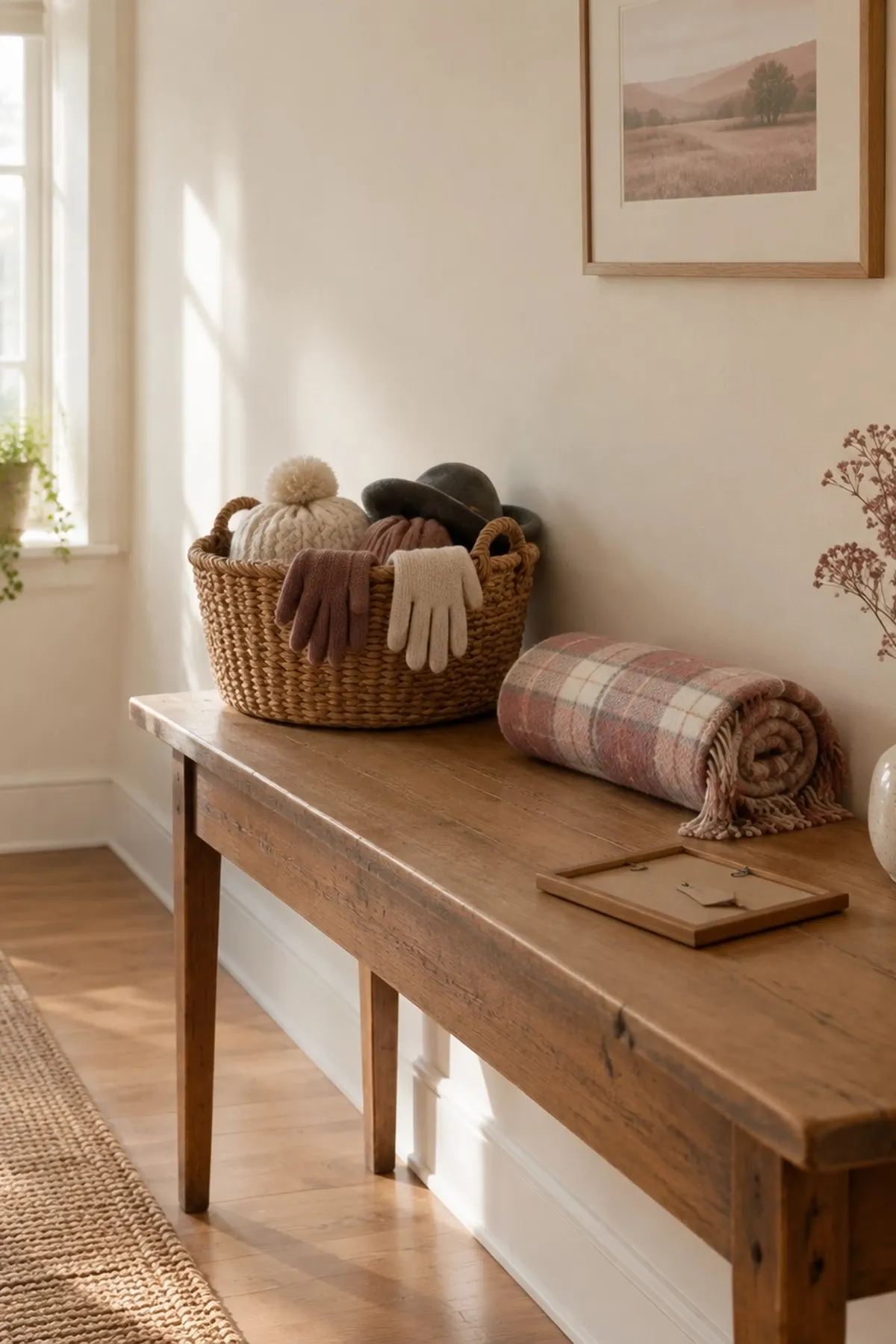
Your scarf is draped over the doorknob again because the closet is already full, and by morning it will be on the floor. Sound familiar? A woven basket by the door ends that migration. Give it one job only: scarves, mittens, and hats go in the moment you walk through the door, nothing else. Where should it sit? On the bench or console by the door, close enough to reach without taking a step inside. How big? Big enough for two or three scarves and a few pairs of mittens, small enough that it never becomes a second closet. The open weave lets damp knitwear breathe instead of going musty, and the basket looks like decor rather than storage, so your entryway reads intentional even on the messiest winter evening.
Just you
A small basket, about the size of a bread bin, holds one scarf, one hat, and two pairs of mittens with room to spare.
Two of you
A medium basket fits two sets of winter bits, and rolling each scarf instead of folding it keeps every layer visible at a glance.
Whole household
Go one size up rather than adding a second basket, and keep a spare pair of mittens at the bottom so a lost glove never stalls the morning.
7. A Round Mirror That Bounces Light Into a Dark Entryway
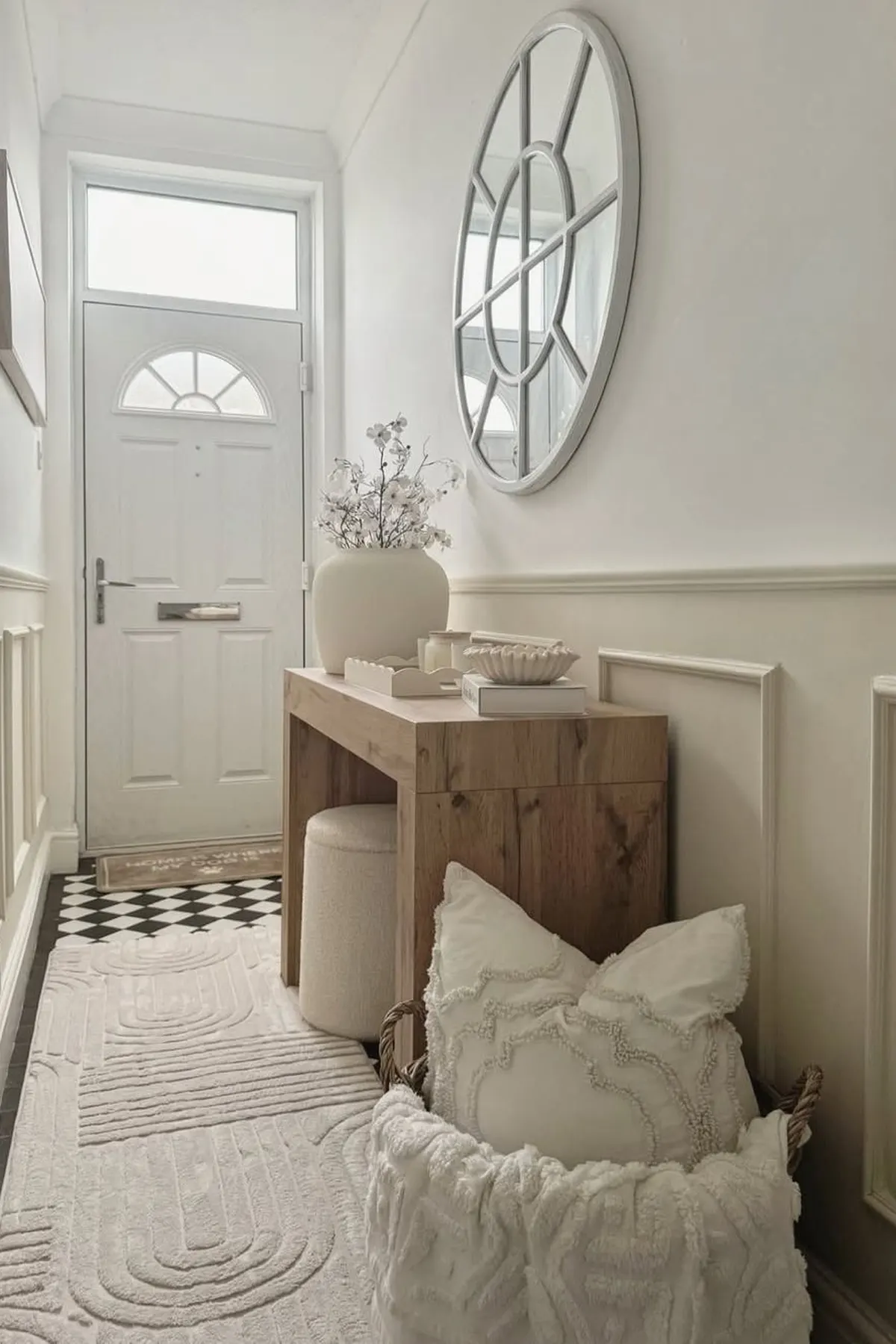
Your entryway gets no daylight at all, and by late afternoon it feels like a tunnel between the front door and the rest of your flat. You walk in, drop your keys, and the whole space reads dark before you have even taken your coat off.
| Hang it | What comes back |
|---|---|
| Centred above the console, a hand's width above the tallest thing on it | The light from the door glass and the room behind you |
| Two-thirds as wide as the console beneath it | A reflection wide enough to push the wall back |
| Facing the brightest thing in the room | Daylight and lamp glow bounced into the hallway |
One round mirror, hung where it can catch what little light you have, makes the walk from the door feel open.
Before
A tunnel with one dim end
The only light comes through the door glass, and it fades out a few steps inside. The wall opposite stays in shadow all day.
After
The same light, sent back down the hall
The round mirror catches the door glass and the lamp behind you, then bounces both back into the entryway, so the whole space reads brighter.
Doorway check: stand in the doorway and look into the mirror. If you can see the brightest window or lamp in the room, the mirror is hung in the right spot. If you see a blank wall, shift it until the light lands in the glass.
8. A Washable Runner That Catches Slush Before It Spreads
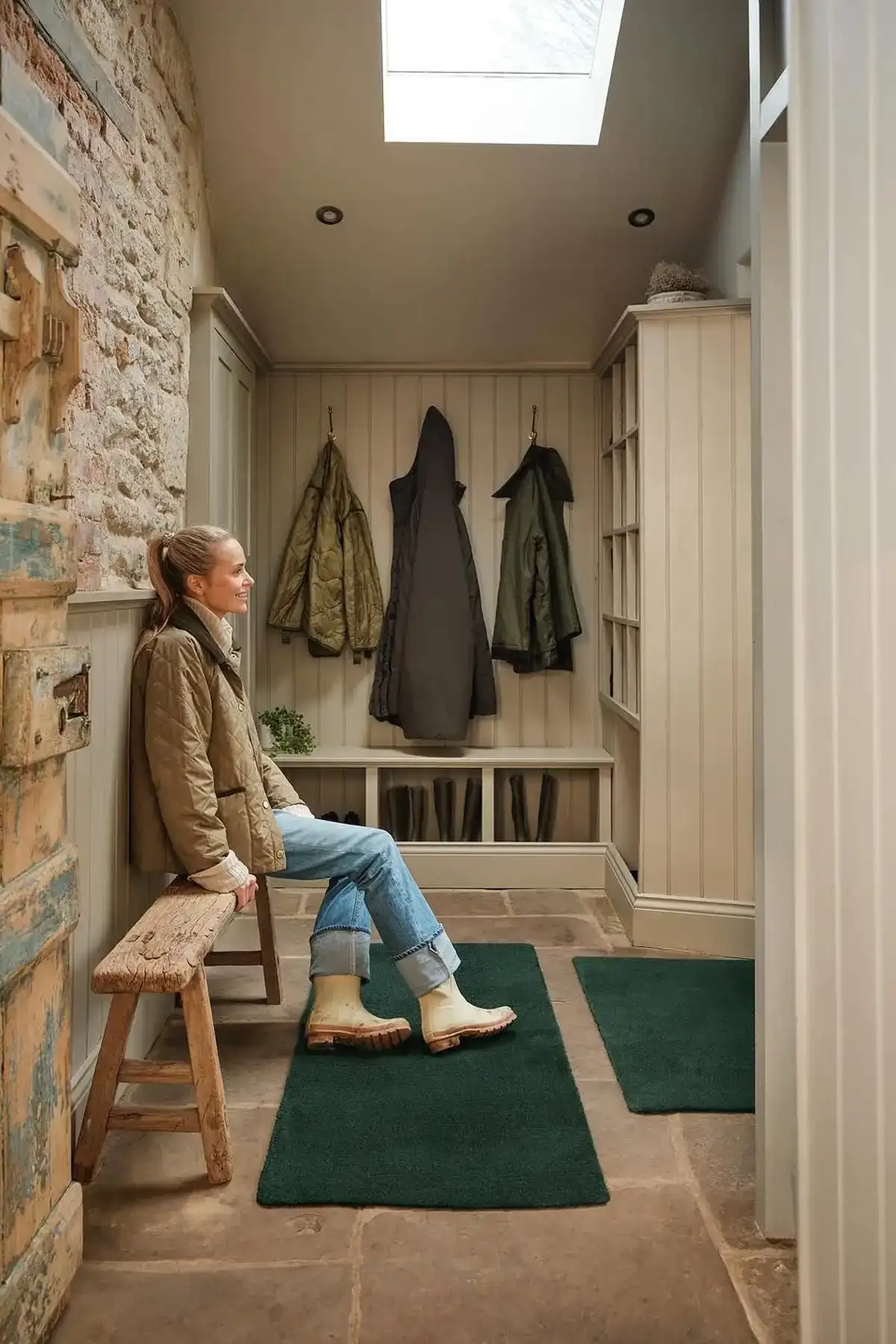
By noon on a snowy day, your bare entryway floor tells the whole story. Every boot print shows, slush melts into grey streaks, and the floor by the door looks tired before lunch. A washable runner laid along that path catches the mess where it lands instead of letting it travel into your flat.
Pick a low, flat weave in a dark or busy pattern so wet footprints blend in between washes, and size it to run from the door to the first step inside. When it looks grubby, roll it up and drop it in the machine, then lay it back down while it is still damp so it settles flat.
Tip: keep a second runner folded in the closet so the entryway never sits bare on wash day.
Runner at a glance
STYLE
Dark or busy pattern, low flat weave, long enough to reach the first step inside
COST
Low, one runner covers the whole path and a spare keeps wash day covered
EFFORT
Roll it up, machine wash, lay it back down while still damp
9. A Small Tray That Gives Keys and Mail a Home
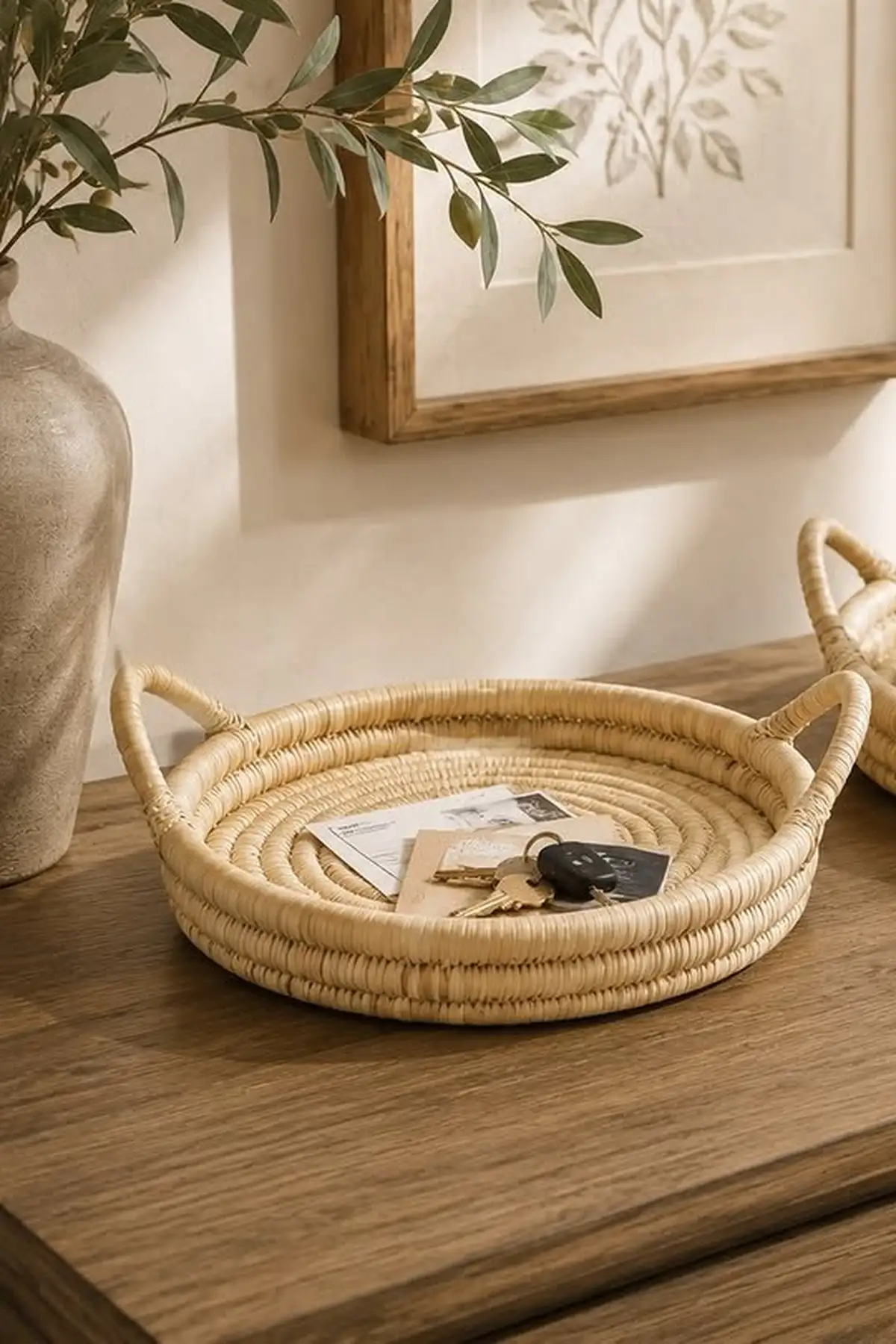
Keys land wherever your hands happen to be when you walk in, which usually means the floor by the door, the bottom of a coat pocket, or wedged between the cushions of the nearest chair. By morning you are patting down every pocket before you can leave, and the mail that came with them is already buried under a scarf.
A small tray on the console ends the hunt. Give it one job, keys and the day's mail, and keep it shallow enough that nothing stacks up inside it. When you walk in, everything lands in the same spot, and when you walk out, you reach for one place instead of searching three.
Do this
Set the tray near the door edge of the console so your hand finds it before your coat comes off. Empty it once a week so only today’s keys and mail live there, and the tray stays a landing spot instead of a pile.
Don’t do this
Let receipts, spare change, and dead batteries move in. Once the tray holds everything, it holds nothing you can find, and your keys go straight back to the floor.
10. Over-the-Door Hooks That Add Coat Space Without a Single Hole
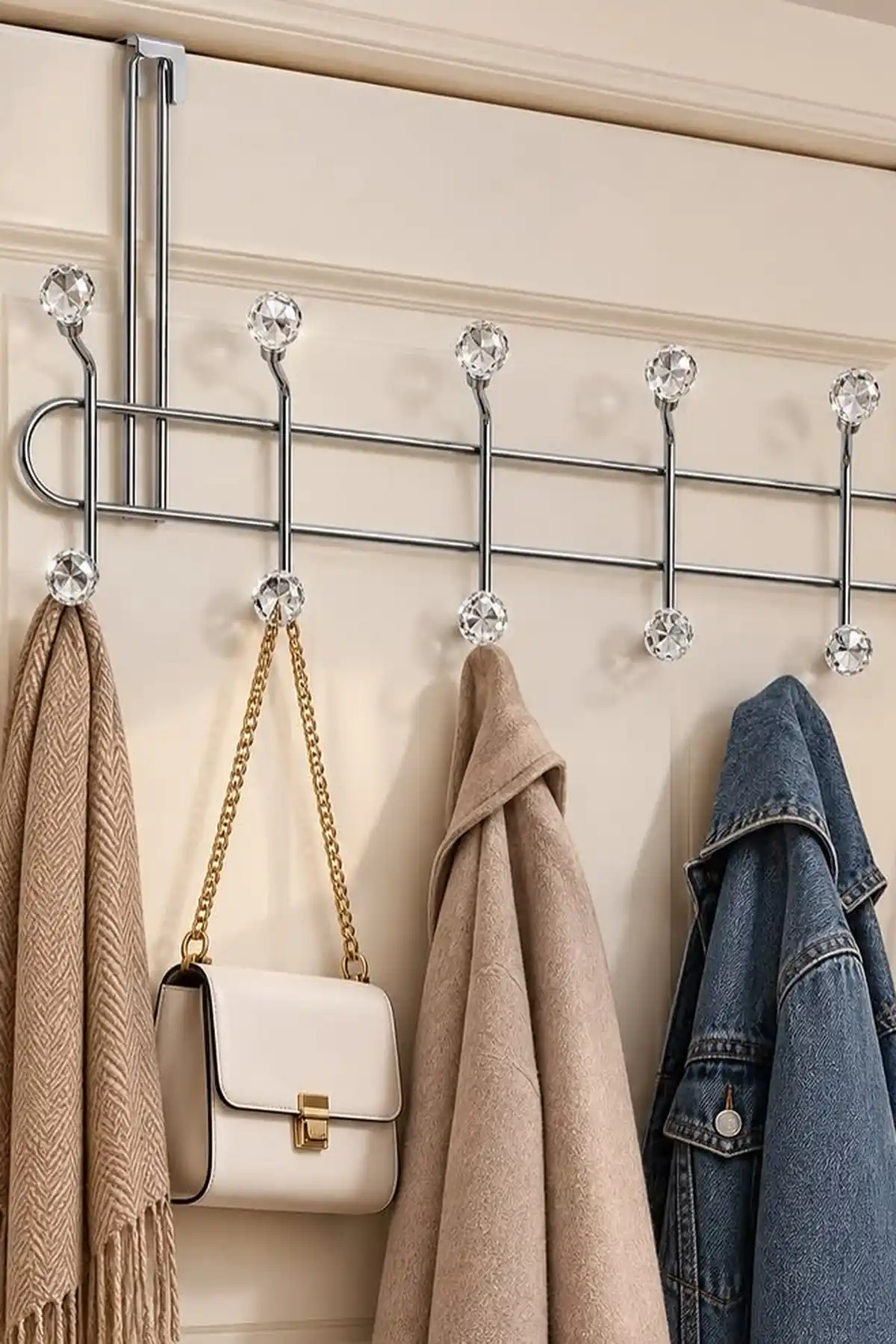
Most rental leases spell it out plainly: no holes in the wall by the front door, and no patching job at move-out will hide a row of them. An over-the-door hook rail works around that rule instead of breaking it. Hang the rail over the top edge of the door, press it flat so it sits steady, and load the heaviest coat on the hook nearest the hinge so the door still swings freely. Give each person one hook, keep the rail to everyday coats and scarves, and leave the bulkiest parka for the closet. Your door becomes the coat closet your entryway never had, and the wall stays exactly as your landlord left it.
Takeaway: the door does the work, the wall stays untouched
Before you load it, close the door on the empty rail and check it clears the frame on both sides. Hang everyday coats and scarves here and keep the heaviest parka in the closet, since a door rail carries light daily layers best. When you move out, the rail lifts straight off the door, so nothing needs patching, painting, or explaining to your landlord.
11. A Vertical Boot Rack That Stacks Pairs Upright
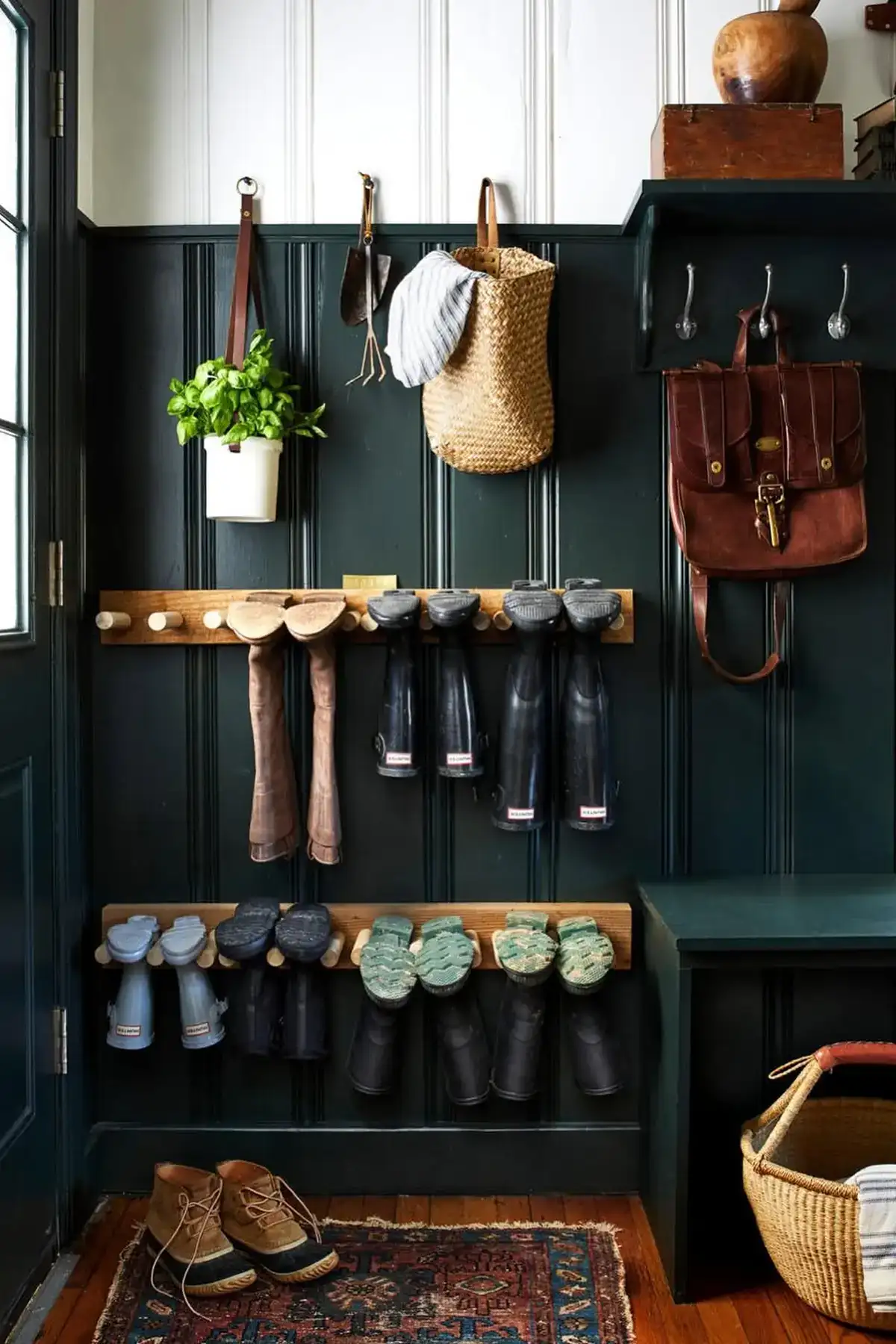
Boots lined up in a row along the wall eat the whole walkway. Each pair claims its own patch of floor, wet soles leave rings on the wood, and the path to the kitchen narrows to a single-file shuffle.
A vertical rack moves that row off the floor and onto the wall. Each pair hangs upside down on its own peg, so the boots dry upright and stay easy to grab on your way out.
Before you hang it: – Pegs spaced so tall boots hang without touching – Rail fixed into a stud, or anchors your landlord allows – Tallest boots on the top rail, shorter pairs below – A tray underneath to catch the last drips
Your walkway opens up again, and every pair has its own spot.
Worth remembering
Hang boots upside down so water runs out of the shaft, not into it.
Shafts that point down dry faster and keep their shape, and the soles face out where you can see which pair is which before you leave.
12. A Winter Wreath That Makes the Door Feel Finished
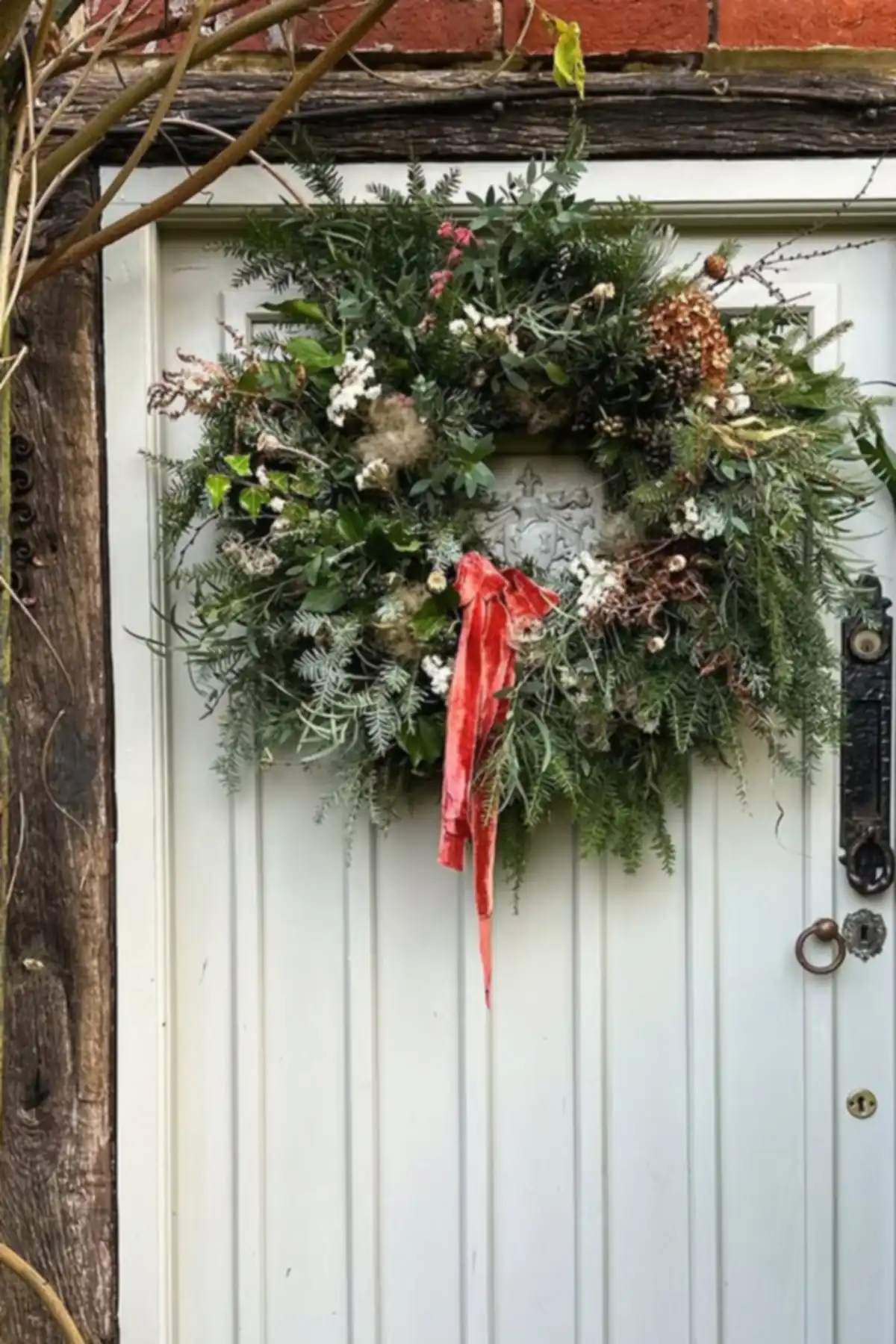
Every door on your floor has something on it by December, and yours is the bare one. The hall makes your flat look empty, though inside is warm and finished. A winter wreath closes the gap in minutes, and it needs no floor space.
Do hang it from an over-the-door hanger or a suction hook so the door stays mark free, and size the wreath two thirds as wide as the door. Let the ribbon tails hang, since that is what makes greenery look deliberate.
Don't buy the biggest wreath you can find, since one that covers the whole door crowds the hallway and hides the knocker. Don't leave a fresh wreath up once the greens turn brown, because a tired wreath looks worse than a bare door.
01
Plain evergreen
Full green, one red ribbon, nothing else to store.
02
Eucalyptus and pinecone
Soft grey-green, light to hang, and it dries well.
03
Dried orange and cinnamon
Warm colour, no shedding, and it keeps past Christmas.
04
Frosted white berries
Pale and quiet, and it suits a white or grey door.
13. A Plug-In Light That Brightens the Darkest Corner by the Door
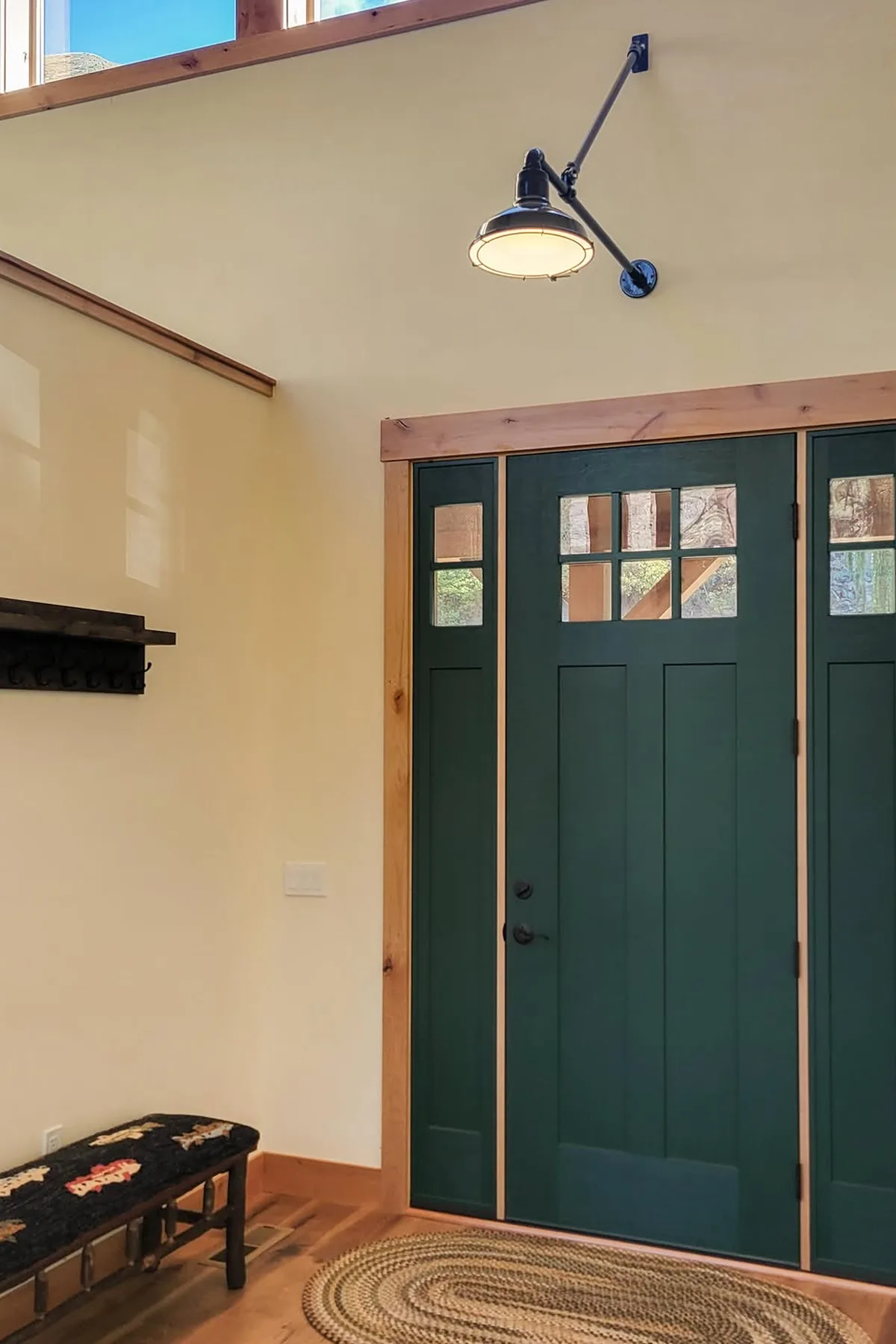
The corner by your front door stays dark even at midday. The hallway light never reaches it, the door blocks what little sun comes through the glass, and by 4 p.m. you are fumbling for your keys in the gloom. Does a plug-in light really fix that without an electrician? Yes, and that is the whole point. A plug-in sconce or a slim LED strip mounts with two small screws or strong adhesive, and the cord drops straight to the nearest outlet. Pick a warm white bulb, aim the glow at the wall beside the door rather than straight at your eyes, and the corner stops feeling like a cave. Your coats, boots, and umbrella finally sit in light you can actually see by.
From dark corner to lit doorway in four moves
1. Find the darkest spot. Stand by the door at dusk and note where the shadows sit; that wall is where the light goes.
2. Mount at shoulder height. High enough to wash the wall with light, low enough that the bulb stays out of your eyeline.
3. Run the cord down, not across. A cord channel or a small clip keeps it tight to the skirting so nobody trips on the way in.
4. Choose warm white. Cool white turns a small entryway clinical; warm white reads like lamplight and suits winter evenings.
14. Labeled Bins So Every Person Has a Winter Gear Spot
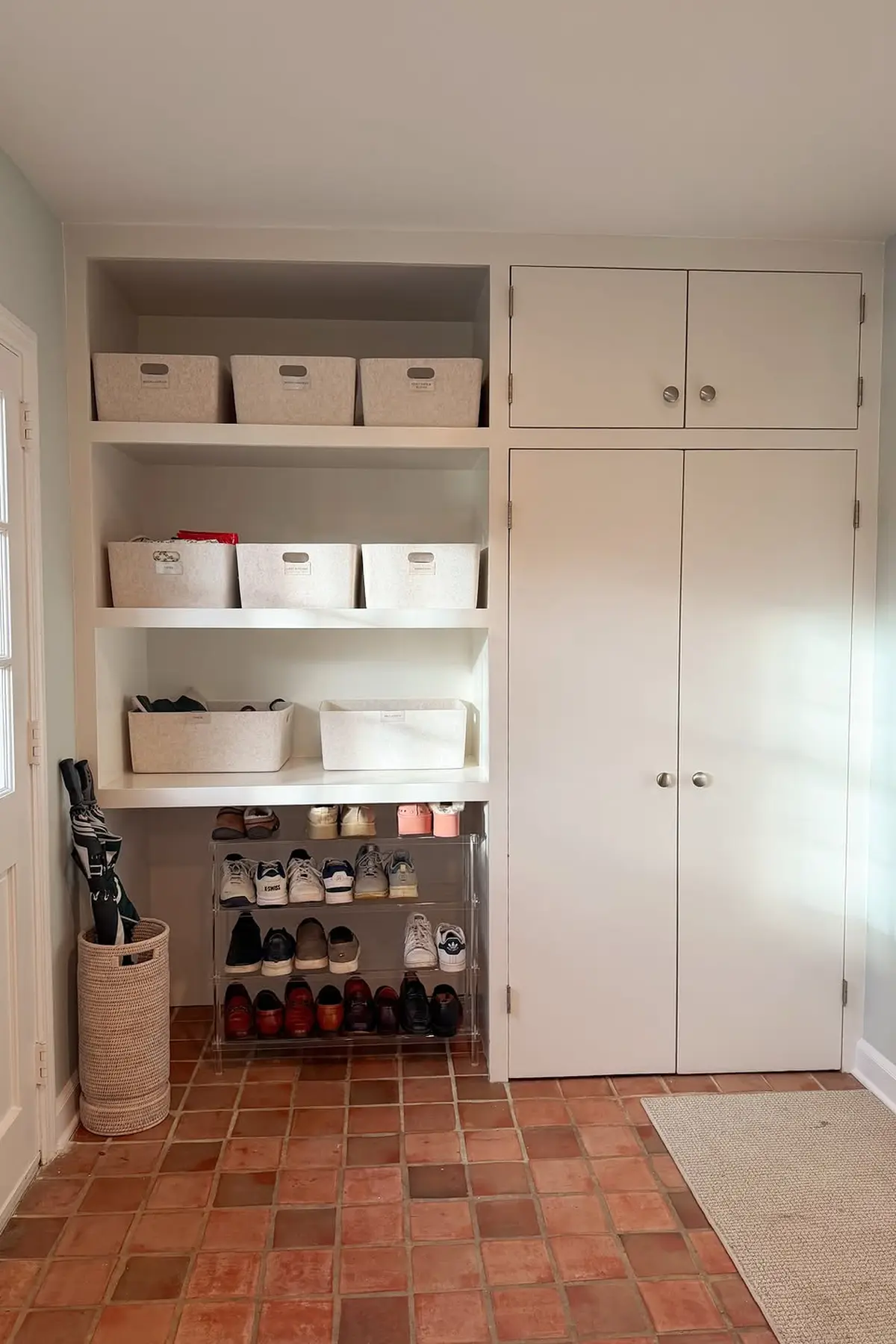
Every glove in your home ends up in one shared pile by the door, and every morning someone is digging through it for the pair that actually fits. A row of labeled bins ends that hunt. Give each person one bin for their own winter gear, hats and gloves in one, a scarf in another, and let the label do the remembering. On the plus side, mornings run faster because nobody has to ask where their things went, and the pile by the door shrinks to whatever is in use. On the downside, the system only works if everyone puts things back, and a bin that is too small will overflow by February. Keep each label to one name or one category, and leave one spare bin empty for guests.
One bin per person, one label each. A shared bin marked only “gloves” turns back into the pile within a week, because nobody owns it.
Daily gear at arm height. Bins parked on the top shelf get ignored, so keep the everyday ones where hands reach without a stretch.
15. A Small Stool That Makes Lacing Boots Less of a Crouch
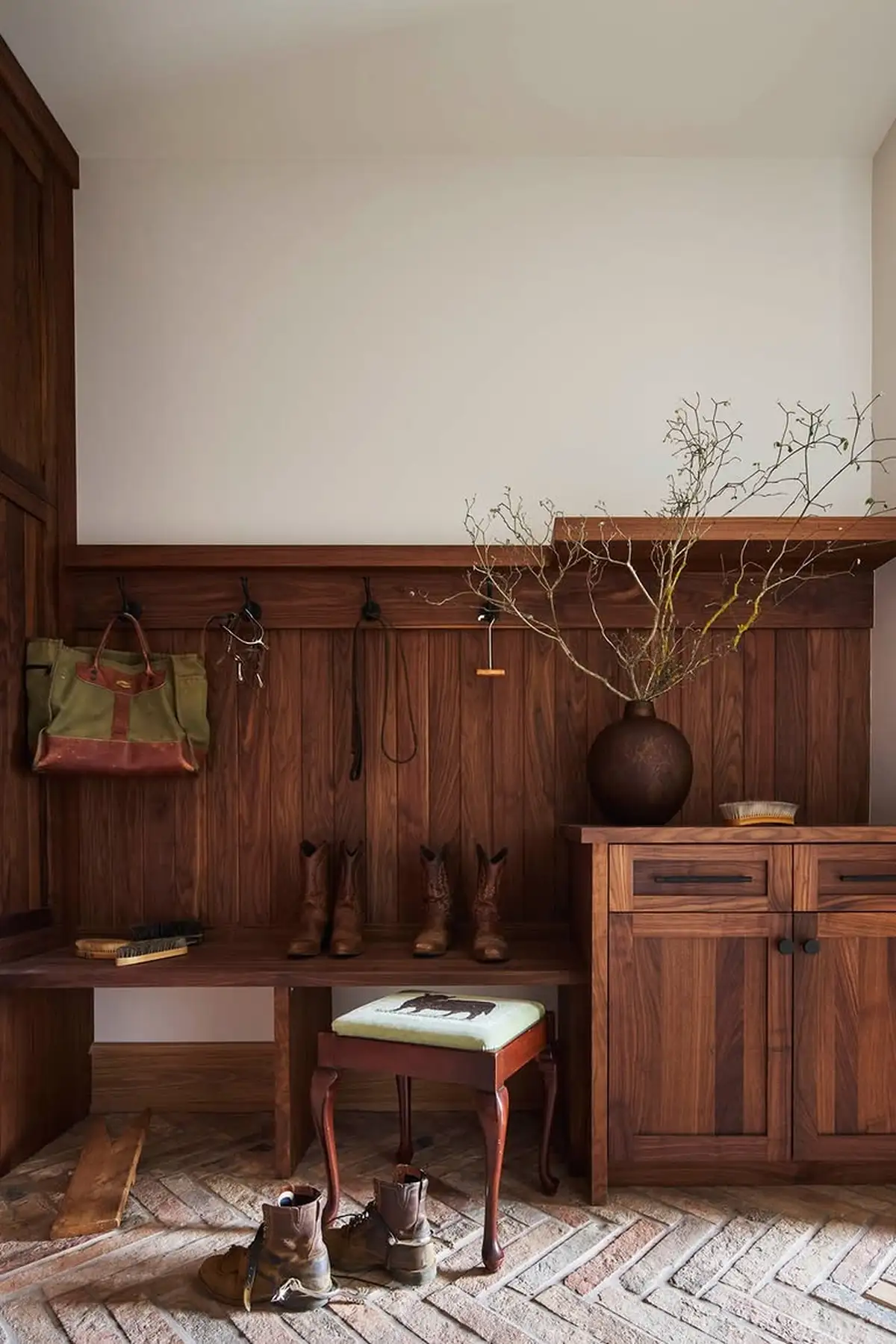
Winter mornings turn lacing boots into a hop-on-one-foot routine: one hand on the wall, one foot in the air, and the laces still loose by the time you give up and bend double. A small stool ends that balancing act. Sit, lace both boots properly, and stand up ready instead of already annoyed.
| Stool spot | Why it works |
|---|---|
| In front of the bench | You sit facing your boots, not sideways |
| By the door, under the hooks | Coats come off, you sit, boots go on |
| Tucked beside the shoe rack | It slides out only when you need it |
Keep it low and light enough to pull out with one hand, and give it a wipe-clean seat, because wet cuffs and snowy boots will brush against it every day.
16. A Folding Drying Rack for Wet Mittens and Hats
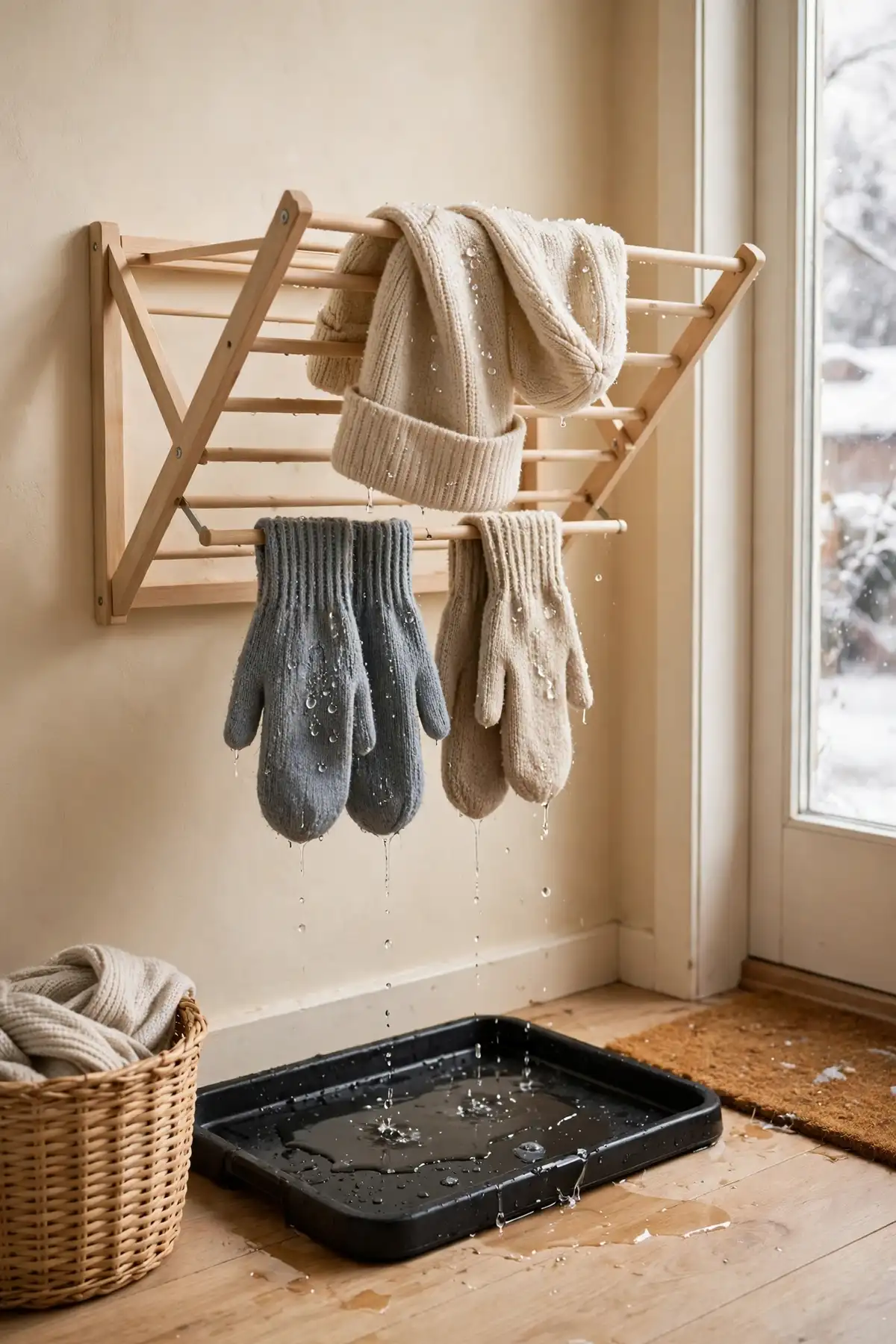
Wet mittens draped over the radiator never quite dry. The tops stay damp, the cuffs curl, and by morning you are pulling on a pair that is still cold and clammy. A folding rack on the wall by the door gives those mittens a place to hang open, with air moving around every side instead of only the side facing the room.
Tip: hang each pair by the cuff with the fingers pointing down, and slide a boot tray underneath so the drips land somewhere you can wipe.
How the rack earns its wall
Pull it out when you come in from the snow, fold it flat against the wall when the gear is dry.
Hang mittens by the cuff with the fingers pointing down, so water runs out instead of pooling inside.
Put the wettest pair on the lowest rung, closest to the tray, and the nearly dry pair up top.
Leave it folded flat on the wall through spring, ready for the first wet day next winter.
17. A Slim Console Table That Fits a Three-Foot Entryway
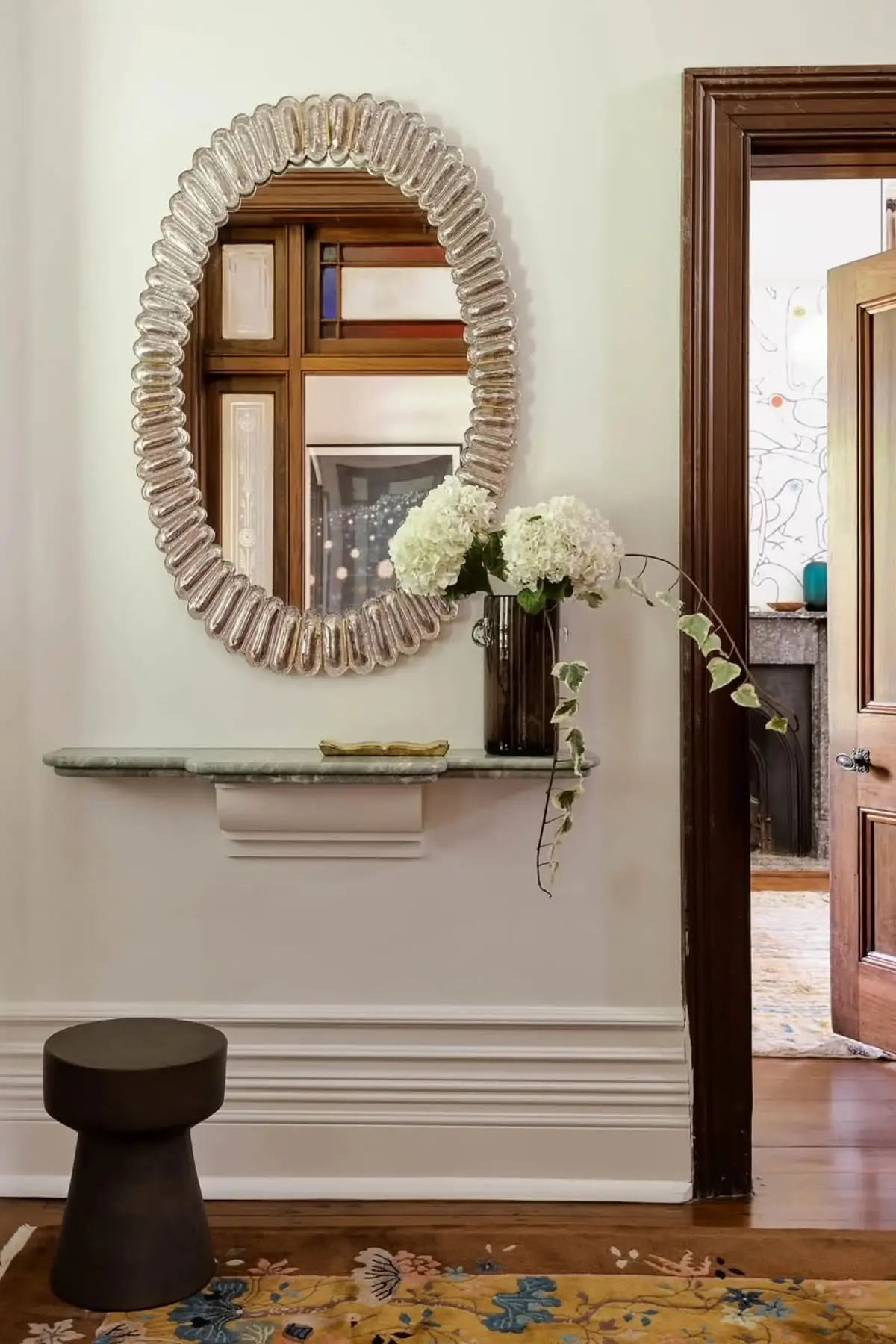
Three feet of wall beside your front door looks too narrow for any table at all. A full-depth piece would jut into the walkway and turn every trip past it into a sideways shuffle, so the wall stays bare and your keys end up on the nearest flat surface instead.
A slim console changes the maths. Pick one about ten inches deep and it leaves the walkway clear while giving you a landing spot for keys, mail, and a small lamp. Keep the top to three things at most and the wall finally reads as finished, not forgotten.
Pick one for your three feet of wall
Wall-mounted ledge
About 6 to 8 inches deep
No legs at all, so the floor stays open and boots slide underneath. Best when your walkway is so tight that even slim legs would catch a shoe.
Legged slim console
About 10 to 12 inches deep
A real tabletop with room for a lamp and a tray, plus a lower shelf for a basket. Best when you want the drop zone to hold more than keys.
Measure first: leave at least two feet of clear walkway in front of whichever one you choose, and keep the top to three things.
18. A Faux Evergreen Garland Along the Shelf for a Quiet Winter Feel
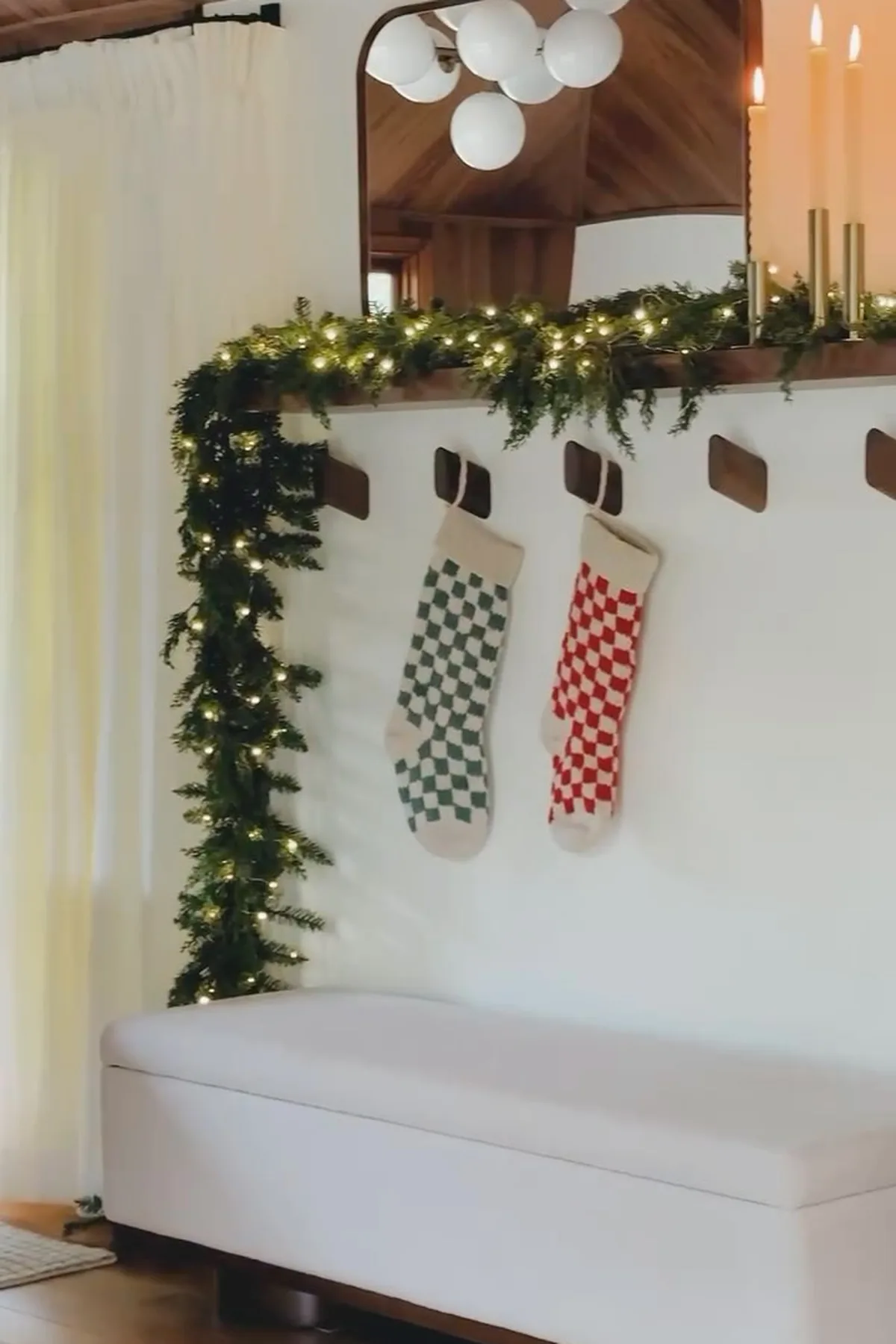
Right now the shelf above your hooks holds a layer of dust and not much else. It is the one surface in the entryway nobody looks at twice, which is exactly why a faux evergreen garland earns its place there.
Measure the shelf, then pick a garland a little longer than it so the ends can spill over each side. Lay it along the front edge, not the back, so the greenery frames whatever sits behind it. Weave a string of warm white lights through the branches if yours did not come lit, and tuck the battery pack behind a candle or a stack of books. Step back and check the drape from the doorway, then fluff any flat spots until the line looks full from end to end.
Where the shelf stays dry
Drips fall straight down from wet coats, so the stretch of shelf above the hooks gets wettest. Hang the garland where the wall stays dry.
Wet zone · above the hooks, by the door
Dry zone · past the last hook, toward the room
Rule of thumb: start the garland one hook past the last coat. The greenery stays clean, and the lights never sit under a dripping sleeve.
19. A Framed Winter Print That Makes the Entryway Feel Intentional
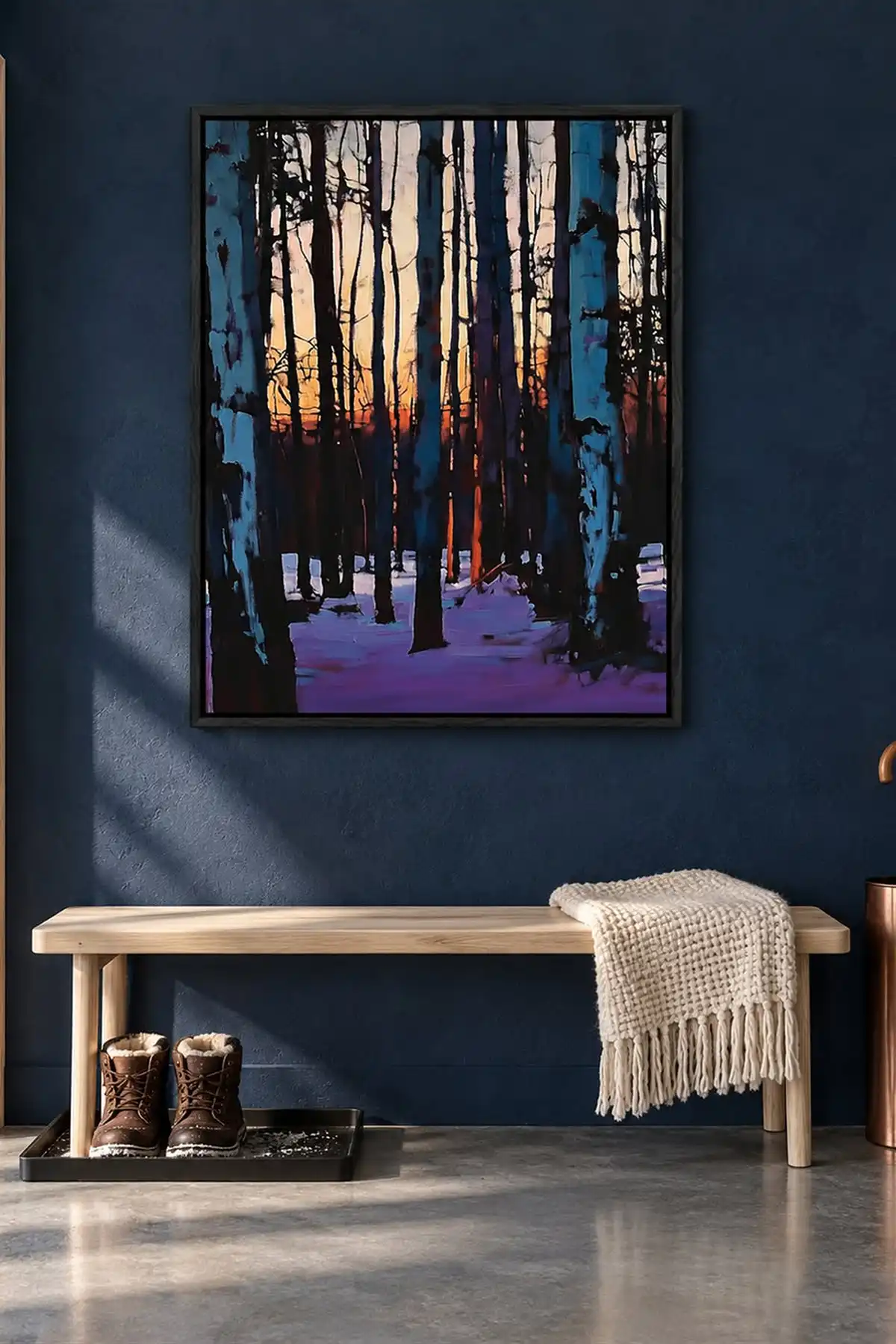
The blank wall above your bench is doing quiet damage. Every coat, boot, and umbrella in the corner reads as clutter because nothing on the wall says the spot was planned, so the whole entryway feels like a holding area instead of a room.
Hang one framed winter print and run this quick check before you commit: the frame should span about two-thirds of the bench width, its centre should sit near eye level when you stand at the door, and the scene inside should read as winter without shouting Christmas, so it can stay up past December. A snowy forest, a quiet birch grove, or a pale winter sky all work. Leave the rest of the wall bare and let the single frame carry the corner.
Swap this for that
OUT
A bare wall above the bench
IN
One framed winter print, hung at eye level
OUT
A small frame that gets lost on a wide wall
IN
A frame about two-thirds as wide as the bench
OUT
A busy row of tiny frames competing for attention
IN
One quiet winter scene, the rest of the wall left bare
Measure the bench first, then shop the frame to fit it. A print that covers most of the bench width looks deliberate; a small one looks like an afterthought, however pretty the scene inside it is.
Frequently Asked Questions
How do I keep a tiny entryway from turning into a muddy pile every winter?
Give everything a landing spot at the door: hooks for coats, a lipped tray for boots, and a basket for mittens. Drips stay in the tray, coats stay off the floor, and the pile never forms. The habit takes a week to set in, and after that the entryway mostly keeps itself tidy.
What is the best boot tray for a small apartment entryway?
A tray with a raised lip, sized to hold one pair per person, in a washable material. The lip holds the slush, the size keeps it from eating the walkway, and you can rinse it in the tub. Skip trays without a lip, since meltwater runs straight onto the floor.
Can I hang coat hooks in a rental without losing my deposit?
Yes, with damage-free options. Over-the-door hooks need no holes at all, and adhesive hooks hold lighter coats. Check the weight rating before you load them up, and keep heavy winter coats on a standing rack if the wall cannot take them.
How do I dry wet mittens and hats in a small entryway?
Hang them where air moves, on a folding wall rack or a hook near the door, cuff down so water drips out. A boot tray underneath catches the drips, and they are dry by morning. Avoid the radiator, which dries the outside while the lining stays damp.
What should go in a three-foot entryway, and what should stay out?
Keep the daily gear only: coats, boots, keys, and the bag you carry. Store off-season coats, spare shoes, and sports gear in the closet or under the bed, so the entryway holds one day's worth of gear, not the whole household.
How do I make a small entryway look intentional instead of cluttered?
Repeat one material and one colour: matching hooks, one basket, one tray, and a single framed print above the bench. When every piece belongs to the same palette, the corner reads as a designed entry, not a pile.
Fix the wettest spot first and the rest follows. A boot tray by the door, a hook for every coat, and a basket for the mittens turn the muddy pile into a system you can keep up without thinking about it. The right winter entryway decor is not the prettiest piece you can buy. It is the one that still works on the snowiest night of the year, when everyone comes home wet at once. Pick the idea that solves tonight’s pile, and let the entryway earn its keep all winter.